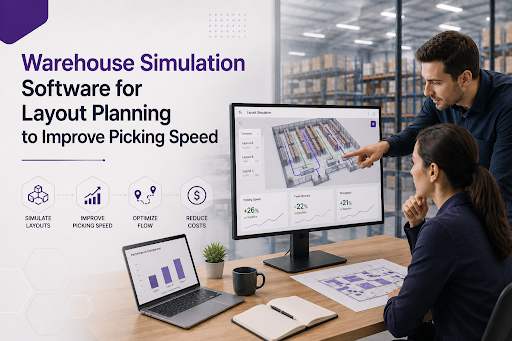
Warehouse simulation software for layout planning focuses on analyzing material flows, picking paths, and layout configurations to identify inefficiencies before making physical changes. According to global supply chain research, order picking and related material handling workflows consume up to 55% of total warehouse operating expenses, making travel distance inflation a primary driver of margin erosion.
Legacy infrastructure setups regularly experience travel-path degradation due to shifting product velocities, SKU proliferation, and seasonal variations that traditional software solutions fail to forecast.
In this blog, we cover how warehouse simulation software identifies operational inefficiencies, validates layout decisions, and improves picking performance through continuous optimization.
Why Picking Speed Problems Often Start With Layout Assumptions
Picking speed problems often start with warehouse layout assumptions that fail to reflect actual order patterns, travel paths, and workflow interactions. Static layouts can create congestion, inefficient travel distances, and labor bottlenecks as operations become more complex.
How Spatial Design Decisions Create Hidden Travel Inefficiencies
Physical footprints designed around basic ABC velocity analysis often embed significant structural inefficiencies. Poor storage assignment can reduce picking efficiency and increase operational delays. A 2024 study reported up to an 8% difference in order picking performance between optimized and random placement strategies. This inflation directly stems from ignoring joint item order probabilities during layout planning. Common problems include:
- Static placement model
- Misses order co-occurrence
- Excessive non-value travel
When high-velocity items are distributed across different storage zones without considering which products are commonly ordered together, workers must travel much longer distances through the aisles to complete picks. These sub-optimal paths compound daily, distorting planned labor productivity metrics and driving up the total labor cost per order.
Why Poor Zone Relationships Distort Pick Flow
The spatial positioning of functional zones, such as cross-docking areas, bulk storage, replenishment reserves, and pack stations, dictates the equilibrium of an entire facility. A structural mismatch between active pick zones and staging areas generates acute queue amplification and localized traffic deadlocks. This spatial fragmentation disrupts the continuous flow of goods, turning high-capacity sorting assets into costly operational bottlenecks.
How Legacy Layout Logic Limits Picking Performance
Legacy warehouse layouts limit picking performance by creating inefficient travel paths, workload imbalances, and congestion that slow order fulfillment as operational complexity increases.
- Rigid Pathing Schemes: Traditional grid configurations rely heavily on single-order routing assumptions that collapse when faced with complex multi-line batching or zone-skipping logic.
- Workload Imbalance: Standard layouts lack the physical agility needed to support dynamic pathing, forcing material handling operators into rigid, predetermined paths that ignore real-time congestion levels.
- SLA Penalties: As SKU churn accelerates, these legacy frameworks struggle with severe workload concentration. Operators end up clustered in identical narrow aisles, triggering acute fulfillment SLA slippage and eroding overall asset utilization.
Why Traditional Layout Planning Often Misses Root Causes of Slow Picking
Traditional layout planning often misses slow-picking root causes because it cannot accurately model real warehouse workflows and bottlenecks. This static orientation introduces execution blind spots, as spreadsheets and CAD designs cannot simulate how variables interact under peak operational stress.
Suggested Read: Warehouse Simulation Software for 3pl Logistics to Optimize Throughput
Why Static Design Approaches Struggle Under Operational Variability
Conventional facility design relies on historical averages that completely mask daily demand volatility and seasonal volume spikes. Order profile variability places growing pressure on traditional warehouse layouts.
Research indicates that up to 80% of warehouses still rely on manual operations, making them particularly vulnerable to inefficiencies when demand patterns shift and storage configurations fail to adapt and rebalance workloads.
How Movement Waste Persists Despite Incremental Adjustments
Micro-level modifications, such as re-indexing individual bin locations or expanding a few pick faces, rarely fix underlying structural flow mismatches.
Without a holistic warehouse simulation software for layout planning, minor modifications often shift the operational bottleneck downstream. For example, clearing congestion in an active picking aisle without adjusting packing conveyor capacity simply creates severe backlogs at the outbound staging docks, failing to reduce the overall labor cost per order.
Why Conventional Layout Optimization Often Underperforms
Conventional layout optimization often underperforms because it relies on static assumptions that fail to predict real-world warehouse congestion, workflow variability, and execution constraints. Idealized routing models typically overlook real-world congestion and changing workflow patterns, while manual fulfillment activities introduce variability that is difficult to predict.
Operators trying to fix these variances using intuition-based rules often over-correct, creating uneven workloads and volatile order cycle times.
Virtual Experimentation for Diagnosing Pick Path Friction
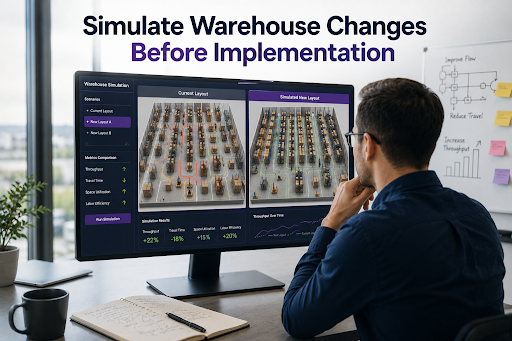
Virtual experimentation helps diagnose pick path friction by allowing businesses to test warehouse layouts, workflows, and routing strategies before making physical changes. Many organizations use layout planning software for warehouse efficiency to identify bottlenecks before they impact throughput.
Scenario Modeling Revealing Hidden Layout Inefficiencies
Advanced warehouse simulation tools for picking path optimization help teams test warehouse performance using historical and projected order data. Digital twin simulations uncover hidden bottlenecks, congestion risks, and workflow conflicts before they impact operations.
Testing Design Assumptions Before Operational Changes
Physical warehouse modifications entail high costs and operational risks.
Using warehouse modeling software for faster order picking, teams can validate alternative layouts and workflow changes in a virtual environment before implementation. This reduces execution risk and helps avoid costly layout rework.
Friction Conditions Traditional Planning Often Overlooks
Traditional planning often overlooks real-world friction points such as congestion, replenishment conflicts, and non-productive travel that can reduce picking efficiency.
- Intermittent Congestion: Multiple operators converge on the same high-velocity pick zones.
- Replenishment Interference: Restocking activities disrupt active picking workflows.
- Dead-Heading Travel: Pickers retrace routes due to restrictive aisle configurations.
- Equipment Variability: Real-world equipment speeds differ from theoretical planning assumptions.
Synkrato Digital Twin helps organizations identify hidden bottlenecks, validate layout changes, and improve picking performance through simulation-driven warehouse optimization.
Layout Tradeoffs That Shape Travel Time Performance
Layout tradeoffs shape travel time performance by influencing storage density, labor movement, equipment flow, and overall picking efficiency.
Positioning Decisions Influencing Travel Distance Outcomes
- The geometric placement of pick locations relative to sorting and shipping areas directly dictates daily travel distances.
- Placing fast-moving SKUs closer to shipping docks reduces travel, but concentrating high-velocity items in a single zone creates severe localized traffic jams.
Warehouse managers must carefully balance velocity-tier reclassification with workload rebalancing logic to distribute picking tasks evenly across separate physical zones, preventing localized slowdowns.
Suggested Read: Warehouse Simulation Software for Ecommerce Fulfillment to Improve Order Accuracy
Flow Density Effects on Pick Speed Stability
High-density storage layouts maximize space utilization but can restrict operator movement and equipment access. Warehouse layouts that fail to account for real-world disruptions can experience significant efficiency losses.
A 2024 study found that optimizing picking routes during order changes and aisle blockages improved travel-distance efficiency by up to 31%, highlighting the operational impact of layout and routing decisions. Warehouse layout simulation software helps teams balance storage density with operational efficiency.
| Layout Attribute | High Storage Density Focus | High Throughput Speed Focus |
| Aisle Configuration | Narrow/Deep (VNA) | Wide/Accessible (Standard) |
| Travel Pathing | Linear, highly constrained | Flexible with frequent cross-aisles |
| Traffic Congestion Risk | High localized clustering | Dispersed, even flow |
| Replenishment Frequency | High, batch-dependent | Continuous, event-triggered |
| Primary KPI Impact | Maximized locations per $ft^2$ | Maximized picks per hour per operator |
Tradeoff Variables Supporting Better Layout Performance
Better layout performance depends on balancing storage capacity, replenishment flow, and travel efficiency. By evaluating these variables in a unified simulation model, organizations can maximize cube utilization while reducing unnecessary travel distances.
To navigate these complex dynamics, operations utilize Synkrato’s Simulation & Optimization engine to eliminate the guesswork. This advanced decision layer runs multi-variable optimization scenarios, evaluating how structural updates impact daily picking speeds.
Suggested Read: Warehouse Simulation Software for Capacity Planning to Reduce Congestion
Design Thresholds That Signal the Need for Layout Reconfiguration
Layout reconfiguration becomes necessary when changing order volumes, SKU profiles, and inventory growth begin to reduce warehouse efficiency and picking performance.
Indicators That Existing Layout Logic Has Reached Limits
The clearest signs of layout inefficiencies appear as systemic performance degradation across core supply chain metrics. When order cycle times steadily rise despite adding seasonal labor, it usually points to travel distance inflation and poor zone relationships rather than worker performance issues.
Synkrato Enterprise Mobility enables real-time workflow visibility, helping teams identify and address layout-driven inefficiencies faster.
Conditions Requiring Simulation-Based Layout Redesign
Simulation-based layout redesign becomes necessary when changing inventory profiles, fulfillment requirements, and operational inefficiencies begin to reduce picking performance and warehouse efficiency.
- Catalog Churn Greater Than 30%: Frequent introductions of new items with unique dimensions invalidate original slotting plans and pick paths.
- Shift Toward E-Commerce Fulfillment: Transitioning from bulk pallet picking to single-item piece picking requires completely different zone layouts.
- Sustained 15% Increase in Travel Distance Per Order: Tracks when pickers must travel further each day to fulfill identical order volumes.
- Frequent Multi-Zone Congestion Blips: Recurring travel delays caused by multiple pieces of material handling equipment blocking the same narrow aisles.
Factors Supporting Sustainable Picking Speed Gains
Sustaining high-speed picking performance requires shifting from reactive warehouse adjustments to a continuous, data-driven optimization model. Understanding how warehouse simulation improves picking speed helps organizations make more effective layout and workflow decisions. By integrating smart layout planning tools into standard operating routines, facilities can implement threshold-based re-slotting plans that adapt to demand changes.
When these performance boundaries are breached, companies leverage Synkrato’s AI Slotting Recommendations to run intelligent, automated adjustments. This advanced system continuously tracks inventory velocity changes, order co-occurrence trends, and spatial constraints to provide optimal slotting configurations.
Suggested Read: The Theory of Constraints in Warehousing and How Synkrato Solves Bottlenecks
Achieve Throughput Stability with Synkrato
Overcoming systemic picking delays requires moving past static spreadsheets and intuition-based layout planning. Modern high-volume distribution centers require an advanced intelligence layer capable of simulating complex workflows, predicting traffic patterns, and optimizing inventory placement in real time.
With Synkrato AI Agents, supply chain leaders can identify hidden travel inefficiencies, balance workloads, and optimize inventory placement using real-time operational intelligence. Book a demo with Synkrato to gain the visibility and intelligence needed to make faster, more confident warehouse optimization decisions.
FAQs
How can simulation reveal hidden tradeoffs between storage density and picking responsiveness?
Simulation tools model the precise movements of equipment and workers within a virtual replication of the warehouse footprint. By testing high-density configurations against real-world order files, the platform calculates exact travel distance inflation and traffic bottlenecks.
Why do picking delays often persist even after warehouse layout redesign initiatives?
Post-redesign delays often persist because traditional planning relies on static assumptions that ignore operational variability and equipment interactions. Without testing the new layout, unforeseen bottlenecks like replenishment interference or zone congestion frequently emerge. Simulation platforms such as Synkrato Digital Twin help validate layout decisions before implementation, reducing the likelihood of unexpected bottlenecks.
How can a simulation evaluate the effect of slotting-policy decisions on picking speed performance?
Simulation systems run historical order data through alternative slotting configurations to measure the impact on daily picker travel paths. By applying Synkrato’s Simulation & Optimization engine, management can accurately compare velocity-tier reclassification plans against co-occurrence clustering strategies.
What role does order profile variability play in long-term layout efficiency outcomes?
Order profile variability alters how items move through a facility, frequently turning highly efficient layouts into congested bottlenecks. When consumers shift from multi-unit case orders to single-piece e-commerce profiles, standard pick paths quickly break down. Using Synkrato’s AI Slotting Recommendations ensures physical placements automatically adapt to changing order trends, preventing travel distance inflation.
How can simulation assess whether aisle configuration decisions may create downstream picking constraints?
Simulation engines track the flow of pickers, material handling equipment, and inventory across every section of a facility footprint. This continuous modeling reveals when tight aisle setups or restricted cross-aisles cause traffic jams and staging backlogs.
Can simulation quantify the cumulative impact of small travel inefficiencies on overall pick performance?
Yes, simulation software tracks and aggregates every second of non-value-added travel time across an entire labor force. By combining thousands of separate worker paths, the system calculates the total labor cost per order driven by layout inefficiencies. This data helps executives build strong, metric-driven business cases for facility modernization investments.
How does simulation support validation of alternative layout concepts before physical changes are made?
A digital simulation solution creates an interactive, risk-free environment to test and compare different structural warehouse designs. Teams can run identical peak-demand scenarios across a traditional grid setup, a fishbone layout, or a multi-level mezzanine system. This clear comparison highlights which layout delivers the best throughput stability and lowest travel times.
What factors determine whether simulation outputs are reliable enough for warehouse layout planning decisions?
The reliability of simulation outputs depends heavily on the accuracy of the underlying data and operational parameters. Models must include precise equipment acceleration rates, historical order variations, actual worker capacities, and real-time inventory balances.