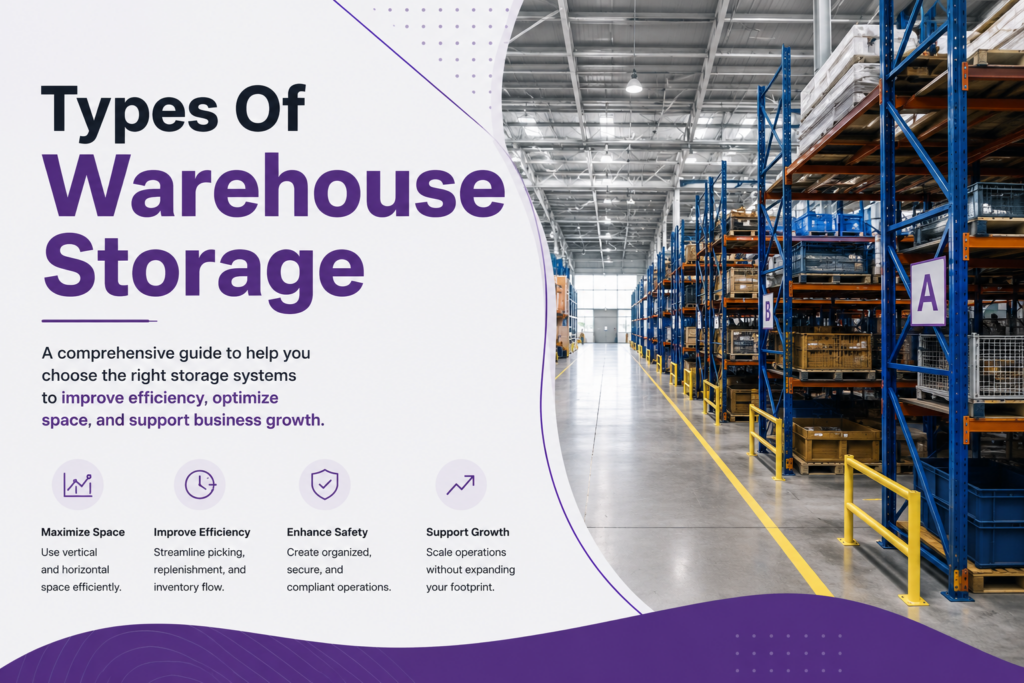
Warehouse storage systems affect how efficiently a facility uses space, how quickly teams replenish and pick stock, how safely people and equipment move, and how long a business can grow within its current footprint before taking on more real estate costs. That makes storage a strategic operating decision and a layout choice.
U.S. retail e-commerce sales reached $1.23 trillion in 2025 and accounted for 16.4% of total retail sales. However, warehouse utilization remained around 85% into January 2026, up from an average of 84.5% in 2024.
In this blog, we explain 10 types of warehouse storage systems, where each one fits, and how to choose the right mix for smarter inventory management.
1. Storage Cabinet
Storage cabinets control, secure, and standardize high-risk or high-value inventory inside a warehouse. They do not increase storage density, but they improve safety, traceability, and operational discipline for sensitive items.
Their role becomes more important in environments where safety and compliance are under pressure. In 2024, warehousing and storage reported 4.8 total recordable injury and illness cases per 100 full-time workers, with 4.1 cases involving Days Away from work, Job Restriction, or Transfer (DART).
Warehouses can use Synkrato’s digital twin and AI slotting optimization to optimize storage cabinet usage. These help identify which items require controlled storage, standardize placement rules, and reduce search time through data-driven organization.
Pros:
- Improves control over expensive, regulated, or hazardous inventory categories.
- Strengthens 5S (Sort, Set in order, Shine, Standardize, Sustain) discipline and workplace organization.
- Reduces search time for maintenance, repair, and operational supplies.
Cons:
- Limited impact on overall warehouse storage capacity or density.
- Can create fragmented storage if ownership and rules are not standardized.
- Does not address broader layout or space-utilization challenges.
Best For:
- Tool rooms
- Maintenance, Repair, and Operations (MRO) inventory
- Batteries
- Electronics
- Chemicals
- Documents
- Controlled small-parts storage
Suggested Read: Warehouse Operations Guide
2. Pallet Storage System
Pallet storage systems provide direct access to palletized inventory while supporting flexible replenishment and standardized warehouse operations. They balance accessibility, scalability, and compatibility with material handling equipment and system-driven workflows.
These systems integrate well with forklifts and warehouse management systems (WMS). Moreover, this storage system includes multiple formats such as selective pallet racking (standard direct-access racks) and narrow-aisle racking (designed to reduce aisle width and increase density).
Also, specialized formats such as cantilever racking are used for long and bulky items like pipes, timber, and metal sheets, where traditional pallet racks are not suitable.
Pros:
- Direct pallet access enables fast picking, replenishment, and cycle counting.
- Scales easily across different product categories and warehouse sizes.
- Integrates seamlessly with forklifts and WMS-driven location control.
- Supports flexible slotting, making it easier to adjust to demand changes.
Cons:
- Lower storage density compared to compact and automated warehouse storage systems.
- Requires significant aisle space, reducing overall cube utilization.
- Travel time increases when high-velocity SKUs are poorly slotted.
- Limited efficiency for very high SKU-density or space-constrained operations.
Best For:
- Mixed-SKU distribution
- Manufacturing support
- Retail replenishment
- Fast-moving consumer goods (FMCG) reserve storage
- Operations that need direct pallet access
3. Static Shelving
Static shelving is used for small-item storage where direct human access, flexibility, and fast picking are required. It is a practical choice for warehouses that are still refining SKU behavior or managing dynamic inventory flows. However, the system becomes less effective when overused.
If fast-moving SKUs are not properly slotted, static shelving increases travel and reduces efficiency. Synkrato’s AI-driven slotting fixes this by placing high-demand items closer to pick paths, reducing movement and improving space use.
Variants such as carton flow racks use gravity rollers to move cartons toward the pick face, improving picking speed and supporting FIFO inventory rotation. Similarly, wide-span shelving is used for bulky, non-palletized items, providing stronger load capacity than standard shelving while maintaining accessibility.
Pros:
- Highly flexible and easy to reconfigure as the SKU mix changes.
- Ideal for small-item picking with direct visual access.
- Lower upfront investment compared to engineered high-density systems.
Cons:
- Low storage density can waste valuable warehouse space if overused.
- Labor productivity drops when slotting and layout are not optimized.
- Increases walking distance in poorly designed pick paths.
- Not suitable for heavy, palletized, or bulk inventory.
Best For:
- Spare parts
- Medical supplies
- Accessories
- Returns
- Light e-commerce picking
- Small-unit, high-access storage zones
Suggested Read: Material Handling in Warehouses
4. Multi-Tier Racking
Multi-tier racking converts vertical height into additional storage and picking levels without requiring full automation. It helps in expanding capacity within an existing building.
This is important as around 40% of built-to-suit warehouse projects in 2025 incorporated automation, which means storage layouts today need to remain compatible with future systems.
While multi-tier racking acts as a bridge strategy, it improves cube utilization immediately. Also, it keeps the operation ready for integration with conveyors, goods-to-person systems, or AI-driven workflows later.
Synkrato’s 3D digital twin and simulation allow teams to test multi-tier layouts, worker flow, and replenishment strategies before implementation, helping avoid congestion and optimize vertical space utilization.
Pros:
- Converts unused vertical space into productive storage and picking areas.
- Expands pick capacity without increasing building footprint.
- Supports future integration with automation and advanced workflows.
- Improves cube utilization in high-SKU environments.
Cons:
- Requires careful planning of replenishment and worker movement.
- Can create congestion if access points and flow paths are undersized.
- More complex to manage than single-level storage systems.
Best For:
- Apparel
- Beauty
- Electronics accessories
- E-commerce
- Parts operations with high SKU variety and moderate unit sizes
5. Double Deep Racking
Double deep racking increases storage density by storing pallets two positions deep. This reduces aisle space while retaining a pallet-based storage system. By reducing the number of aisles, double deep racking improves cube utilization and recovers valuable floor space compared to selective racking.
Other such high-density pallet systems include drive-in and drive-through racking, where forklifts enter storage lanes to store pallets in depth. These systems follow a Last-In, First-Out (LIFO) or First-In, First-Out (FIFO) logic and are suited for high-volume, low-SKU environments.
Pros:
- Increases pallet storage density compared to selective racking.
- Reduces aisle space, improving overall cube utilization.
- Lower capital investment than automated storage systems.
- Maintains a familiar pallet-based operating model.
- Helps extend the usable capacity of existing warehouse space.
Cons:
- Reduces direct access to every pallet.
- Requires suitable reach equipment and tighter slotting rules.
- Not ideal for highly fragmented fast-moving inventories.
Best For:
- Reserve storage
- Seasonal stock
- Medium-variety pallet inventory
- Businesses carrying several pallets of the same SKU
Suggested Read: Warehouse Labor Management
6. Mobile Shelving
Mobile shelving eliminates fixed aisles and opens only the aisle needed for access, while still maintaining direct access to inventory. It is ideal for environments where space is limited but selectivity cannot be compromised.
The system is especially valuable in controlled environments such as cold storage, pharmaceuticals, archives, and high-value parts storage, where both space and operating costs are critical.
The benefit goes beyond density. In temperature-controlled facilities, reducing unused space lowers the volume that needs cooling, which impacts energy costs.
Pros:
- Maximizes storage density by removing unused aisle space.
- Maintains direct access to all inventory positions.
- Reduces energy costs in temperature-controlled environments.
- Suitable for high-value or controlled inventory storage.
Cons:
- Limited simultaneous access compared to open-aisle systems.
- Not ideal for high-speed, high-traffic picking operations.
- Requires disciplined workflow and access control.
- Dependence on mechanical systems increases maintenance needs.
- Slower access during peak or unstructured demand periods.
Best For:
- Cold storage
- Pharmaceutical environments
- Archives
- Controlled parts storage
- Facilities where space efficiency and energy cost are both critical
7. Mechanical System
Mechanical storage systems automate the storage and retrieval of inventory to improve density, speed, and accuracy at scale. These systems include automated storage and retrieval systems (AS/RS), shuttle systems, goods-to-person storage, and robotic cube-based solutions.
This category also includes pallet shuttle systems and pallet flow racks, where pallets move automatically using gravity or motorized shuttles to improve storage density, speed, and retrieval efficiency. Likewise, advanced systems such as vertical lift modules (VLMs) and carousel systems automate vertical storage and retrieval.
Pros:
- Improves storage density, throughput, and accuracy simultaneously.
- Reduces manual travel and repetitive handling tasks.
- Enables efficient use of vertical space.
- Supports high-volume, scalable operations.
- Enhances worker ergonomics and safety.
Cons:
- High capital investment and longer implementation timelines.
- Requires strong integration with software and control systems.
- Demands advanced maintenance and technical capabilities.
- Less flexible when SKU profiles change rapidly.
- Higher operational risk if system downtime is not well managed.
Best For:
- Large e-commerce operations
- Omnichannel fulfillment centers
- Pharmaceuticals
- Grocery distribution
- High-throughput warehouses designed for scale
8. Block Stacking
Block stacking stores inventory directly on the floor in stacked lanes, which makes it a low-cost, high-density option for specific inventory types. It is most effective when used as a planned strategy for stable, uniform products rather than as an unstructured overflow solution.
The primary advantage is cost efficiency, as it eliminates the need for racking systems while still achieving reasonable storage density for uniform goods. However, block stacking comes with significant trade-offs in access and safety. Improper stacking is identified as a warehouse hazard, and forklift operations remain a major risk.
Pros:
- Very low infrastructure and setup cost.
- Provides good density for uniform, stackable inventory.
- Quick to deploy for seasonal demand or overflow.
Cons:
- Higher safety risks if stacking and aisle control are weak.
- Increased potential for product damage under improper loads.
- Inefficient for frequent picking or mixed inventory.
- Difficult to scale in complex, high-SKU environments.
Best For:
- Bulk reserve inventory
- Stable packaged goods
- Short-term overflow
- Operations with clear batch-based storage logic
Suggested Read: What is Smart Warehousing
9. Wire Partitions
Wire partitions create secure, enclosed zones within a warehouse to control and segregate sensitive or high-risk inventory without permanent construction. They are designed for visibility, flexibility, and compliance.
Wire partitions are used to separate inventory such as returns, quarantine stock, batteries, tools, high-value goods, and regulated materials. They also improve operational discipline by replacing temporary fixes such as blocked aisles, improvised cages, or unstructured storage areas.
Pros:
- Creates secure zones without requiring permanent structural changes.
- Maintains visibility and airflow for better monitoring and safety.
- Flexible and easy to reconfigure as storage needs change.
- Supports compliance for regulated or restricted inventory.
- Improves organization and control of exception-based inventory.
Cons:
- Does not increase overall storage density or capacity.
- Requires clear ownership and access control policies.
- Can become cluttered if inventory is not regularly managed.
- Adds complexity if too many segmented zones are created.
- Limited impact on throughput or picking efficiency.
Best For:
- Returns
- Quarantine inventory
- Batteries
- Tools
- High-value goods
- Regulated or restricted storage zones
10. Mezzanine Flooring
Unlike racking systems that store inventory vertically, mezzanine flooring creates additional floor area for activities such as picking, packing, kitting, value-added services, light storage, and staging. This makes it useful for operations that are running out of floor space but still have available vertical height.
However, performance depends on design. The additional level must be planned around vertical flow, including lifts, stairs, and material movement, as well as load capacity, fire safety, and ergonomics.
Pros:
- Adds usable space without expanding the building footprint.
- Supports multiple workflows, including picking, packing, and kitting.
- Delays the need for relocation or facility expansion.
- Makes effective use of vertical building height.
Cons:
- Can create bottlenecks if access points are insufficient.
- Adds operational complexity compared to single-level layouts.
- Does not replace the need for effective slotting and replenishment strategies.
Best For:
- E-commerce operations
- Value-added services
- Returns processing, Light assembly support
- Mixed manual workflows that require additional floor space
Turn your warehouse storage strategy into measurable results. With Synkrato, simulate layouts, optimize slotting, and improve throughput while reducing congestion and maximizing space. Book a demo to see what your warehouse can achieve.
FAQs
What are the main types of warehouse storage systems?
Warehouse storage systems include cabinets, pallet racking, shelving, multi-tier, dense racking, mobile systems, automation, block stacking, partitions, and mezzanines. Warehouses can use Synkrato’s 3D digital twin to simulate how each storage type impacts space, flow, and performance before implementation.
Which storage decisions can Synkrato help optimize for better warehouse performance?
Synkrato optimizes where inventory should be placed and how storage zones should be structured. Using AI Slotting and Simulation, it analyzes order history, demand patterns, and movement data to recommend better slotting, aisle design, and storage allocation across reserve, pick, and exception areas.
How do businesses choose the right warehouse storage type?
The right storage type depends on SKU behavior, demand patterns, space constraints, and future scalability. Synkrato simplifies this by testing different layouts in a digital twin, allowing teams to compare access vs density trade-offs and choose the best-fit strategy based on real operational impact.
Why can traditional storage planning methods limit efficiency without platforms like Synkrato?
Traditional planning relies on static assumptions that do not reflect real warehouse behavior. Synkrato replaces this with AI-driven simulation, showing how storage decisions affect travel time, congestion, and throughput before changes are made, reducing costly trial-and-error.
What are common challenges in warehouse storage management?
Common challenges include poor space utilization, inefficient slotting, congestion, and limited scalability. Synkrato addresses these using AI Agents and real-time data analysis to identify bottlenecks, optimize slotting, and continuously improve storage decisions as demand changes.
What is the difference between static and dynamic warehouse storage?
Static storage keeps inventory fixed, while dynamic storage improves flow through movement or automation. Synkrato helps determine the right balance by simulating both approaches in its Digital Twin, showing where dynamic systems or AI-driven slotting can improve efficiency.
Where can Synkrato add value when businesses evaluate warehouse storage strategies?
Synkrato adds value by turning storage decisions into measurable outcomes before execution. With digital twin, simulation, AI slotting, and AI agents, it enables warehouses to test scenarios, predict performance, and optimize storage strategies for better throughput, lower travel time, and higher productivity.