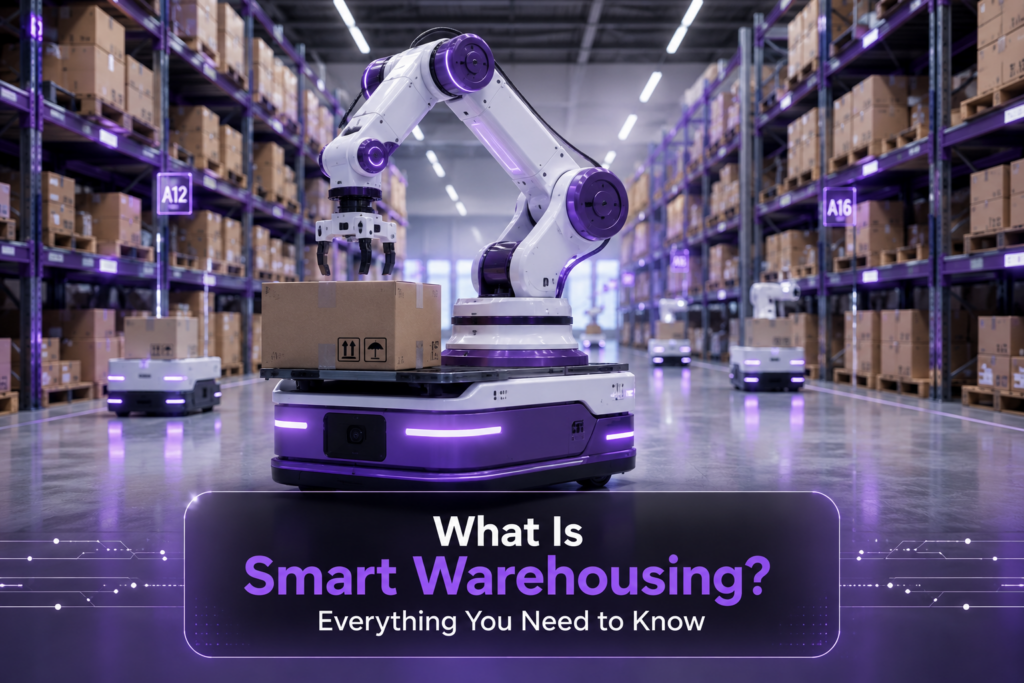
Smart warehousing uses connected systems, automation, AI, sensors, and real-time data to make warehouse operations faster, more accurate, and easier to control. It helps businesses move beyond manual processes by improving inventory visibility, labor productivity, order fulfillment, and decision-making across the warehouse.
The need for smart warehousing is growing because businesses are under pressure to deliver faster while managing labor constraints, rising order complexity, and accuracy expectations.
In this blog, we’ll explain what smart warehousing means, the technologies behind it, its key benefits, implementation challenges, best practices, and real-world use cases from leading companies.
How Smart Warehousing Works?
Smart warehousing works by creating a continuous decision loop where operational data is captured, analyzed, and acted on in near real time. The system adjusts actions based on current conditions such as workload, inventory behavior, and delays, which makes operations more responsive.
Moreover, inventory positioning, task execution, and resource allocation are coordinated through shared data. This reduces conflicts between processes like picking, replenishment, and shipping.
More advanced setups focus on decision validation. With Synkrato, warehouses can simulate scenarios, test changes, and refine strategies before applying them on the floor to reduce risk and improve outcomes.
Suggested Read: Warehouse Operations Guide
Technologies Behind Smart Warehousing
Connected technologies enable warehouses to manage inventory, labor, movement, visibility, and decisions in real time. The strongest results come when these systems work together as a coordinated operation rather than functioning as separate tools.
Warehouse Management Systems (WMS)
A WMS is the control layer of smart warehousing because it decides how work should flow across inventory, locations, and labor in real time. It translates demand, inventory position, and operational rules into executable tasks such as:
- Where to store incoming goods
- How to prioritize picking
- When to trigger replenishment
- How to sequence outbound shipments
For instance, Synkrato turns WMS data into real-time, AI-driven recommendations for better operational decisions.
Internet of Things (IoT) Sensors
IoT sensors help warehouses track what is happening in real time by using a combination of technologies such as RFID tags, GPS trackers, Bluetooth Low Energy (BLE) beacons, real-time location systems (RTLS), and environmental sensors. These technologies capture data on location, equipment status, movement, handling conditions, and asset behavior, giving teams better visibility before problems become delays.
Congestion, misplaced inventory, equipment downtime, and handling errors are easier to fix when teams can detect them early. Thus, IoT improves inventory visibility, identifies exceptions faster, and helps manage equipment, space, and labor with more confidence. However, because these sensors connect physical operations with digital systems, companies also need strong governance and cybersecurity controls from the start.
Robotics and Automation
Robotics and automation improve warehouse performance by reducing travel time, stabilizing repetitive tasks, and making throughput less dependent on labor availability.
Different technologies serve different roles.
- Autonomous mobile robots (AMRs) and automated guided vehicles (AGVs) move goods across the warehouse with more flexibility than fixed conveyors.
- Automated storage and retrieval systems (ASRS) increase storage density and retrieval speed by using vertical space efficiently.
- Collaborative robots (cobots) work alongside employees to support picking, sorting, and handling tasks without replacing human input entirely.
- Warehouse drones use a combination of technologies such as computer vision, barcode scanning, RFID readers, light detection and ranging (LiDAR) navigation, and autonomous flight systems to improve inventory visibility.
Nevertheless, only about 20% of warehouses in North America had adopted automation, while 70% of supply chain executives planned to invest around $100 million in automation over five years.
Suggested Read: Material Handling in Warehouses
Artificial Intelligence (AI) and Machine Learning (ML)
AI and ML help forecast demand, position inventory, prioritize labor, detect anomalies, and improve workflow decisions as conditions change. In 2024, embedding AI in operations:
- Reduced inventory by 20-30%
- Lowered logistics costs by 5-20%
- Reduced procurement spend by 5-15%.
A report cited a building products distributor that improved fill rates by 5-8% using an AI-enabled control tower that proactively managed inventory across its warehouse network. For business leaders, this is where smart warehousing starts to move from process efficiency to decision intelligence.
Radio Frequency Identification (RFID) and Barcode Scanning
RFID and barcode systems enable accurate, real-time identification of inventory at every step of warehouse operations.
RFID uses radio frequency waves through passive or active tags, fixed readers, handheld readers, and antenna networks to capture data without line-of-sight scanning. This allows multiple items to be read simultaneously, even in bulk movement scenarios like pallets or cartons.
On the other hand, barcode systems use 1D and 2D codes (such as QR codes) scanned through handheld devices, mobile computers, or fixed scanners at key checkpoints. These are simple, low-cost, and effective for structured workflows.
Item-level RFID has enabled close to 100% inventory accuracy and reduced stocktaking time by 93%. For high-volume environments, this means faster receiving, fewer manual checks, and better inventory visibility across locations.
Cloud-Based Integration
Cloud-based integration allows different warehouse technologies to operate as a single system by connecting data, workflows, and decisions across platforms. Warehouses use APIs, middleware platforms, and cloud-native architectures to enable real-time communication between systems.
Key technologies include API-based integrations for system-to-system communication, cloud data platforms for centralized storage and analytics, and event-driven architectures that trigger actions based on real-time changes in inventory or operations.
Such management layers built on cloud technologies can reduce implementation time by up to 60%.
Suggested Read: Types of Warehouse Storage
Benefits of Smart Warehousing
Smart warehousing improves performance by turning warehouse operations into a coordinated system where inventory, labor, equipment, and decisions are continuously aligned using real-time data.
Increased Efficiency
Efficiency improves when task execution is dynamically controlled instead of manually managed. Work is released, sequenced, and balanced in real time based on order priority, congestion, and labor availability.
This shifts the focus from speeding up individual tasks to managing overall flow. Techniques such as task interleaving and congestion-aware routing reduce idle time and unnecessary movement, while maintaining consistent throughput across zones.
Improved Accuracy
Accuracy becomes a system-driven outcome when validation is embedded into every transaction. Inventory movements are verified at the point of execution, and location-level tracking ensures continuous alignment between physical and system stock.
More advanced setups detect anomalies such as unusual dwell times or inconsistent pick patterns. This allows teams to correct issues before they impact fulfillment.
Scalability
Scalability comes from separating growth from operational complexity. As volume and SKU variety increase, execution remains stable. That’s because workflows are governed by rules, automation, and real-time coordination rather than manual intervention.
This is where Synkrato adds depth to scalability. Its AI slotting analyzes inventory patterns, order history, and demand shifts to continuously optimize where products should be stored. Warehouse can handle demand shifts without disrupting performance with:
- dynamic AI slotting
- system-directed picking
- adaptive replenishment
Cost Savings
Cost reduction is driven by tighter control over inventory, labor, and space utilization rather than isolated cost-cutting measures. Decisions such as where to store inventory, when to replenish, and how to deploy labor are continuously optimized based on real-time conditions.
This reduces hidden costs like excess inventory, rework, and inefficient labor allocation, leading to sustained efficiency gains over time.
Enhanced Customer Satisfaction
Customer experience improves when fulfillment decisions align with service commitments in real time. Orders are prioritized based on delivery timelines, inventory availability, and operational constraints instead of static processing sequences.
This leads to higher order accuracy, better fill rates, and more consistent delivery performance, especially during demand fluctuations.
Suggested Read: Warehouse Labor Management
Challenges of Implementing Smart Warehousing
Implementing smart warehousing is complex because it involves more than adopting new technology. It requires aligning systems, redesigning workflows, securing operations, and enabling workforce adoption without disrupting ongoing performance.
- High Initial Investment: The investment is often distributed across multiple areas, including software, automation, infrastructure, integration, and change management. Early investment in disconnected tools often leads to low returns. A phased approach with clear use cases, integration planning, and defined outcomes is more effective than large, uncoordinated spending.
- System Integration Issues: Most environments already include WMS, ERP, spreadsheets, automation controls, and external platforms, each with different data structures and workflows. Data delays, duplicate processes, and inconsistent workflows reduce the effectiveness of smart warehousing automation and decision-making tools.
- Cybersecurity Risks: Cybersecurity risk increases as warehouses adopt connected technologies such as IoT devices, automation systems, and cloud platforms. The global average cost of a data breach reached $4.88 million in 2024. So, warehouses require stronger controls such as network segmentation, device visibility, access management, and continuous monitoring.
- Workforce Adaptation: New systems change how work is assigned, executed, and measured, which can create resistance if not managed carefully. Effective adoption involves training, role redesign, and clear communication of how workflows will change.
Smart Warehousing Best Practices
Smart warehousing strategies work best when systems, layout, inventory logic, and execution priorities are aligned into a single operating model.
Optimize Your Warehouse Regularly
Demand patterns, SKU behavior, congestion points, and labor productivity change over time, which means static configurations quickly become inefficient. For this, Synkrato offers optimization tools to analyze patterns and continuously redesign slotting, replenishment, and task flows using AI-driven insights and simulation. So,
- Use dynamic slotting models that reposition inventory based on changing demand velocity, not fixed ABC classifications
- Track dwell time and idle zones to identify hidden congestion that standard KPIs often miss
- Apply scenario testing before implementing changes to avoid operational disruption
Partner with a Tech-enabled 3PL
Execution speed often determines the success of smart warehousing more than strategy. A tech-enabled 3PL brings pre-built capabilities such as integrated systems, automation experience, and operational playbooks to reduce the time required to implement and scale.
- Evaluate partners based on integration architecture and data transparency, not just cost and capacity
- Align service-level agreements with operational metrics such as throughput, accuracy, and turnaround time
- Ensure the partner supports real-time data exchange to maintain visibility across internal and external operations
Implement Demand Forecasting
Demand forecasting influences where inventory is stored, how labor is allocated, and when replenishment occurs. Advanced forecasting models use AI and large datasets to predict demand at a granular level, allowing warehouses to prepare before workload reaches the floor.
- Segment demand by channel, geography, and order profile to improve placement decisions
- Use short-term forecasting for labor planning and long-term forecasting for capacity and layout decisions
- Align inbound scheduling with forecasted demand to reduce receiving congestion
Rethink Your Warehouse Layout
Physical layout remains a critical factor in warehouse performance because it defines how people and goods move through the facility. Even with advanced systems, inefficient layouts create unnecessary travel, congestion, and delays. Smart warehousing uses data-driven design to align storage, picking zones, and material flow with actual demand patterns and handling requirements.
- Design zones based on activity type (fast-moving, bulk storage, replenishment) instead of uniform layouts
- Use vertical space strategically with ASRS or high-density storage to increase capacity without expanding footprint
- Separate high-frequency and low-frequency movement paths to reduce cross-traffic
- Incorporate flexible layouts that can adapt to seasonal changes or new product categories
Ready to turn your warehouse data into real-time decisions? Schedule an appointment with Synkrato to see how AI-driven insights can optimize your operations.
FAQs
What is smart warehousing?
Smart warehousing uses connected systems, automation, and real-time data to manage inventory, labor, and workflows more efficiently. With Synkrato, this data is translated into AI-driven decisions, simulations, and actionable recommendations that improve day-to-day operations.
Why do businesses exploring smart warehousing look beyond automation to platforms like Synkrato?
Automation improves execution, but it does not determine the best operational decisions. Synkrato’s decision intelligence layer enables simulation, AI slotting, and scenario testing so teams can optimize workflows before making physical changes.
How does smart warehousing differ from traditional warehousing?
Traditional warehousing depends on manual processes and static rules, while smart warehousing uses real-time data and system-driven execution. Continuous optimization becomes possible when solutions like Synkrato analyze live operations and recommend improvements based on actual performance data.
Which smart warehouse capabilities can Synkrato help strengthen through data-driven intelligence?
Smart warehousing relies on accurate inventory, efficient workflows, and responsive decision-making. These capabilities are strengthened through digital twins, AI slotting, simulation, enterprise mobility, and AI agents within Synkrato that convert data into optimized actions.
What technologies are used in smart warehousing?
Smart warehousing includes WMS, IoT sensors, robotics, AI, RFID, cloud integration, and drones working together as a connected system. Synkrato integrates with these technologies to unify data and apply intelligence across inventory, labor, and workflows.
When does Synkrato become valuable in a smart warehousing transformation strategy?
Value becomes clear when businesses need to move from visibility to decision-making and optimization. This is where Synkrato supports transformation by enabling simulation, predicting bottlenecks, and testing improvements before execution.
What challenges can businesses face when adopting smart warehousing?
Adoption challenges include high investment, system integration complexity, workforce adaptation, and maintaining accurate data. These can be addressed more effectively when Synkrato provides a unified layer for visibility, simulation, and controlled, data-driven execution.