Material handling in warehouses is the backbone of fast, accurate, and efficient operations. From moving inventory across aisles to speeding up order fulfillment, the way materials are handled can make the difference between smooth workflows and costly delays. In fact, 54% of 3PL warehouses now fulfill orders in less than one hour, highlighting how optimized material handling processes directly impact speed and operational performance.
In this blog, we’ll break down the core functions of material handling in warehouses, the most widely used equipment categories, advanced material handling best practices, and the latest warehouse trends shaping modern fulfillment operations.
Functions of Material Handling
Material handling plays a crucial role in maintaining smooth, organized, and efficient warehouse operations. It helps businesses streamline the flow of goods, optimize storage, improve inventory accuracy, and ensure product safety throughout the supply chain. The main functions of material handling include:
Movement
Movement is the core function of material handling in warehouses. The objective is not simply faster transportation, but reducing unnecessary travel while maintaining continuous inventory flow.
Advanced facilities optimize movement using:
- Dynamic slotting strategies
- Zone-based picking
- Directed putaway logic
- Conveyor routing systems
- Autonomous mobile robots (AMRs)
- Real-time labor orchestration
- AI-driven travel optimization
In high-throughput facilities, congestion around staging areas and replenishment aisles can quickly affect fulfillment speed. Many operations now use Synkrato’s digital twins and simulation to model warehouse flow behavior before making layout or process changes.
Storage
Storage strategies directly influence accessibility, replenishment frequency, picking efficiency, and cube utilization. Traditional storage optimization focused primarily on maximizing available space. Modern warehouse material handling solutions instead prioritize flow efficiency and operational responsiveness. High-performing facilities evaluate storage systems based on:
- SKU velocity
- Order frequency
- Inventory dimensions
- Handling requirements
- Replenishment cycles
- Picking methodology
- Seasonal demand variability
Automated storage architectures are becoming increasingly important for dense fulfillment environments. Automated storage systems can significantly improve storage density while reducing labor-intensive travel activities.
Stock Control
Stock control ensures inventory accuracy while maintaining uninterrupted operational flow. Inventory discrepancies often originate from handling inefficiencies such as:
- Incorrect pallet movement
- Scan compliance failures
- Delayed replenishment
- Manual handling errors
- Untracked inventory transfers
Advanced warehouse material handling systems integrate barcode scanning, RFID tracking, IoT sensors, and warehouse execution systems (WES) to improve inventory visibility. Facilities increasingly use predictive analytics to identify inventory risk conditions before they affect throughput or service levels.
Overall Protection
Material handling helps protect goods, equipment, and workers throughout warehouse operations. Proper handling techniques reduce the risk of product damage during transportation and storage while also improving workplace safety.
Modern warehouses reduce handling risks through:
- Rack protection systems
- Collision avoidance technology
- Load stability monitoring
- Ergonomic workflows
- Traffic management systems
- Automated safety enforcement
Leading warehouse operators now integrate safety analytics into warehouse material handling systems to identify recurring congestion patterns, unsafe equipment interactions, and operational risks before disruptions occur.
Suggested Read: Warehouse Operations Guide
Types of Equipment in Warehouse Material Handling
Warehouse material handling equipment forms the backbone of efficient logistics operations, enabling the smooth flow of goods from receiving to storage and finally to dispatch. The right combination of systems not only improves productivity but also reduces errors, labor strain, and operational delays while making better use of available space. The primary equipment types used in modern warehouses are:
Automated Storage and Retrieval Systems (AS/RS)
Automated Storage and Retrieval Systems (AS/RS) are designed to store and retrieve inventory with minimal human intervention. These systems improve storage density, reduce operator travel time, and support faster inventory access in high-volume fulfillment environments.
AS/RS technologies are commonly used in e-commerce, manufacturing, and cold storage operations where speed and space optimization are critical. Modern AS/RS environments are often integrated with warehouse execution systems, robotics, and AI-driven inventory management platforms to improve operational coordination.
Conveyors
Conveyor systems move products automatically between warehouse zones to support continuous material flow. They are widely used for sortation, replenishment, packing, and shipping operations in large distribution facilities. Conveyors reduce manual transport, improve throughput consistency, and help minimize congestion across high-traffic warehouse areas. Advanced conveyor networks now include:
- Automated routing logic
- Real-time throughput monitoring
- IoT-based condition tracking
- AI-assisted jam detection
Conveyors are especially valuable in warehouse material handling systems managing high order volumes and fast fulfillment cycles.
Forklifts
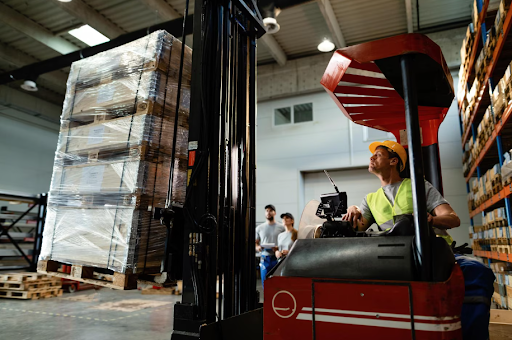
Forklifts remain one of the most widely used types of warehouse material handling equipment for pallet movement and heavy-load transportation. They support:
- Putaway operations
- Dock handling
- Inventory replenishment
- Bulk pallet movement
- Trailer loading and unloading
Warehouses increasingly use electric forklifts and telematics-enabled fleets to improve energy efficiency and operational visibility. Operations teams also use forklift analytics to identify congestion patterns, idle time, and inefficient travel routes.
Pallet Jacks
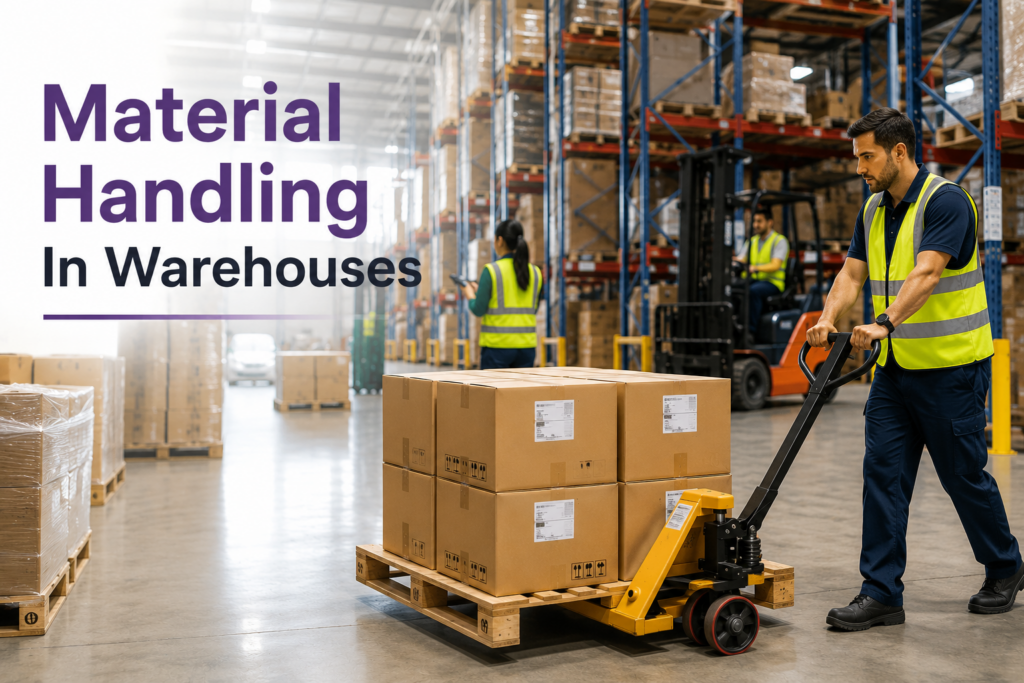
Pallet jacks are commonly used for short-distance pallet movement within receiving, staging, and shipping zones. Although simpler than forklifts, pallet jacks remain essential in material handling processes in warehouses due to their flexibility and ease of use.
Electric pallet jacks help reduce manual strain while improving movement efficiency in high-frequency transport areas. They are especially effective in:
- Cross-docking operations
- Fast-moving replenishment zones
- Tight warehouse aisles
- Last-touch shipping workflows
Warehouse operators also monitor pallet jack movement to identify travel inefficiencies and dock congestion patterns.
Pallet Racks
Pallet racks are storage systems designed to organize inventory while maximizing warehouse accessibility and vertical space utilization. Modern pallet rack configurations include:
- Selective racking
- Push-back racking
- Drive-in systems
- Flow racks
- Double-deep racking
The right rack system depends on SKU velocity, replenishment frequency, and picking methodology. Well-designed pallet rack systems help improve throughput, inventory visibility, and operational scalability across high-volume warehouse environments.
Suggested Read: Types of Warehouse Storage
Best Practices for Warehouse Material Handling
Efficient warehouse material handling is not just about having the right equipment—it’s about using smart strategies that improve flow, reduce waste, and enhance safety across operations. When best practices are followed consistently, warehouses can achieve higher productivity, lower costs, and better accuracy.
1. Optimize Your Warehouse Space
Warehouse layouts should support efficient inventory flow instead of maximizing storage density alone. Facilities increasingly use slotting analytics and warehouse simulation tools to reduce travel distance and congestion.
Key strategies include:
- Dynamic slotting
- Zone-based layouts
- Optimized pick paths
- Fast-moving SKU positioning
2. Prioritize Technology Integration
Disconnected systems create visibility gaps that affect inventory flow and operational coordination. Modern warehouse material handling solutions integrate WMS, RFID tracking, IoT sensors, and warehouse execution systems to improve real-time decision-making and throughput visibility throughout the facility.
3. Train Employees Regularly
Even advanced warehouse material handling systems depend on workforce consistency. Continuous training helps operators improve equipment handling, safety compliance, and process execution during changing operational conditions. Warehouses with structured training programs often experience fewer operational disruptions and handling errors.
4. Standardize Processes
Process variability can create delays, inventory inaccuracies, and inconsistent throughput performance. Standardized workflows help warehouses maintain operational stability during high-volume periods while improving coordination between labor and automation systems. Commonly standardized workflows include:
- Putaway procedures
- Picking sequences
- Replenishment timing
- Dock staging operations
5. Use the Right Equipment for the Job
Warehouse material handling equipment should align with throughput requirements, SKU characteristics, and warehouse layout constraints. For example, AS/RS systems improve dense storage efficiency, while AMRs support flexible inventory movement in dynamic fulfillment environments. Poor equipment selection often increases labor strain, aisle congestion, and unnecessary handling.
6. Maintain Equipment Properly
Equipment downtime directly affects throughput performance and fulfillment speed. Many warehouses now use predictive maintenance tools that monitor fleet utilization, battery performance, and equipment wear in real time. Preventive maintenance strategies help facilities:
- Reduce operational disruptions
- Improve equipment lifespan
- Lower repair costs
- Maintain consistent throughput
7. Reduce Manual Handling
Reducing repetitive manual movement improves both labor productivity and workplace safety. Modern material handling processes in warehouses increasingly use automation technologies such as robotic picking, goods-to-person systems, and automated conveyors to minimize unnecessary handling activities. This also helps warehouses scale operations during peak demand periods.
8. Focus on Safety
Warehouse safety strategies now extend beyond compliance requirements. High-volume facilities use collision avoidance systems, traffic management controls, ergonomic workflows, and AI-driven safety analytics to reduce operational risks.
Forklifts remain one of the leading causes of warehouse-related injuries, making operator coordination and movement visibility critical.
9. Implement Lean Warehousing Practices
Lean warehousing focuses on eliminating operational waste while improving inventory flow and labor efficiency. Facilities increasingly adopt lean material handling best practices such as cross-docking, pull-based replenishment, and dynamic slotting to reduce delays and unnecessary travel distance.
These strategies help warehouses improve throughput without immediately expanding infrastructure.
10. Monitor and Improve Continuously
Warehouse operations constantly evolve due to changing order profiles, labor conditions, and fulfillment expectations. High-performing facilities continuously analyze KPIs such as pick rate, inventory accuracy, and equipment utilization to identify operational bottlenecks.
Synkrato helps warehouse leaders simulate process changes, evaluate warehouse flow behavior, and improve long-term operational scalability.
Suggested Read: Warehouse Labor Management
Latest Trends in Warehousing for Material Handling
Warehouse material handling is evolving rapidly as businesses adopt smarter technologies and more efficient operational practices. These innovations are helping warehouses improve productivity, accuracy, safety, and sustainability while meeting growing supply chain demands. Some of the latest trends shaping modern warehouse material handling include:
Automation and Advanced Technologies
Automation continues to transform warehouse material handling solutions across distribution and fulfillment operations. Modern warehouses now use:
- AI-driven warehouse orchestration
- Robotics and automated picking
- Warehouse execution systems (WES)
- Automated sortation systems
- Digital twins and simulation platforms
Advanced facilities increasingly combine automation with predictive analytics to improve throughput stability and reduce operational bottlenecks.
Autonomous Vehicles
Autonomous vehicles such as Automated Guided Vehicles (AGVs) and Autonomous Mobile Robots (AMRs) are becoming central to warehouse material handling systems. These technologies help warehouses improve:
- Inventory movement efficiency
- Replenishment speed
- Labor scalability
- Congestion reduction
- Multi-zone coordination
The growing adoption of warehouse automation is accelerating investment in autonomous technologies. The warehouse robotics market was valued at USD 7.21 billion in 2025 and is projected to cross USD 18 billion by 2033, growing at a CAGR of 12.67% between 2026 and 2033.
As warehouse throughput demands continue increasing, autonomous vehicles are helping facilities reduce manual travel while improving operational flexibility and fulfillment speed.
Real-time Visibility
Real-time visibility has become essential for managing modern material handling processes in warehouses. Warehouses now use:
- RFID tracking
- IoT sensors
- Equipment telematics
- AI-powered analytics
- Computer vision systems
These technologies provide live operational visibility into inventory movement, labor allocation, equipment utilization, and throughput performance.
With Synkrato, warehouse operators can simulate warehouse flow behavior and identify hidden operational inefficiencies before they affect fulfillment performance.
Sustainability Initiatives
Sustainability goals are influencing warehouse material handling equipment decisions across logistics networks.
Organizations are increasingly adopting:
- Electric forklifts
- Energy-efficient conveyors
- Smart power management systems
- Sustainable packaging workflows
- Optimized warehouse layouts
Warehouse operators are also redesigning workflows to reduce unnecessary travel distance and excess handling activities.
Wearable Technology for Workers
Wearable technologies are improving workforce productivity and safety across warehouse operations. Common wearable technologies include:
- Voice-picking headsets
- Smart glasses
- Wearable scanners
- Ergonomic support systems
- Real-time safety monitoring devices
Wearable technologies improve worker efficiency, safety, and labor coordination while providing operational data to optimize warehouse material handling processes.
Suggested Read: What is Smart Warehousing
See How Synkrato Can Help Manage Your Material Handling Today
Modern material handling in warehouses requires more than static reporting and reactive decision-making. As warehouse operations become more complex, organizations need real-time operational intelligence to improve throughput, reduce congestion, and optimize warehouse material handling systems before inefficiencies affect fulfillment performance.
How Synkrato Helps Optimize Warehouse Material Handling
- Simulate warehouse flow behavior before operational changes are implemented
- Identify hidden bottlenecks across picking, replenishment, and staging operations
- Optimize labor allocation and equipment utilization using digital twin technology
- Improve throughput stability during peak demand and high-volume fulfillment periods
- Evaluate automation strategies without disrupting live warehouse operations
- Reduce congestion, travel inefficiencies, and unnecessary handling movement
- Support data-driven warehouse material handling solutions for long-term scalability
Book a personalized demo with Synkrato to discover how simulation-driven intelligence can optimize your warehouse material handling systems, improve throughput visibility, and reduce operational inefficiencies.
FAQs
What is material handling in warehouses?
Material handling in warehouses refers to moving, storing, controlling, and protecting inventory throughout warehouse operations. Modern warehouse material handling systems use automation, analytics, and real-time visibility tools to improve throughput, inventory accuracy, labor efficiency, and fulfillment speed.
Which material handling inefficiencies can Synkrato help uncover in warehouse operations?
Synkrato helps warehouse operators identify hidden inefficiencies such as congestion hotspots, excessive travel paths, poor replenishment sequencing, underutilized equipment, and throughput bottlenecks. Its simulation-driven platform improves visibility into warehouse material handling systems before operational disruptions occur.
Why is material handling important in warehouse operations?
Material handling directly affects warehouse productivity, order accuracy, inventory flow, labor utilization, and operational scalability. Efficient material handling processes in warehouses help reduce delays, minimize product damage, improve fulfillment speed, and maintain consistent throughput across high-volume operations.
Why can traditional material handling processes struggle without intelligence layers like Synkrato?
Traditional warehouse material handling systems often rely on static reporting and limited operational visibility. Without Synkrato’s decision intelligence layer, warehouses may struggle to identify interconnected bottlenecks, congestion patterns, equipment inefficiencies, and process variability affecting overall operational performance.
What types of material handling equipment are used in warehouses?
Common warehouse material handling equipment includes AS/RS systems, conveyors, forklifts, pallet jacks, pallet racks, AGVs, AMRs, and robotic picking systems. These technologies help warehouses improve inventory movement, storage optimization, labor efficiency, and throughput consistency.
When does Synkrato become most valuable for improving warehouse material handling performance?
Synkrato becomes especially valuable in high-throughput, automation-heavy, or rapidly scaling warehouse environments. It helps warehouse leaders simulate operational scenarios, evaluate process interactions, and identify bottlenecks before implementing costly layout, labor, or automation changes.
Which KPIs help measure material handling performance?
Key warehouse material handling KPIs include order cycle time, inventory accuracy, equipment utilization, dock-to-stock time, replenishment speed, travel distance per order, and throughput per zone. These metrics help warehouses monitor efficiency, labor productivity, and operational stability.