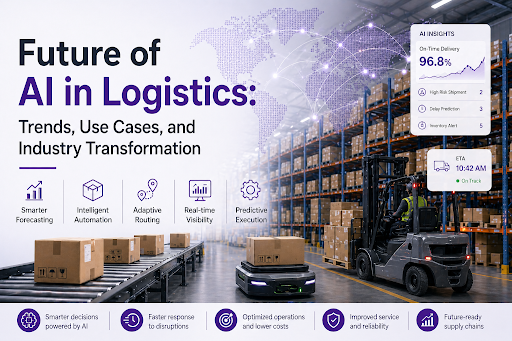
The future of AI in logistics is predictive, autonomous, and continuously adaptive. Instead of supporting decisions after the fact, AI will anticipate demand shifts, identify risks early, and trigger actions across planning, execution, and delivery in real time.
As supply chains become more complex, this evolution shifts logistics from reactive coordination to self-optimizing systems. Thus, decisions around inventory, routes, and resources are continuously recalibrated to balance cost, speed, and service levels.
This blog breaks down the key trends, technologies, and real-world use cases shaping how AI will redefine logistics performance and decision-making in the coming years.
How AI is Changing the Logistics Industry
AI is transforming logistics by replacing manual planning and delayed reporting with real-time, AI-driven decision systems. These systems continuously analyze demand signals, automate workflows, and enable faster, more accurate operational decisions.
Over 40% of shippers across Europe, North America, Asia Pacific, and the Middle East now consider AI capabilities when selecting logistics partners. This indicates that AI is becoming a core differentiator in logistics operations.
89% of operations and supply chain leaders in the USA say actionable data matters more than complete data. On the other hand, 84% are comfortable making decisions with imperfect information, highlighting a shift toward faster, data-driven execution.
Suggested Read: AI in Warehouse Management
AI Technologies Driving Logistics Evolution
AI in logistics is not one tool. It is a stack of technologies that improve how companies forecast demand, allocate inventory, plan routes, automate execution, and respond when real-world conditions change.
- Machine Learning (ML): ML improves demand forecasting by continuously updating predictions using real-time orders, historical data, and external signals. This enables SKU-level demand sensing, better inventory positioning, and faster response to demand volatility.
- Predictive Analytics: Predictive analytics identifies risks before they impact operations, including predictive maintenance for vehicles and warehouse equipment. It helps reduce downtime, anticipate delays, and improve planning accuracy across logistics networks.
- Optimization Algorithms (AI-based OR): Optimization algorithms enable route optimization by solving complex constraints such as delivery windows, traffic, and cost. They dynamically adjust routes and schedules in real time to improve efficiency and service reliability.
- Intelligent Automation: Intelligent automation executes logistics workflows using AI-driven decision-making instead of fixed rules. It dynamically assigns tasks in warehouses and transport operations based on real-time conditions like demand, labor, and congestion.
- Agentic AI / AI Agents: AI agents allow systems to take autonomous, goal-driven actions across logistics operations. They monitor workflows, trigger decisions, and resolve exceptions without manual intervention, acting as a real-time execution layer.
- Digital Twins: Digital twins simulate logistics networks and warehouse environments to test scenarios before execution. They help evaluate the impact of changes on throughput, cost, and flow, reducing risk in decision-making.
- Internet of Things (IoT) + AI Integration: IoT devices provide real-time data from shipments, assets, and infrastructure, which AI uses to enable continuous monitoring and faster decisions. This improves visibility, condition tracking, and operational responsiveness.
- Computer Vision: Computer vision automates visual tasks such as scanning, quality checks, and damage detection. It increases speed and accuracy in high-volume warehouse and yard operations.
- Reinforcement Learning: Reinforcement learning improves decision-making by learning from outcomes in dynamic environments. It is used for routing, task allocation, and flow optimization where conditions continuously change.
- AI Decision Engines / Control Towers: AI decision engines connect data across systems and continuously optimize logistics decisions. They balance trade-offs across cost, speed, and service levels in real time.
Suggested Read: AI in Inventory Management
AI in Supply Chain Visibility and Risk Management
AI strengthens supply chain visibility by turning tracking data, shipment updates, external risk signals, and operational exceptions into timely decisions, not just dashboards.
Real-time tracking and end-to-end visibility
Visibility with artificial intelligence in the supply chain elevates logistics tracking from basic location updates to real-time, decision-ready insights. It interprets shipment movement, compares planned versus actual flows, predicts arrival times, and surfaces exceptions that require immediate action.
This plays out across key visibility workflows:
- ETA predictions update continuously based on live transport and network conditions
- Exception prioritization focuses attention on high-impact delays instead of low-value alerts
- Multi-node tracking integrates data across suppliers, warehouses, carriers, and last-mile delivery
- Event correlation connects upstream disruptions to downstream inventory and fulfillment risks
- Rerouting recommendations propose alternate paths when delays or bottlenecks are detected
AI-based disruption detection and mitigation
AI-based disruption detection enables logistics teams to identify risks early and act before they escalate into service failures. It combines external signals with internal operational data to determine which disruptions will impact specific shipments, routes, customers, or inventory positions.
As a result, it leads to more targeted and timely interventions:
- Impact analysis pinpoints shipments or orders most likely to be affected
- Alternate routing identifies viable paths to avoid delays or congestion
- Inventory reallocation redistributes stock to maintain availability across locations
- Order reprioritization adjusts fulfillment sequences based on urgency and risk exposure
- Automated notifications trigger proactive communication with customers and suppliers
Suggested Read: Using Simulation to Reduce Warehouse Bottlenecks
Benefits of AI in Logistics
The biggest benefits of applying AI in logistics trends include faster execution, lower cost, improved planning accuracy, and more resilient operations.
Improved efficiency and faster operations
AI improves logistics efficiency by compressing the time between signal, decision, and action.
On the execution side, this leads to faster and more streamlined workflows:
- Order prioritization updates automatically based on urgency and service commitments
- Picking paths are optimized to reduce travel time and congestion inside warehouses
- Dock scheduling aligns inbound and outbound flows to minimize idle time
Reduced operational costs and resource optimization
AI reduces logistics costs by improving how resources are used across inventory, labor, space, and transport capacity. Instead of reacting to inefficiencies after they occur, AI helps detect patterns of waste early and recommends actions that prevent cost buildup across the network.
At a cost-control level, this shows up in how inefficiencies are identified and corrected:
- Route optimization reduces fuel consumption and unnecessary mileage
- Demand-driven inventory levels prevent excess stock and holding costs
- Automated validation minimizes errors that lead to rework and returns
Better accuracy in forecasting and planning
AI updates forecasts using real-time and historical data, allowing companies to respond earlier to demand shifts and supply variability.
This improves how demand and supply signals are interpreted:
- Multi-variable forecasting incorporates demand drivers beyond historical sales
- Real-time updates adjust forecasts as new data becomes available
- Demand sensing detects short-term spikes or drops earlier than traditional models
Suggested Read: Warehouse Digitalization
Challenges in AI Adoption in Logistics
AI adoption in logistics is difficult because most logistics networks were not built for connected, real-time, AI-driven decision-making. The biggest barriers are data quality, system fragmentation, integration complexity, and change management.
Data integration and system compatibility issues
Data integration and system compatibility issues remain one of the biggest barriers to effective AI adoption in logistics because AI depends on consistent, connected, and reliable data across systems. Most logistics environments operate with multiple platforms such as warehouse management systems (WMS), transport management systems (TMS), and enterprise resource planning (ERP). Each stores and updates data differently while often defining the same metrics in inconsistent ways.
This fragmentation creates a gap between available data and usable intelligence. Moreover, addressing this requires more than just connecting systems. Companies need to establish a strong data foundation that includes clear data ownership, standardized definitions, API-driven connectivity, exception handling frameworks, and governance structures that ensure data quality over time.
The challenge, therefore, is not only technical integration but also operational alignment, where teams trust the data enough to rely on AI-driven recommendations in day-to-day execution.
Suggested Read: Warehouse Robotics
High implementation and transition complexity
AI implementation in logistics changes both systems and operating behavior. A company buys AI-enabled software, but value only comes when workflows, roles, KPIs, and decision rights change with it.
Transition complexity is also high because logistics operations do not pause for transformation. Warehouses must keep shipping, carriers must keep moving, and customer commitments must still be met while new systems are introduced. This makes phased adoption important.
Companies often need to begin with focused use cases, such as demand forecasting, route optimization, control tower visibility, or warehouse labor planning. Once teams trust the outputs, AI expands into more autonomous decisions. The hardest part is embedding AI into daily execution without disrupting service quality.
Suggested Read: Warehouse Digital Twins
Future Trends in AI-Powered Logistics
The future of AI in logistics will move from isolated tools toward connected ecosystems where autonomous systems, digital twins, predictive analytics, and human decision-makers work together.
Rise of autonomous logistics systems
Autonomous logistics systems will become more important as companies seek faster, more flexible, and less labor-dependent operations.
Moreover, robot shipments in warehouse automation are expected to grow by up to 50% annually through 2030. Human roles will not disappear, but they will shift toward supervision, exception handling, governance, and continuous improvement.
Use cases:
- Autonomous mobile robots dynamically reroute based on aisle congestion
- Real-time task allocation across pickers, robots, and zones
- Automated picking and sorting systems adjust throughput during peak demand
- Self-balancing workloads across warehouse zones to prevent bottlenecks
Suggested Read: Benefits of Warehouse Robotics
AI + digital twin integration in supply chains
AI and digital twins will become a powerful combination for logistics planning and execution. A digital twin creates a virtual model of a logistics network, warehouse, transport lane, fleet, or supply chain process. AI makes that model more predictive and useful by analyzing real-time and historical data, testing scenarios, and recommending better decisions.
Use cases:
- Simulating slotting strategies to reduce picker travel time
- Testing warehouse layout changes before physical reconfiguration
- Evaluating picking paths and congestion scenarios under demand spikes
- Predicting labor and throughput impact of seasonal volume changes
Shift toward fully predictive logistics ecosystems
53% of organizations are already using AI to anticipate and mitigate supply chain disruptions, indicating that predictive capabilities are becoming embedded in daily operations.
This will change how logistics teams plan and manage performance. Instead of asking, “Where is the shipment?” teams will ask, “Which shipments are likely to miss the promise date, what is the business impact, and what should we do now?”
Use cases:
- Predicting stockouts and triggering pre-emptive replenishment
- Identifying orders at risk of delay and reprioritizing picking sequences
- Forecasting inbound congestion and adjusting dock scheduling
- Anticipating labor shortages and reallocating resources in advance
The future of supply chain AI technology is predictive and decision-driven. See how Synkrato brings real-time intelligence into every layer of your warehouse operations. Book a demo today.
Suggested Read: Types of Warehouse Robots
FAQs
How is AI expected to transform the logistics industry in the future?
AI will shift logistics from reactive execution to real-time, decision-driven operations where every movement is continuously optimized. Platforms like Synkrato accelerate this by turning warehouse data into live recommendations, automations, and AI-driven decisions.
Why are traditional logistics systems unable to keep up with AI-driven supply chain complexity?
Traditional systems rely on static rules and delayed reporting, which break down in dynamic, multi-node logistics networks. Synkrato overcomes this by layering AI, digital twins, and real-time intelligence on top of existing systems to enable continuous optimization.
What are the biggest AI-driven changes expected in logistics?
The biggest shifts include autonomous decision-making, predictive planning, and fully connected execution across warehouse and transport layers. Synkrato brings these capabilities together by combining AI agents, simulation, and real-time execution intelligence in one platform.
Why does Synkrato’s AI-driven approach matter in the future of logistics optimization?
Synkrato goes beyond analytics by enabling action, using digital twins and AI slotting to test and implement decisions before they impact operations. This reduces risk, improves efficiency, and ensures every optimization is validated before execution.
Will AI replace human roles in logistics operations?
AI will reduce repetitive decision-making but increase the need for human oversight in exceptions, strategy, and continuous improvement. Synkrato supports this shift by augmenting teams with AI agents that simplify complex data into actionable insights.
Why will AI-powered platforms like Synkrato define the next generation of logistics performance?
Future logistics performance will depend on how fast companies sense, decide, and act across operations. Synkrato enables this by transforming WMS into a decision-making system powered by AI, simulation, and real-time execution data.
How will AI influence cost management in logistics?
AI will reduce costs by eliminating inefficiencies across inventory, labor, space, and transport through better decision-making. Synkrato strengthens this by using digital twins and AI-driven simulations to optimize resource usage before costs are incurred.