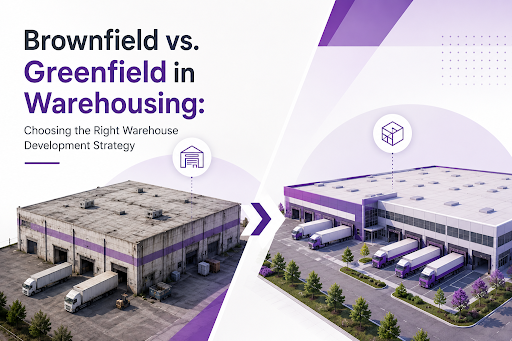
Selecting between brownfield and greenfield in warehousing requires balancing growth expectations, operational requirements, investment capacity, and deployment speed. Brownfield warehouses offer faster implementation and lower upfront investment, while greenfield warehouses provide greater scalability, layout flexibility, and automation readiness.
When supply chain networks approach capacity limits, the wrong warehouse development strategy can create lasting throughput constraints, rising labor costs, and operational inefficiencies.
In this blog, we compare brownfield and greenfield warehouse strategies, including costs, infrastructure, automation considerations, and key selection factors.
Brownfield vs. Greenfield Warehousing Comparison
The right warehouse development strategy depends on whether the business needs rapid capacity expansion or a purpose-built facility optimized for future operations. Brownfield projects reduce time-to-market, whereas greenfield projects maximize long-term operational flexibility. Here’s a comparison between the two:
| Brownfield Warehousing | Greenfield Warehousing | |
| Infrastructure | Existing facility requiring retrofitting, modification, or structural adaptation. | Custom-engineered site built from raw land to precise technical specifications. |
| Initial Investment | Lower upfront capital expenditure; primary costs stem from structural remediation. | High initial capital requirements for land acquisition, site preparation, and construction. |
| Deployment Speed | Rapid time-to-market, often accelerating operational go-live timelines by months. | Extended deployment timeline due to permitting, environmental reviews, and civil engineering requirements. |
| Layout Flexibility | Constrained by existing structural pillars, fixed dock doors, and clear-height limitations. | Complete configuration flexibility tailored to specific product velocity and workflow requirements. |
| Automation Integration | More complex due to structural barriers, legacy flooring, and existing building constraints. | Native integration of high-density robotics, AS/RS systems, monorails, and advanced automation technologies. |
| Scalability | Limited by the property’s physical footprint and zoning restrictions. | High scalability with planned acreage reserves and modular expansion capabilities. |
| Operational Disruption | Higher risk during retrofit projects, potentially causing temporary throughput declines. | No disruption to existing logistics operations during construction. |
| Space Optimization | Dependent on adaptive space allocation strategies and specialized slotting approaches. | Maximized volumetric utilization through optimized ceiling heights, aisle configurations, and storage design. |
| Best Fit | Rapid regional market entry, facility modernization, or capital-constrained expansion initiatives. | High-volume, automation-intensive fulfillment centers designed for long-term growth. |
When Greenfield Warehousing Becomes the Better Long-Term Investment
Greenfield warehousing becomes the superior long-term investment when legacy constraints permanently restrict volume expansion or the integration of advanced logistics systems. When evaluating a brownfield vs. greenfield warehouse comparison, executive teams look past initial capital savings to prioritize long-term throughput stability and scalability across high-volume networks.
Suggested Read: Predictive Analytics in Warehousing
Building Warehouses Around Automation From Day One
Warehouse automation projects often fail because existing facilities were never designed for robotics, AS/RS systems, or high-density storage. Warehouse automation investments are increasing rapidly, yet many projects underperform due to infrastructure limitations and poor facility alignment with automation requirements.
Designing a greenfield warehouse around automation from the start reduces implementation risk and supports long-term productivity gains.
Designing Optimized Warehouse Layouts Without Existing Constraints
Poor warehouse layouts increase travel distances, create congestion, and amplify execution variance during peak periods.
- Recent warehouse layout research demonstrates that layout optimization variables can directly account for up to 75.4% of the variance in operational work productivity.
- Inefficient aisle layouts and poorly assigned storage locations can force pickers to travel significantly longer distances during fulfillment operations. Computational optimization studies indicate that these design inefficiencies can account for up to 32% of unnecessary travel distance within a warehouse.
Supporting Future Scalability and Expansion
Many warehouse networks outgrow available capacity faster than expected, creating operational fragmentation and rising logistics costs.
- SKU Proliferation: Expanding product catalogs consumes storage capacity and increases space allocation complexity.
- Channel Expansion: Supporting additional sales channels creates new fulfillment requirements and inventory pressures.
- Fulfillment Growth: Rising order volumes can force businesses to rely on overflow facilities, increasing transportation costs and workflow fragmentation.
Improving Operational Flow and Space Utilization
Space constraints can become a major operational limitation as fulfillment volumes grow. Research on warehouse design and storage optimization highlights the increasing importance of vertical space utilization, particularly in facilities deploying high-density storage and automation technologies.
Challenges in Brownfield and Greenfield Warehouses
The primary challenges in brownfield and greenfield warehouses stem from infrastructure limitations, technology integration requirements, and long-term investment decisions.
Suggested Read: What is Micro Warehousing
Integrating Robotics Into Existing Facilities
Brownfield automation projects often encounter physical constraints that software cannot solve. Legacy floors, fixed column grids, and limited clear heights can restrict robot movement and increase deployment complexity.
Warehouse automation adoption continues to accelerate, yet a 2024 review of Industry 4.0 warehouse technologies identified infrastructure constraints, layout limitations, and integration complexity as recurring barriers to automation deployment in existing facilities.
Designing Automation-Ready Greenfield Warehouses
A greenfield facility offers design freedom, but poor assumptions can become expensive mistakes.
- Throughput forecasts may become inaccurate within a few years.
- Fixed conveyor placements can restrict future workflow changes.
- Overdesigned infrastructure may leave capital underutilized.
Unlike brownfield projects, design errors are often embedded before operations even begin. This is where Synkrato’s digital twin technology can help simulate warehouse layouts to prevent design errors before implementation.
System Compatibility and Warehouse Technology Planning
Technology integration challenges affect both warehouse models differently. Increasing digitalization often creates additional system coordination requirements between software, robotics, and operational control layers. As the number of connected technologies grows, implementation complexity increases.
Balancing Flexibility With Automation Investment
Automation can lower operating expenses, but it may also reduce adaptability when business requirements change. McKinsey estimates that logistics automation can reduce operating costs by 15%-35%, making the investment decision more complex than a simple cost comparison.
Fixed System Risk
Highly specialized automation infrastructure can become difficult to reconfigure when SKU profiles, order patterns, or fulfillment models evolve.
Long-Term Investment Exposure
Facilities may remain locked into technology decisions for years, even as operational requirements change faster than expected.
Suggested Read: Warehouse Capacity Planning
Common Risks Businesses Overlook Before Choosing a Warehouse Strategy
Before finalizing a warehouse strategy, businesses must identify hidden structural constraints, technology gaps, and inefficient layout designs. Overlooking these factors can lead to rising costs, operational bottlenecks, and reduced long-term network performance.
- Underestimating Retrofitting Costs: Unexpected infrastructure remediation expenses, such as upgrading electrical grids for fast-charging AMR fleets or repairing concrete slab joints to meet precision tolerances, frequently inflate brownfield warehouse and greenfield warehouse cost calculations.
- Ignoring Long-Term Automation Requirements: Selecting a facility based solely on current volumes creates severe throughput bottlenecks within 24 to 36 months if the physical footprint lacks the clear heights or floor load capacities required to deploy high-density warehouse automation.
- Poor Space Utilization Planning: Neglecting to account for product affinity shifts and velocity changes during initial layout modeling traps operations in a permanent, costly reactive state marked by inflated travel distances and heavy pick-face congestion.
Identifying these risks early is critical for protecting long-term ROI and operational flexibility. Synkrato Digital Twin enables teams to validate warehouse strategies through simulation and scenario analysis before major infrastructure investments are made.
Choosing the Right Warehouse Strategy for Your Business Goals
Understanding how to choose between brownfield and greenfield warehouse strategies requires evaluating growth expectations, capital availability, automation requirements, and long-term operational objectives. Businesses should align facility decisions with future scalability needs rather than focusing solely on short-term cost or deployment speed.
Best Fit for High-Growth Operations
- Greenfield warehouses are often the strongest choice for organizations expecting sustained growth.
- A purpose-built facility provides the flexibility to expand storage capacity, reconfigure workflows, and accommodate increasing order volumes without creating operational fragmentation.
Synkrato AI Agents can continuously evaluate demand patterns, capacity utilization, and operational scenarios, helping teams align warehouse expansion decisions with long-term business growth.
Suggested Read: Flexible Warehouse
Best Fit for Budget-Conscious Expansion
Brownfield projects help businesses increase capacity while controlling capital expenditures.
- Lower Upfront Investment: Existing infrastructure reduces land acquisition and construction costs.
- Faster Deployment: Facilities can often be operational sooner than new developments.
- Reduced Expansion Risk: Companies can scale incrementally rather than committing significant capital upfront.
Research shows that AI-driven layout optimization can increase space utilization by 20%-35%, while warehouse reconfiguration initiatives have reduced order cycle times by 15%-45% in complex distribution environments. Organizations can further evaluate retrofit scenarios and space utilization strategies using Synkrato Simulation & Optimization Engine before committing to major capital investments.
Best Fit for Automation-Heavy Warehouses
Key requirements for automation-intensive operations include:
- High floor-load capacity
- Precise floor flatness tolerances
- Adequate power infrastructure
- Support for AS/RS and robotic systems
Greenfield facilities make it easier to align building specifications with automation requirements from the outset, reducing future infrastructure constraints.
Best Fit for Long-Term Supply Chain Scalability
Long-term supply chain scalability depends on the ability to adapt to changing demand patterns, inventory profiles, and fulfillment requirements over time. Organizations can use Synkrato AI Slotting Recommendations to continuously evaluate warehouse performance, optimize space allocation, and support future growth across both brownfield and greenfield environments without relying on static planning assumptions.
Suggested Read: On Demand Warehousing
Maximize Infrastructure ROI With Synkrato’s Advanced Warehouse Simulation
Warehouse infrastructure decisions can create long-term cost and throughput constraints when expansion, automation, and capacity requirements are not properly evaluated. Organizations need a data-driven approach to validate facility strategies before committing capital.
Synkrato Enterprise Modeling enables supply chain leaders to simulate warehouse layouts, test automation scenarios, and evaluate operational performance using real-world data.
Book a demo with Synkrato to validate warehousing decisions before implementation, reduce risk, uncover hidden capacity, and improve infrastructure ROI.
FAQs
What is the difference between brownfield and greenfield warehousing?
The difference between brownfield and greenfield warehouse strategies lies in the starting state of the infrastructure and the level of customization available for future operations. A brownfield project involves leasing or purchasing an existing facility that requires retrofitting, whereas greenfield projects entail building an entirely new structure from raw land to match precise operational specifications.
Why do businesses compare brownfield vs greenfield warehouse strategies?
Supply chain leaders evaluate these options to balance initial capital expenditures against long-term operational efficiency and throughput potential. This comparison helps companies pick the right real estate strategy to support their automation roadmaps while managing the risks of operational disruption. Using Synkrato’s simulation & optimization, teams can simulate different warehouse scenarios to validate strategic decisions before committing significant capital.
What factors should businesses consider before choosing brownfield or greenfield warehousing?
Key evaluation factors include available capital, deployment timelines, automation requirements, and future expansion plans. Comparing brownfield vs. greenfield warehouse advantages and disadvantages helps businesses align facility decisions with long-term operational and financial goals.
How does warehouse automation impact brownfield and greenfield decisions?
Advanced automation requires precise structural conditions, such as perfect floor flatness and high vertical clearances, which are easier to build into greenfield designs. Integrating heavy robotics into brownfield sites often demands significant floor and electrical retrofitting, which requires using an AI decision layer like Synkrato Simulation & Optimization to model workflows and protect your tech investment.
How can Synkrato help businesses evaluate brownfield vs greenfield warehouse strategies?
The Synkrato allows supply chain executives to build high-fidelity digital twins of both existing brownfield spaces and planned greenfield facilities. By simulating real-world order volumes against different layout variants, the platform provides clear, data-backed proof of performance and ROI before you sign a lease or pour concrete.
Why can brownfield and greenfield warehouse projects face operational inefficiencies without platforms like Synkrato?
Without a centralized orchestration layer, both facility types often suffer from static space planning that fails to adapt to shifting product demands and velocity changes. Synkrato provides continuous simulation, intelligent space optimization, and real-time operational visibility to help warehouses make more informed decisions.
What operational improvements can Synkrato support in warehouse design and expansion projects?
Synkrato helps companies optimize travel paths, balance workloads across picking zones, and increase overall cubic space utilization. By replacing guesswork with continuous, real-time intelligence, the platform helps logistics operations maximize throughput stability and hit their fulfillment SLAs across the entire network.