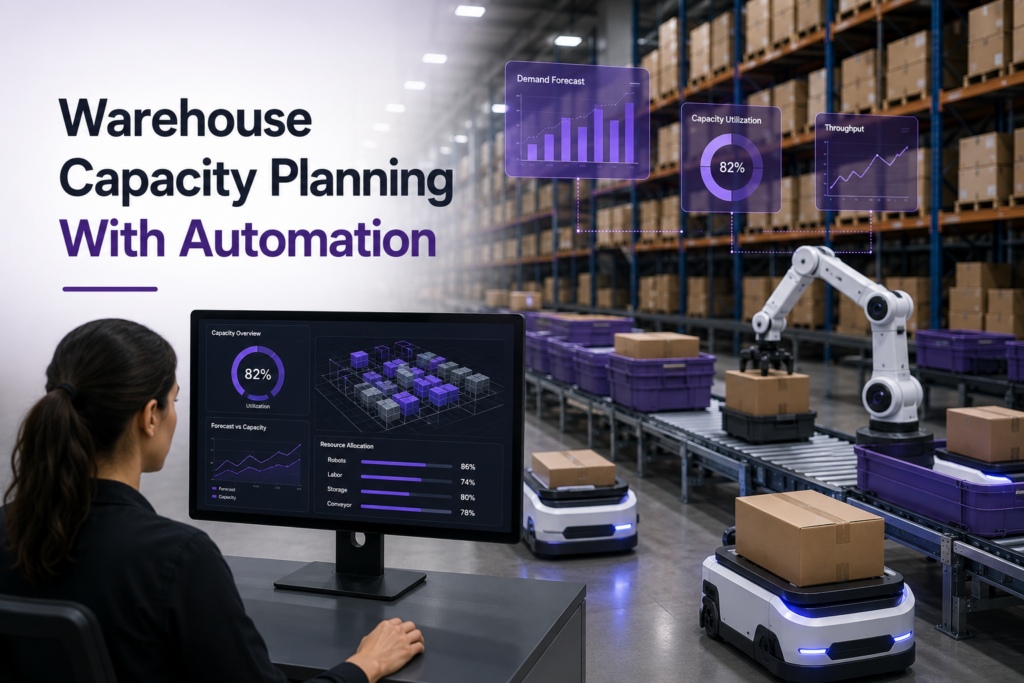
Warehouse capacity planning with automation helps businesses increase throughput, improve resource utilization, and prepare for demand growth without relying solely on facility expansion. As warehouses become more complex, capacity is no longer limited by storage space alone.
It depends on how inventory, labor, equipment, and workflows interact under changing demand conditions. Organizations that adopt data-driven warehouse automation capacity planning gain greater operational stability while avoiding costly bottlenecks.
In this blog, we explore why traditional capacity planning falls short, the hidden factors that limit warehouse capacity, and how automation enables smarter, scalable capacity decisions.
Why Traditional Capacity Planning Breaks as Warehouse Operations Scale
Traditional warehouse capacity planning becomes unreliable as operations grow because it assumes stable demand, predictable workflows, and fixed resource availability. Modern warehouses experience continuous fluctuations that require capacity decisions based on system-wide performance rather than static calculations.
Why Static Capacity Models Cannot Keep Pace With Demand Variability
Most capacity models are built using historical order volumes. While this approach may work in stable environments, it becomes less effective when promotions, seasonal demand, and customer expectations change frequently.
- Warehouse throughput rarely increases at the same pace as order volume.
- Even moderate increases in daily order volumes can create disproportionate congestion when multiple workflows compete for the same docks, storage aisles, and picking zones.
This makes warehouse throughput and capacity planning increasingly difficult because every disruption propagates across interconnected processes rather than remaining isolated.
How SKU Growth Creates Capacity Constraints Beyond Storage Space
As product catalogs expand, inventory becomes fragmented across additional storage locations. Pick paths become longer, replenishment frequency increases, and inventory balancing becomes more difficult. Two warehouses with identical storage capacity can experience vastly different throughput depending on SKU velocity distribution.
As SKU counts increase, inventory complexity places greater pressure on warehouse decision-making, replenishment, and storage allocation. Research on large-scale warehouse inventory management published in 2022 found that traditional inventory optimization approaches struggle to scale efficiently as the number of products and stocking locations increases, making AI-driven decision models increasingly valuable for complex warehouse operations.
Why Labor-Centric Capacity Planning Misses System-Wide Bottlenecks
In many facilities, labor productivity declines because workers spend more time waiting than processing orders. Order picking remains the largest operational cost driver, accounting for up to 55% of total warehouse operating costs, making travel inefficiencies and upstream bottlenecks major constraints on warehouse productivity.
Focusing only on labor creates several blind spots:
| Labor Metric | System-Level Reality |
| More workers | Equipment queues increase |
| Faster picking | Packing becomes overloaded |
| More replenishment | Storage congestion rises |
| Higher productivity | Dock capacity becomes the new bottleneck |
As warehouses scale, effective warehouse automation capacity planning requires understanding how every operational dependency influences total throughput rather than optimizing isolated activities.
The Hidden Constraints That Limit Warehouse Capacity
Warehouse capacity is usually constrained by workflow dependencies rather than physical space. Small delays across interconnected operations accumulate quickly, reducing throughput long before the facility reaches its theoretical capacity.
Flow Imbalances Across Inbound, Storage, Picking, and Dispatch
Warehouse operations function as a continuous flow network. When one stage processes work faster than the next, inventory begins accumulating between processes. Workflow synchronization has a direct impact on warehouse performance.
- Traditional order-picking methods: A 2024 study on dynamic warehouse operations found that under high order arrival rates, traditional order-picking methods fulfilled only 82% of orders.
- Dynamically coordinated operations: But dynamically coordinated operations increased fulfillment to approximately 98%, highlighting how poor workflow synchronization rapidly limits downstream performance.
Rather than viewing each department independently, warehouse space and capacity optimization require balancing the flow of inventory across every operational stage.
Resource Dependencies That Restrict Effective Capacity
Warehouse resources rarely operate independently. Equipment, labor, storage locations, transportation schedules, and inventory availability constantly influence one another. These dependencies reduce effective capacity even when individual resources appear underutilized.
Research published in 2023 found that warehouse traffic congestion can prevent automated systems from scaling efficiently. Under congested conditions, warehouses may require substantially more travel and coordination, limiting throughput long before equipment or labor reaches full utilization.
Why Localized Improvements Often Shift Congestion Instead of Eliminating It
In many cases, local optimization simply transfers congestion elsewhere.
- Increasing picking speed without expanding packing capacity creates larger queues downstream.
- Expanding receiving capacity without improving storage allocation increases internal travel.
- Adding automation to one workflow while adjacent processes remain manual introduces new synchronization challenges.
Effective warehouse automation for capacity optimization requires evaluating how improvements affect the entire warehouse system rather than measuring isolated productivity gains.
How Automation Changes Capacity Planning Beyond Labor Reduction
Warehouse automation improves capacity by optimizing warehouse flow, reducing operational variability, and removing constraints across interconnected processes. Rather than replacing labor, it enables businesses to increase throughput using existing resources more effectively.
Increasing Throughput Without Proportional Resource Expansion
Automation enables warehouses to process more orders without proportionally increasing labor or expanding facilities by reducing idle time, improving inventory movement, and minimizing workflow interruptions.
Research published in the Journal of Artificial Intelligence General Science in 2024 found that IoT-integrated inventory management systems improved inventory accuracy by 25-35%, reduced carrying costs by 20-30%, decreased stockout incidents by 35-45%, and improved demand forecasting accuracy by 40%. These improvements enable warehouses to utilize existing resources more efficiently before investing in additional capacity.
Balancing Equipment Utilization With Warehouse Flow
Automation delivers the greatest value when equipment operates as one coordinated system instead of isolated assets. Poor synchronization between conveyors, AMRs, storage systems, and sortation equipment reduces utilization across the warehouse.
Synkrato Simulation & Optimization allows teams to simulate AI-driven operational adjustments before implementation. Simulation helps answer questions such as:
- Which process becomes the next bottleneck?
- Will packing support faster picking rates?
- Can dock schedules handle higher outbound volume?
- Which automation investment delivers the greatest capacity gain?
This supports long-term warehouse space and capacity optimization by validating decisions before deployment.
Removing Operational Constraints That Cap Warehouse Capacity
Poor slotting, inconsistent replenishment, inventory imbalance, and delayed decisions continue to restrict throughput even after automation investments. But a balanced approach will include:
- Dynamic Slotting: Place high-demand SKUs closer to picking zones to reduce travel.
- Flow Simulation: Test workflow changes before implementation to balance operations.
- AI-Driven Scenario Analysis: Compare capacity scenarios to reduce execution risk.
- Inventory Positioning: Optimize SKU placement for faster replenishment and higher throughput.
Together, these capabilities strengthen warehouse automation for capacity optimization by removing constraints that prevent warehouses from fully utilizing existing resources.
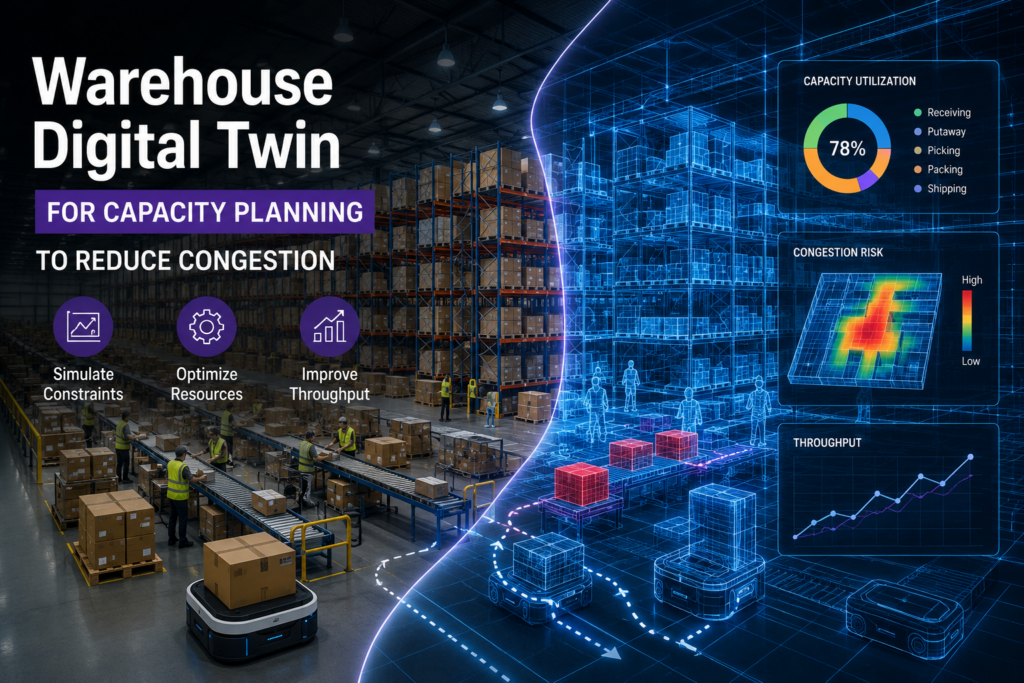
Instead of accelerating inefficient workflows, Synkrato Digital Twin enables businesses to evaluate how changes in inventory flow, equipment utilization, and warehouse layout affect overall capacity before implementation.
Why Capacity Decisions Require System-Level Performance Analysis
Warehouse capacity decisions should be based on how the entire operation performs under different demand conditions rather than on individual resource utilization. System-level analysis reveals hidden dependencies, evaluates operational risk, and supports sustainable capacity growth.
Evaluating Process Interdependencies Before Expanding Capacity
Warehouse processes are tightly connected, so improving one area without evaluating downstream effects can simply shift bottlenecks elsewhere. Synkrato AI Agents continuously analyze cross-functional workflows to identify dependencies, enabling more informed warehouse capacity analysis for automation before expansion decisions are made.
Identifying Capacity Risks Under Different Growth Scenarios
Demand rarely grows predictably, making scenario analysis essential for determining when and where automation delivers the highest operational value. Recent logistics research indicates that shifting from static forecasts to AI-driven scenario modeling reduces automated system downtime by 30% to 40%, allowing facilities to adapt dynamically to sudden market corrections.
Balancing Utilization, Flexibility, and Future Scalability
Running warehouse resources at maximum utilization increases congestion risk and reduces the ability to respond to demand fluctuations. Long-term warehouse capacity planning with automation should balance high utilization, operational flexibility, and scalable automation to support sustainable growth without repeated redesign.
Planning priorities should include:
| Planning Objective | Operational Outcome |
| High utilization | Lower idle capacity but higher congestion risk |
| Operational flexibility | Faster response to demand fluctuations |
| Scalable automation | Sustainable growth without repeated redesign |
This system-level approach transforms warehouse capacity planning with automation from a one-time infrastructure project into a continuous capability that supports long-term operational growth.
Operational Signals That Indicate Automation Is Required for Capacity Growth
Automation becomes necessary when operational improvements no longer deliver meaningful capacity gains. Persistent congestion, declining throughput, and resource saturation indicate structural limitations that require system-level changes rather than incremental process improvements.
Persistent Capacity Saturation Despite Process Improvements
Warehouses often reach a point where improvements in labor productivity or workflow redesign produce only marginal gains because the underlying capacity constraints remain unchanged. Common indicators include:
- Order backlogs despite stable staffing levels
- Dock congestion during normal operating hours
- Increasing overtime with little throughput improvement
- Growing replenishment delays affecting picking performance
According to a 2024 Gartner supply chain report, organizations experiencing sustained resource saturation typically require automation or process redesign to support further growth rather than additional manual interventions.
Demand Growth Outpacing Operational Performance
As order volumes increase, warehouse performance does not always scale proportionally.
- Growing Operational Complexity: More SKUs, higher-order complexity, and tighter delivery windows create greater operational pressure than simple volume increases suggest.
- Shrinking Capacity Buffers: As capacity buffers shrink, even minor operational disruptions can trigger congestion across receiving, picking, packing, and shipping workflows.
When warehouse throughput consistently grows more slowly than customer demand, automation becomes a strategic investment instead of an efficiency initiative.
Indicators That Existing Warehouse Infrastructure Has Reached Its Limits
Infrastructure constraints often emerge as recurring operational delays rather than a single failure. When congestion, longer travel paths, slower order processing, and rising labor effort become persistent despite process improvements, it signals that existing capacity has reached its limit. Synkrato Enterprise Mobility helps remove the guesswork by simulating and optimizing AI-driven operational adjustments before they impact warehouse performance.
Power Warehouse Capacity Planning With Synkrato
Warehouse growth depends on understanding how people, inventory, equipment, and workflows perform as one connected system. Organizations that combine automation with system-level analysis are better positioned to improve throughput, optimize capacity, and support future demand without unnecessary capital expansion. Synkrato helps businesses make faster, data-driven capacity decisions with confidence.
Book a demo now with Synkrato to evaluate automation strategies, validate operational decisions, and remove hidden constraints before they affect performance.
FAQs
How does Synkrato support warehouse capacity planning with automation?
Synkrato’s Digital Twin platform enables businesses to simulate warehouse operations before implementing changes. It evaluates different capacity scenarios, identifies operational bottlenecks, and helps decision-makers understand how automation investments affect throughput, utilization, and long-term scalability.
How can automation improve warehouse capacity without expanding the facility footprint?
Automation increases capacity by improving inventory flow, reducing travel time, balancing workloads, and minimizing operational delays. Better process coordination allows warehouses to process more orders using existing resources instead of relying solely on additional storage or labor.
Can Synkrato identify warehouse capacity constraints before they impact operations?
Yes. Synkrato’s AI Agents platform continuously analyzes warehouse data to identify emerging bottlenecks, workflow dependencies, and resource constraints. This allows operations teams to address issues proactively before they affect throughput or customer service levels.
How does demand variability influence warehouse capacity planning decisions?
Demand variability changes workload distribution across receiving, storage, picking, and shipping. Capacity planning should evaluate multiple demand scenarios rather than relying on historical averages, ensuring the warehouse remains resilient during seasonal peaks and unexpected market shifts.
How does Synkrato help businesses evaluate automation strategies for long-term warehouse capacity planning?
Synkrato’s Simulation & Optimization allows organizations to compare automation scenarios before making capital investments. By testing different layouts, workflows, and resource allocations, businesses can select strategies that improve throughput while reducing implementation risk.
How can businesses distinguish between temporary capacity shortages and structural capacity limitations?
Temporary shortages usually occur during seasonal demand peaks and improve once demand stabilizes. Structural limitations persist despite workflow improvements and staffing adjustments. Synkrato AI Slotting Recommendations can help identify whether recurring congestion is caused by inventory positioning, workflow design, or fundamental capacity constraints.