
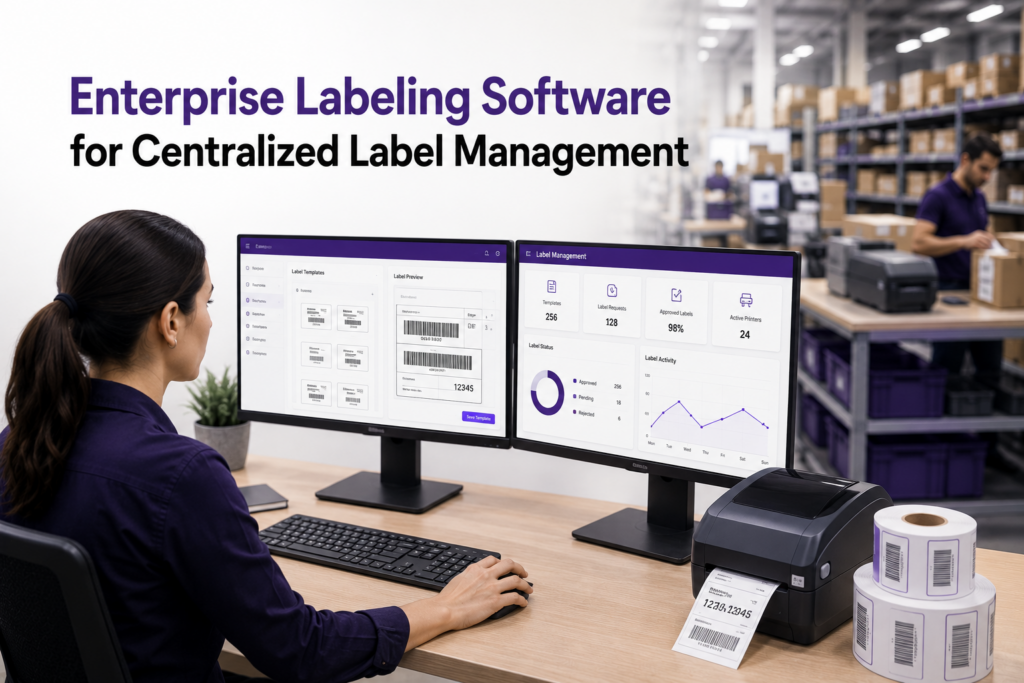
Enterprise labeling software for centralized label management to ensure accuracy helps organizations eliminate inconsistent labels by establishing a single source of truth for templates, business rules, and print execution. It improves accuracy, strengthens compliance, and standardizes labeling across facilities.
As enterprises scale, centralized governance also simplifies change management and reduces operational risk across distributed environments.
In this blog, we cover the causes of label inaccuracies, how centralized label management improves accuracy, and the governance models that sustain long-term labeling performance.
Why Label Accuracy Breaks in Decentralized Enterprise Environments
Label accuracy breaks when facilities create, modify, and execute labels independently. Different systems, local governance practices, and disconnected data sources introduce inconsistencies that eventually spread across the enterprise.
Disconnected Label Data Causing Version Control Errors
Enterprise environments typically depend on ERP systems, warehouse management systems, manufacturing systems, and product information databases. Each system generates and consumes label-related data. When facilities make independent updates and maintain local templates, version control becomes fragmented.
A packaging update may be implemented at one site while another location continues using an older label version. Product descriptions, barcodes, lot information, and customer instructions gradually become inconsistent.
Organizations experience:
- Product traceability issues
- Inventory discrepancies
- Customer chargebacks
- Delayed shipments
- Increased rework costs
A 2024 study on real-time supply chain analytics found that organizations operating with fragmented systems suffer from poor visibility and delayed decisions. Siloed data governance and disconnected information flows can leave organizations operating with up to 45% lower efficiency, 38% longer lead times, and 35% weaker responsiveness compared with enterprises that implement integrated information systems.
Manual Label Changes Increasing Compliance Risk
Manual updates introduce risk because every modification creates another opportunity for inconsistency. Industries such as pharmaceuticals, food manufacturing, and chemicals continuously update regulatory requirements and product declarations. When changes are managed locally, there is no guarantee that every facility adopts the same version simultaneously. A small modification can quickly become a major compliance issue. Common failure scenarios include:
- Incorrect ingredient declarations: Missing or inaccurate ingredient information can lead to regulatory violations, product recalls, and consumer safety concerns.
- Invalid hazard information: Incorrect hazard labels may result in non-compliance with safety regulations and increase operational and legal risks.
- Outdated customer-specific labels: Using old customer requirements can cause shipment rejections, chargebacks, and damaged business relationships.
- Missing regulatory requirements: Omitting mandatory declarations, symbols, or compliance information can trigger product holds, penalties, and audit findings.
A 2024 study on data integrity and electronic data capture found that manual processes remain highly vulnerable to transcription errors, inconsistent updates, and delayed issue detection, increasing compliance and operational risks in complex environments.
Cross-System Synchronization Gaps Driving Label Inconsistency
Most enterprises operate within highly interconnected environments. However, these changes rarely synchronize across every system in real time. Delayed updates create information mismatches between operational platforms. Small data discrepancies can quickly propagate into labeling errors and execution delays.
Why Legacy Label Governance Creates Structural Accuracy Failures
Legacy label governance models create structural weaknesses as they depend on static logic, fragmented ownership, and uncontrolled execution processes. These limitations become increasingly visible as organizations expand product portfolios and operational complexity.
Static Label Logic Failing Under Dynamic Data Conditions
Modern enterprises operate in highly dynamic environments. Static label environments struggle to keep pace with this level of volatility. Legacy systems often rely on hard-coded templates and manually maintained business rules that were originally designed for relatively stable environments.
According to McKinsey’s research on AI-driven operations forecasting, static and inflexible operating models can contribute to 20% to 50% higher forecasting errors, 20% to 30% higher inventory levels, and administrative costs up to 40% greater than those achieved through adaptive operational systems. Static label governance faces similar limitations as complexity increases.
Distributed Rule Ownership Increasing Error Propagation
Many enterprises divide labeling responsibilities across multiple departments. Operations teams manage shipping labels. This creates duplicate logic, conflicting requirements, and inconsistent template management. The consequences include:
| Operational Impact | Business Outcome |
| Duplicate templates | Higher exception rates |
| Conflicting rules | Slower approvals |
| Local modifications | Greater compliance risk |
| Inconsistent governance | Increased rework costs |
Uncontrolled Print Execution Introducing Accuracy Risks
Print execution is often treated as an operational afterthought. In reality, it represents the final control point before labels enter production and distribution processes. Without centralized governance:
- Unauthorized templates may be selected
- Obsolete versions may remain active
- Incorrect data may be printed
- Errors can spread across multiple facilities
A recent study on AI-driven warehouse optimization and operational efficiency found that organizations operating without intelligent and integrated frameworks can experience 15% to 45% longer cycle times, 20% to 35% lower space utilization, and execution accuracy below 98%, illustrating the operational cost of fragmented execution environments and disconnected governance.
Why Centralized Label Management Improves Accuracy Control
Centralized label management software for accuracy improves consistency by establishing a single source of truth for templates, business rules, and approval workflows. Centralized label management improves accuracy by reducing execution variability and strengthening governance across every facility.
Standardized Rules Improving Label Output Consistency
Research from McKinsey’s work on AI-enabled supply chains found that organizations implementing digitally integrated operations have achieved:
- Up to 15% lower logistics costs
- Up to 35% lower inventory levels
- Up to 65% higher service levels
Standardized governance directly supports these outcomes by reducing inconsistencies that slow operations and create unnecessary rework. Key improvements include:
- Higher first-pass labeling accuracy
- Lower label exception rates
- Lower reprint percentages
- Faster change deployment time
Validation Controls Preventing Labeling Exceptions
Label management software should validate information before labels are generated. As operational complexity grows, organizations need intelligent decision frameworks that can identify dependencies before execution occurs.
Controlled Change Management Reducing Accuracy Drift
Labels continuously evolve. New products enter the portfolio. Suppliers change. Regulations are updated. Customer requirements become more complex. Without governance controls, organizations experience gradual accuracy drift. This is where label management software for compliance and standardization becomes essential.
Controlled change management introduces structured approval workflows, version controls, and deployment governance. Synkrato’s Enterprise Labeling helps organizations centralize label templates, automate approval workflows, and control label deployment across facilities and enterprise systems.
This reduces version inconsistencies, maintains labeling accuracy, and ensures approved changes are implemented consistently throughout the organization.
Why Distributed Label Execution Creates Hidden Operational Risks
Distributed label execution creates hidden risks because printing decisions, exception management, and performance visibility become fragmented across facilities. Errors are often detected only after they have affected shipments or customers.
Fragmented Print Decisions Delaying Error Detection
Warehouses, manufacturing sites, and distribution centers often print labels independently using local systems and processes. While this approach appears flexible, it creates information silos that delay problem identification. A typical failure sequence looks like this:
Local label modification → Incorrect print execution → Product shipment → Customer rejection → Investigation and rework.
According to McKinsey’s research on distribution operations and automation, organizations implementing intelligent operational monitoring have achieved up to 20% faster response times and substantial improvements in execution visibility. The earlier organizations detect labeling issues, the lower the cost of correction.
Exception Handling Gaps Increasing High-Risk Label Failures
Exception management processes often vary by location. Some facilities perform multiple validation checks. Others depend heavily on operator experience and local procedures. This inconsistency creates high-risk failure scenarios. Common labeling failures include:
- Incorrect lot information
- Invalid product identifiers
- Missing compliance declarations
- Incorrect customer instructions
- Outdated packaging information
A labeling issue that escapes one facility can affect inventory records, transportation planning, customer compliance, and product traceability simultaneously.
Limited Visibility Across Sites Weakening Accuracy Control
Executives need enterprise-wide visibility into labeling performance because isolated performance data makes it difficult to identify emerging issues and prioritize corrective actions. Limited visibility delays decision-making, extends issue resolution times, and allows localized labeling problems to propagate across multiple facilities before they are detected.
Why Long-Term Label Accuracy Depends on System Governance
Long-term label accuracy depends on system governance because labels rely on data, approvals, and changes that originate across multiple enterprise systems. Without integrated workflows, controlled change management, and continuous performance monitoring, inconsistencies gradually accumulate and increase the risk of labeling errors.
Integration Across Enterprise Data and Print Systems
Labels depend on information originating from multiple enterprise systems. ERP platforms manage product information. WMS applications control inventory data. Manufacturing systems track production activities. Product information systems maintain specifications and attributes. When these environments operate independently, data discrepancies emerge.
Governance Models Supporting Controlled Label Lifecycles
High-performing organizations treat labels as governed enterprise assets. Their governance frameworks generally operate through three stages.
- Stage One: Standardization: Templates, business rules, and approval requirements are centrally defined.
- Stage Two: Validation: Every modification undergoes structured reviews and authorization processes.
- Stage Three: Controlled Deployment: Approved changes are implemented consistently across facilities. This approach improves:
- Accountability
- Traceability
- Audit readiness
- Change management efficiency
- Operational stability
Synkrato Enterprise Mobility strengthens this governance model by providing real-time visibility and enabling faster approval and exception management workflows across enterprise operations.
Audit Intelligence Sustaining Accuracy Performance
Long-term accuracy requires continuous monitoring of performance indicators.
- First-pass labeling accuracy: Measures labeling reliability.
- Label exception rate: Reveals governance gaps.
- Reprint percentage: Indicates process efficiency.
- Compliance incidents: Measures regulatory risk.
- Data synchronization accuracy: Reflects data integrity.
- Template change cycle time: Measures governance agility.
The Synkrato Digital Twin Platform helps establish this intelligence layer by visualizing workflow dependencies, surfacing emerging bottlenecks, and enabling data-driven governance decisions across labeling operations.
Build Sustainable Label Accuracy Through Governance With Synkrato
Labeling failures usually indicate deeper problems involving fragmented data, disconnected systems, and uncontrolled execution processes. Organizations that implement enterprise labeling software for centralized label management to ensure accuracy create stronger operational resilience, improve compliance performance, and reduce execution variability across facilities.
Book a demo with Synkrato to continuously evaluate process dependencies, validate changes before deployment, and sustain long-term label accuracy across complex operational environments.
FAQs
What is enterprise labeling software?
Enterprise labeling software is a centralized solution that enables organizations to design, manage, and print labels consistently across multiple locations, departments, and production facilities. It helps ensure label accuracy, regulatory compliance, and seamless integration with systems such as ERP and WMS.
How does centralized label management improve accuracy?
Centralized label management improves accuracy in warehouses by ensuring all users access approved, up-to-date label templates and data from a single source. It minimizes manual errors, prevents outdated labels, maintains consistency across locations, and integrates with warehouse systems to support accurate inventory tracking and shipping.
What causes label accuracy errors in enterprise environments?
Label accuracy errors are often caused by manual data entry, outdated label templates, inconsistent processes across locations, disconnected business systems, and insufficient version control. These issues can result in incorrect product information, shipping mistakes, compliance violations, and costly operational delays.
How is centralized labeling different from legacy labeling systems?
Centralized labeling stores templates, data, and controls in one system, ensuring consistent labels across all warehouse locations. Legacy labeling systems often rely on local files and manual updates, increasing the risk of outdated templates, inconsistent labeling, errors, and compliance issues. Synkrato’s enterprise labeling solution centralizes label management, helping warehouses maintain accuracy, streamline updates, and ensure consistent labeling across distributed operations.
Can enterprise labeling software reduce compliance risk?
Yes. Enterprise labeling software reduces compliance risk by enforcing approved templates, automating validation controls, maintaining audit trails, and implementing structured change management processes that minimize labeling inconsistencies across facilities and business units.
What systems should integrate with labeling software?
Enterprise labeling software should integrate with ERP, WMS, and transportation management systems (TMS) to automatically retrieve accurate data for label printing. Synkrato’s enterprise labeling solution supports seamless integration, enabling consistent, real-time labeling across warehouse and supply chain operations.
What KPIs measure label accuracy performance?
Key KPIs for measuring label accuracy include label error rate, first-pass print accuracy, reprint frequency, order fulfillment accuracy, shipping error rate, compliance violations, and inventory accuracy. These metrics help organizations evaluate labeling performance, reduce operational errors, and improve warehouse efficiency.
Can centralized labeling reduce rework and mislabeling costs?
Yes. Centralized label management software for accuracy reduces mislabeling incidents, improves compliance performance, minimizes reprints, and lowers operational rework costs by establishing standardized and governed labeling processes across enterprise environments and distributed operations.