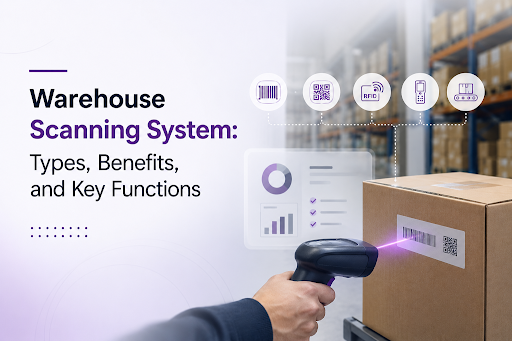
A warehouse scanning system helps warehouses track products, storage locations, inventory movement, and order activity in real time. It captures data during receiving, putaway, picking, packing, shipping, replenishment, and cycle counting, so physical warehouse activity stays aligned with digital inventory records.
Modern warehouse scanning systems now go beyond handheld barcode scanners. They include 1D barcodes, 2D barcodes, QR codes, RFID, mobile computers, wearable devices, and fixed scanning stations. These tools help warehouses reduce manual entry, verify item movement, improve inventory accuracy, and create a clearer view of what is happening across the facility.
This blog covers types of warehouse scanning systems, their benefits, key inventory functions, and factors to consider when choosing a solution.
Types of Warehouse Scanning System
Warehouse scanning systems use different technologies to track inventory, confirm product movement, and improve operational visibility. Various types of warehouse scanning systems include:
1. Barcode Scanning
Most warehouses still use 1D barcodes because they are cost-effective, easy to print, and compatible with WMS, ERP, supplier, and carrier systems. They work well for SKU identification, pallet tracking, and location labeling. However, because 1D barcodes hold limited information, warehouses managing lot tracking, expiry dates, serial numbers, or regulated inventory often add 2D barcode capabilities alongside traditional barcode scanning.
Key functions of barcode scanning include:
- Confirming inbound inventory during receiving
- Linking products to storage locations during putaway
- Verifying the correct SKU during picking
- Confirming cartons and pallets before shipping
- Supporting inventory counts and replenishment workflows
Suggested Read: What is a Warehouse Management System
2. QR Codes
QR codes are advanced 2D barcodes that store more information than traditional barcodes. A single scan can identify the item while also connecting employees to maintenance guides, inspection records, warranty details, or workflow instructions. This helps warehouses improve execution speed and information access without relying on separate manual searches.
Warehouses use QR codes for:
- Batch, lot, and expiry tracking
- Asset identification and maintenance records
- Return and inspection workflows
- Digital document access
3. Radio Frequency Identification (RFID)
RFID uses radio waves to identify and track tagged inventory without requiring direct line-of-sight scanning. Unlike traditional barcode scanning, RFID systems can detect multiple tagged items at the same time.
Warehouses commonly use RFID for:
- High-speed inventory counting
- Apparel and item-level tracking
- Pallet and tote visibility
- Automated dock door monitoring
- Returnable asset management
UPS is one example of RFID scaling beyond manual scanning. In 2026, UPS announced more than $100 million in RFID investments across its U.S. package network, including facilities, vehicles, and packages moving through over 5,500 UPS store locations.
Suggested Read: How to Choose a Wms System
4. Mobile Scanning
Mobile scanning uses handheld computers, rugged tablets, and scanning-enabled mobile devices to capture warehouse data directly at the point of work. Instead of relying on paper instructions or employee memory, the system directs the next task, validates each scan, and confirms inventory movement in real time.
Common mobile scanning functions include:
- Receiving and inventory check-in
- Putaway and location confirmation
- Picking and order verification
- Replenishment tasks
- Cycle counting and audits
5. Wearable Devices
Common wearable technologies include ring scanners, wrist-mounted computers, smart glasses, and voice-directed picking systems connected to barcode or RFID scanning. Wearables can also improve ergonomics and worker efficiency when designed correctly. These devices are commonly used for:
- Sortation workflows
- Replenishment tasks
- Pack-out operations
- Tote-to-order verification
- Item-to-bin confirmation
- Carton-to-pallet validation
Suggested Read: Future of Warehouse Management System
6. Fixed Scanning Stations
Fixed scanning stations automatically capture inventory movement at designated warehouse checkpoints. These systems use mounted barcode scanners, RFID portals, machine vision cameras, and conveyor tunnel scanners.
This type of scanning works best in repeatable workflows with stable movement patterns. While these systems are less flexible than handheld mobile scanning, they are highly effective for high-volume operations.
Common fixed scanning station use cases include:
- Inbound receiving doors
- Conveyor and sortation systems
- Packing stations
- Pallet wrapping areas
- Dock door verification
- Outbound shipping lanes
- RFID portal checkpoints
- Automated carton tracking
Benefits of Warehouse Scanning System
Warehouse scanning systems improve inventory accuracy, operational visibility, fulfillment speed, labor efficiency, and real-time warehouse decision-making across every stage of inventory movement.
- Accuracy and Reduced Errors: Warehouse scanning systems record every inventory transaction with user, location, time, and workflow details, improving traceability, reducing manual errors, and helping teams quickly identify and resolve operational issues.
- Speed and Productivity: By removing manual data entry, scanning accelerates receiving, picking, packing, replenishment, shipping, and counting while directing workers to the highest-priority tasks for greater productivity.
- Real-Time Visibility: Every inventory movement updates instantly, giving managers live insight into stock availability, order progress, storage utilization, replenishment needs, outbound readiness, and operational bottlenecks.
- Cost Savings: Scanning prevents picking and shipping mistakes before orders leave the warehouse, reducing returns, replacement shipments, customer service costs, inventory adjustments, and shipment disputes through accurate verification.
- Scalability: Standardized scanning workflows support growing SKU counts, warehouse locations, order volumes, and fulfillment channels, enabling consistent inventory control without proportionally increasing operational complexity or errors.
- Integration with ERP and Supply Chain Systems: Warehouse scanning synchronizes physical inventory movements with ERP and supply chain systems, reducing data delays and enabling faster, coordinated decisions across procurement, fulfillment, transportation, and customer service.
- Optimized Space and Labor: Movement data from scanning improves slotting, labor allocation, replenishment timing, travel paths, forward-pick sizing, and dock scheduling, increasing warehouse efficiency while maximizing available storage space and workforce productivity.
Synkrato unifies warehouse scanning data across inventory, labor, automation, and operational workflows to support faster and more connected warehouse decision-making.
Suggested Read: Wms vs Wes vs Wcs
Key Functions of Warehouse Scanning Systems in Inventory Management
Warehouse scanning systems support inventory control by validating inventory movement, location accuracy, order activity, and operational status in real time across the warehouse network. Key functions of warehouse scanning systems include:
Receiving and Check-In
As inbound inventory arrives, workers scan cartons, pallets, labels, serial numbers, lot numbers, or ASNs to confirm that physical inventory matches purchase orders, supplier shipments, transfer orders, or return authorizations. This process helps warehouses validate inventory before it enters active storage or fulfillment workflows.
Receiving scan workflows support:
- ASN and purchase order validation
- Lot, serial number, and expiry verification
- Supplier compliance checks
- Damage and shortage reporting
- Real-time inventory availability updates
Putaway and Location Assignment
Putaway scanning helps warehouses maintain accurate location-level inventory visibility after receiving is complete. Workers scan both the inventory and destination location to confirm where products are physically stored, whether in racks, bins, pallet positions, cold storage zones, flow lanes, or bulk storage areas.
Advanced putaway scanning supports:
- Directed storage recommendations
- High-density inventory tracking
- Dynamic slotting strategies
- FIFO and FEFO inventory rotation
- Multi-zone storage validation
- Real-time location updates
Picking and Order Fulfillment
Picking scans help warehouses verify that the correct inventory is selected before orders move into packing and shipping workflows. It also supports multiple picking methodologies, including batch picking, wave picking, zone picking, cluster picking, and goods-to-person automation workflows.
Scanning supports fulfillment operations through:
- SKU and location validation
- Batch and wave picking workflows
- Tote and carton confirmation
- Lot and serial number verification
- High-value inventory tracking
- Real-time order progress visibility
- Reduced mispick prevention
Cycle Counts and Audits
Businesses can continuously audit inventory through scheduled cycle count tasks across selected SKUs, storage zones, or locations. It improves audit reliability by reducing manual counting errors and capturing variance data directly inside the warehouse system.
Cycle count scanning helps warehouses:
- Reduce full physical inventory dependency
- Improve inventory audit accuracy
- Capture and investigate variances faster
- Support perpetual inventory strategies
Suggested Read: Types of Warehouse Management Systems
Restock and Replenishment
Replenishment scanning helps warehouses maintain inventory availability within forward picking locations. This process becomes important in high-velocity fulfillment environments where depleted pick faces can slow order processing and create labor inefficiencies.
Replenishment scan workflows commonly support:
- Forward-pick replenishment validation
- Reserve inventory tracking
- Dynamic min-max replenishment logic
- Pick-face availability monitoring
- Slotting optimization analysis
- Priority replenishment execution
Shipping and Outbound
Outbound scanning validates the final movement of inventory before goods leave the warehouse. It synchronizes outbound operations with transportation and customer-facing systems. Once the shipment is validated, carrier systems, order management platforms, and customer tracking tools can update shipment status automatically.
Outbound scanning workflows help support:
- Shipment verification
- Dock and trailer validation
- Carrier and route confirmation
- Packing accuracy checks
- Pallet and carton tracking
- Customer shipment visibility
- Reduced outbound shipping errors
Transfers and Movements Within the Warehouse
Internal transfer scanning maintains visibility when inventory moves between storage locations, workstations, quality zones, production areas, staging lanes, cross-dock areas, or separate warehouse facilities.
Transfer scanning helps with:
- Inter-zone inventory movement
- Quality hold and inspection workflows
- Cross-docking operations
- Returns and repacking workflows
Factors for Picking a Warehouse Scanning System
While choosing a warehouse scanning system, it must support warehouse workflows, operational complexity, environmental conditions, inventory requirements, integration architecture, and future scalability.
Integration with Other Software
Warehouse scanning systems should integrate directly with WMS, ERP, transportation, supplier, fulfillment, and automation platforms. That way, inventory activity updates operational systems in real time instead of requiring manual reconciliation.
Key integration capabilities include:
- Real-time inventory synchronization across receiving, putaway, replenishment, picking, packing, and shipping workflows.
- Automated updates for purchase orders, shipment confirmation, inventory availability, and order status.
- Support for warehouse automation systems such as conveyors, AS/RS, sortation, robotics, and RFID portals.
- Compatibility with GS1 standards, 1D and 2D barcodes, QR codes, DataMatrix labels, SSCC pallet labels, serial numbers, and lot tracking.
For this, Synkrato connects warehouse scanning data with inventory visibility, automation workflows, labor activity, and warehouse decision-making across the supply chain.
Suggested Read: Warehouse Management Software in 2026
Connectivity and Requirements
Warehouse scanning performance depends on connectivity stability, environmental conditions, and device reliability across operational workflows.
Important infrastructure and hardware considerations include:
- Wi-Fi coverage across aisles, racks, dock areas, mezzanines, conveyors, freezer zones, and outdoor yards.
- Roaming stability and offline scanning support for uninterrupted warehouse execution.
- Rugged hardware for drops, vibration, dust, moisture, freezer conditions, and high-traffic environments.
- Long battery life and fast charging support for multi-shift warehouse operations.
- Glove-compatible screens, wearable devices, vehicle mounts, and hands-free scanning support.
Customer Service
Vendor support directly affects warehouse uptime because scanning systems operate inside critical inventory, fulfillment, and shipping workflows.
Warehouses should evaluate support capabilities such as:
- Device replacement and spare part availability
- Firmware updates and scanner configuration support
- Battery replacement programs and charging management
- Label testing and barcode validation assistance
- Integration troubleshooting across WMS, ERP, and automation systems
- Peak-season response times and emergency technical support
Synkrato for Smarter Warehouse Scanning Operations
Modern warehouse scanning generates real-time operational data across inventory movement, fulfillment workflows, labor activity, and warehouse automation. Synkrato connects this scanning data with warehouse visibility, operational workflows, and AI-driven decision-making to support more efficient warehouse operations.
It helps warehouses:
- Improve real-time visibility across inventory movement and fulfillment activity.
- Connect warehouse barcode scanning system, RFID, WMS, ERP, and automation workflows.
- Optimize slotting, replenishment, storage utilization, and labor planning.
- Identify bottlenecks, delays, and inventory exceptions faster through operational insights and Digital Twin simulation.
Book an appointment with Synkrato to see how connected warehouse intelligence can improve warehouse scanning and operational visibility.
Suggested Read: Warehouse Barcode Systems
Conclusion
The most effective warehouse scanning strategy rarely depends on a single technology. Instead, warehouses often combine barcode scanning, QR codes, RFID, mobile devices, wearables, and fixed scanning stations based on fulfillment volume, inventory complexity, and operational requirements.
As warehouse operations become more automated and data-driven, real-time visibility is becoming increasingly important across the supply chain. In response, Synkrato turns warehouse scanning data into connected operational insights and real-time warehouse intelligence.
FAQs
What are warehouse scanning systems?
Warehouse scanning systems are technologies that help warehouses track inventory, locations, pallets, cartons, and shipments using barcodes, QR codes, RFID tags, and mobile scanning devices. They create real-time digital records for receiving, putaway, picking, replenishment, packing, shipping, and inventory counting workflows.
Why are scanning systems important in warehouse operations?
Scanning systems improve inventory accuracy, fulfillment speed, and operational visibility by validating inventory movement in real time. With Synkrato, warehouses can also connect scanning activity with broader inventory, labor, and fulfillment workflows for more coordinated operations.
What types of scanning technologies are commonly used in warehouses?
Warehouses commonly use barcode scanners, QR codes, RFID systems, handheld mobile computers, wearable scanning devices, and fixed scanning stations, depending on operational requirements. Synkrato supports operational visibility across these technologies by linking scanning activity with warehouse workflows and automation systems.
What challenges can affect warehouse scanning system performance?
Warehouse scanning performance can be affected by weak Wi-Fi coverage, poor label quality, damaged barcodes, RFID interference, environmental conditions, device downtime, and disconnected system integration. Synkrato’s operational intelligence platform can help warehouses identify workflow bottlenecks and scan inefficiencies faster.
How can Synkrato help businesses optimize warehouse scanning system operations?
Synkrato connects warehouse scanning data with inventory visibility, labor activity, automation workflows, and operational planning. This allows warehouses to improve exception handling, monitor warehouse activity in real time, and support faster operational decisions.
Why do warehouses still experience inventory inaccuracies despite using scanning systems without platforms like Synkrato?
Scanning systems may capture inventory movement, but disconnected workflows, delayed updates, weak exception handling, and siloed operational data can still create inventory inaccuracies. By creating connected visibility across warehouse operations, Synkrato supports better coordination between inventory, replenishment, fulfillment, and warehouse execution workflows.
What operational improvements can Synkrato support alongside warehouse scanning systems?
Alongside warehouse scanning systems, Synkrato can support slotting optimization, replenishment planning, labor coordination, workflow monitoring, and operational bottleneck analysis. This helps warehouses improve fulfillment efficiency and maintain more connected warehouse operations.