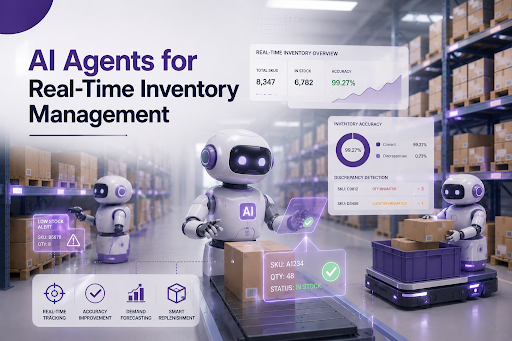
AI agents improve real-time inventory management by continuously monitoring stock movement, replenishment signals, demand shifts, and warehouse transactions as they happen. This helps teams detect inventory inaccuracies earlier, before mismatched records turn into stockouts, excess inventory, allocation errors, or fulfillment delays.
For warehouses exploring AI agents to improve inventory accuracy, the goal is not simply to count inventory more frequently. Instead, it is to interpret and act on real-time inventory signals across WMS, ERP, supplier, transportation, and fulfillment systems. By connecting data sources and making real-time decisions, AI agents can help improve inventory accuracy by identifying discrepancies earlier and supporting faster corrective actions.
This blog explores why inventory accuracy breaks down, how AI agents improve inventory control, and where agent-led inventory management delivers the most operational value.
Why Inventory Accuracy Problems Often Start With Signal Distortion
For many complex warehouses, inventory accuracy challenges increasingly stem from data synchronization, visibility, and signal reliability issues rather than physical counting errors alone. As inventory data moves across WMS platforms and other operational tools, delays, inconsistencies, and synchronization gaps can create a distorted view of inventory availability.
How Data Variability Creates Hidden Inventory Mismatches
Inventory decisions depend on data from multiple sources, each operating with different update frequencies and reliability levels. As these differences accumulate, organizations can experience replenishment errors or inventory drift despite having accurate records in individual systems. Gartner estimates poor data quality costs organizations an average of $12.9 million annually, highlighting the operational impact of unreliable inventory signals.
Suggested Read: AI Agents for High Volume Warehouses to Improve Efficiency
Why Timing Gaps Distort Inventory Accuracy Outcomes
Inventory conditions often change faster than reporting cycles. Timing gaps emerge when physical inventory movement happens before systems reflect the change, creating risk across:
- Supplier delays: Replenishment plans continue using expected arrival dates even when inbound stock is late.
- Demand spikes: Available-to-promise logic may overcommit inventory before updated demand signals are processed.
- Inventory transfers: Stock may appear available at one node while it is already in transit.
- Fulfillment activity: Picking, packing, and shipment events can reduce physical stock before system records update.
How Inconsistent Signals Weaken Stock Reliability
When forecasts, supplier updates, warehouse transactions, and transportation data point to different inventory conditions, confidence in stock availability declines. According to McKinsey, advanced inventory optimization programs can reduce inventory levels by 20-30% while maintaining service performance, demonstrating the value of improving inventory signal quality before discrepancies affect operations.
Synkrato AI Agents help strengthen inventory signal reliability by continuously evaluating stock movement, replenishment patterns, supplier variability, and fulfillment activity across connected warehouse systems.
Why Traditional Inventory Controls Often Misread Accuracy Drivers
Traditional inventory controls were designed to validate inventory records, not to continuously evaluate inventory risk. As inventory networks become more dynamic, periodic reviews often struggle to explain why accuracy deteriorates between audits.
Static Reconciliation Logic Failing Under Real-Time Conditions
Cycle counts, inventory audits, and fixed reorder points provide periodic visibility, but inventory conditions change continuously. Between review cycles, organizations can experience:
- Supplier variability that alters replenishment timing.
- Demand shifts that change inventory consumption patterns.
- Multi-site inventory drift that creates conflicting stock positions.
As a result, inventory inaccuracies often emerge long before traditional controls detect them.
Suggested Read: AI Agents for 3pl Logistics to Optimize Fulfillment Accuracy
Accuracy Risks That Conventional Controls Often Overlook
Many inventory risks develop gradually rather than appearing as immediate exceptions.
Common examples include:
- Inventory imbalances across facilities
- Growing replenishment delays
- Recurring SKU shortages
- Declining forecast reliability
Because traditional controls rely on thresholds and scheduled reviews, these conditions may remain invisible until they affect service levels or inventory costs. This is why many organizations are adopting AI agents for inventory accuracy improvement to identify risk patterns earlier.
Why Exception Handling Alone Often Leaves Root Causes Unresolved
Resolving exceptions does not always explain why they occurred. Repeated stockouts, for example, may result from supplier variability, allocation decisions, or replenishment latency rather than inventory availability itself.
To address this, organizations increasingly use intelligent agents for automated inventory management to continuously evaluate inventory signals, supplier performance, demand behavior, and inventory movement patterns.
Synkrato Digital Twin helps identify root causes, test inventory scenarios, and address emerging risks before they affect inventory accuracy or operational performance.
Agent-Led Interpretation of Inventory Risk Conditions
Instead of waiting for inventory discrepancies to appear, AI Agents identify operating conditions that increase the probability of stockouts, inventory drift, allocation errors, or replenishment instability.
Suggested Read: AI Agents for Ecommerce Warehouses to Improve Operational Decision-making
Continuous Signal Analysis Supporting Better Inventory Decisions
Modern inventory networks generate thousands of inventory-related events daily. The difficulty is not collecting data but determining which signals indicate meaningful inventory risk.
AI agents continuously evaluate:
| Signal Category | Inventory Accuracy Risk |
| Lead-time variability | Replenishment instability |
| Inventory transfers | Inventory synchronization gaps |
| Demand velocity shifts | Allocation errors |
| Supplier performance changes | Stock availability risk |
| Fulfillment exceptions | Inventory drift indicators |
Rather than responding to every inventory event equally, AI agents for inventory management automation help prioritize the conditions most likely to affect inventory accuracy.
Pattern Recognition Influencing Inventory Accuracy Stability
Many inventory accuracy issues follow recurring operational patterns long before they appear in inventory reports.
Examples include:
- Supplier variability clusters where the same suppliers repeatedly create replenishment instability.
- SKU concentration patterns where inventory accumulates in locations with declining demand.
- Transfer dependency cycles where facilities become increasingly reliant on inter-site inventory movement.
- Replenishment degradation trends where replenishment performance gradually weakens without triggering immediate alerts.
These patterns are difficult to identify through manual monitoring because each event appears isolated. Intelligent agents for automated inventory management can connect these events and reveal emerging inventory risks earlier.
Risk Conditions Revealed Through Agent-Based Monitoring
Inventory disruptions are often preceded by measurable changes in operating conditions. Common early-warning indicators include:
| Risk Condition | Potential Business Impact |
| Rising replenishment variance | Increased stockout exposure |
| Declining forecast reliability | Excess inventory accumulation |
| Inventory concentration by location | Lower fulfillment responsiveness |
| Growing transfer frequency | Higher inventory handling costs |
| Increasing lead-time volatility | Reduced inventory confidence |
Combined with Synkrato’s AI Agents, organizations can continuously evaluate these conditions and identify inventory risks before they affect replenishment decisions, service levels, or inventory accuracy across the network.
Autonomous Adjustments That Influence Inventory Accuracy Outcomes
Detecting inventory risks is important. Acting on them effectively is where measurable business value is created. As inventory networks become more dynamic, organizations increasingly require systems capable of supporting faster operational responses.
Dynamic Response Decisions Affecting Stock Integrity
Inventory availability can be influenced by changing demand patterns, supply disruptions, transportation delays, and warehouse constraints. Maintaining inventory accuracy requires organizations to make timely adjustments that support inventory continuity while minimizing operational disruption.
Key applications include:
- Prioritizing inventory transfers between facilities based on demand and availability
- Identifying alternative replenishment options when supply conditions change
- Recommending inventory rebalancing across warehouse locations
- Supporting safety stock adjustments based on current inventory risks
- Highlighting potential fulfillment issues before they affect service levels
These capabilities help organizations maintain inventory integrity while reducing reliance on reactive decision-making.
Suggested Read: AI Agents for Operational Scenario Analysis to Optimize Workflows
Adjustment Logic Supporting Continuous Inventory Control
Inventory conditions rarely remain static. Demand patterns, supplier performance, and replenishment requirements can change frequently, making periodic inventory reviews less effective in dynamic operating environments.
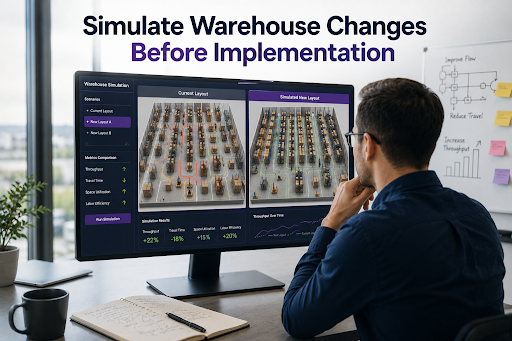
Synkrato’s Simulation & Optimization capabilities can further support decision-making by allowing organizations to evaluate potential outcomes before implementing inventory changes.
Learning Effects Improving Accuracy Over Time
One advantage of agent-led inventory management is the ability to strengthen decision quality through operational learning. As inventory data, replenishment outcomes, and inventory movement patterns are continuously evaluated, organizations gain a better understanding of the factors influencing inventory performance.
This can contribute to:
- More accurate SKU prioritization
- Better replenishment timing
- Reduced inventory drift across facilities
- Improved inventory allocation decisions
- Lower dependence on excess safety stock
Organizations adopting autonomous AI agents for inventory tracking and control often find that the greatest value comes from improving inventory decision consistency rather than simply increasing warehouse automation.
Control Thresholds That Signal the Need for Agent-Led Inventory Management
Agent-led inventory management is needed when cycle counts, fixed reorder points, and scheduled reconciliation no longer catch inventory risks early enough. In dynamic warehouse networks, AI agents help monitor stock movement, replenishment timing, supplier variability, and demand shifts continuously to improve inventory accuracy before discrepancies affect fulfillment.
Inventory Signals That Expose the Limits of Existing Control Logic
The first signals often appear as rising buffers, recurring stockouts, and more manual overrides across planning, replenishment, and execution workflows. These patterns indicate that existing inventory controls are no longer interpreting demand, supply, and warehouse signals fast enough.
Common indicators include:
- Rising safety stock: More working capital is tied up because teams no longer trust replenishment timing or demand signals.
- Frequent stockouts: Availability gaps continue even when inventory appears sufficient in planning systems.
- Growing manual intervention: Teams rely on overrides, spreadsheets, and exception handling to keep inventory moving.
- Cross-site discrepancies: Inventory positions differ across facilities, weakening allocation and replenishment decisions.
- Higher carrying costs: Excess inventory grows while service levels remain unstable.
- Recurring replenishment issues: The same SKU, supplier, or location problems repeat without a clear root cause.
Conditions Requiring AI-Driven Inventory Control
AI-driven inventory control becomes valuable when inventory accuracy depends on decisions that span multiple facilities, suppliers, channels, and fulfillment operations.
Organizations are more likely to benefit from AI-driven inventory control when they manage:
- Multi-facility warehouse networks
- Large SKU portfolios
- Omnichannel fulfillment operations
- Volatile demand patterns
- Complex supplier ecosystems
- Global distribution networks
Factors Supporting Sustainable Inventory Accuracy Gains
Sustainable inventory accuracy depends on continuous control, not repeated correction. The strongest gains come when warehouses can detect inventory drift early, validate replenishment timing, and act on stock-risk signals before they affect fulfillment.
Key enablers include:
- Real-time stock visibility: Keeps system inventory closer to physical inventory movement.
- Connected WMS and ERP data: Reduces mismatches between operational and financial inventory records.
- Reliable scan activity: Improves confidence in receiving, putaway, picking, and transfer events.
- Supplier performance tracking: Helps identify lead-time variability before it creates stock risk.
- Defined control thresholds: Gives AI agents clear signals for when to flag variance, recommend rebalancing, or escalate recurring SKU issues.
Conclusion
Inventory accuracy is no longer determined by how often inventory is counted. It depends on how quickly organizations can detect signal distortion, interpret inventory risk, and respond before discrepancies affect replenishment, fulfillment, and service performance.
AI agents for real-time inventory management to improve accuracy mean moving from reactive inventory correction to continuous inventory control by identifying emerging risks, monitoring inventory conditions, and supporting better operational decisions.
Book a demo with Synkrato to improve inventory accuracy, reduce stock risk, and strengthen inventory control with AI-driven inventory intelligence.
FAQs
How can AI agents reveal hidden tradeoffs between inventory availability targets and accuracy performance?
AI agents evaluate how inventory policies affect both service levels and inventory accuracy. Increasing safety stock may improve availability but can also mask replenishment inefficiencies and inventory drift. Synkrato AI Agents help teams analyze these tradeoffs continuously, allowing organizations to balance stock availability, carrying costs, and inventory accuracy more effectively.
Why do inventory accuracy issues often persist even after cycle counting and reconciliation improvements?
Cycle counts identify discrepancies, but they rarely explain why they occur. Inventory inaccuracies often originate from supplier variability, delayed replenishment, inventory transfers, or signal mismatches across systems. Synkrato AI Agents help uncover these underlying causes by continuously monitoring inventory conditions rather than relying solely on periodic validation.
How can AI agents evaluate the downstream impact of replenishment decisions on inventory accuracy outcomes?
Replenishment decisions affect inventory availability, allocation, fulfillment performance, and service levels simultaneously. AI agents evaluate how changes in replenishment timing or inventory positioning influence stock accuracy across the network. Combined with Synkrato Simulation & Optimization, teams can test these impacts before implementing operational changes.
What role does inventory variability play in long-term stock accuracy instability?
Inventory variability introduces continuous changes in demand, lead times, supplier performance, and inventory movement. Over time, these fluctuations create inventory drift, stock imbalances, and replenishment inefficiencies. Without continuous monitoring, small variations can accumulate into larger inventory accuracy problems that affect operational performance.
How can AI agents assess whether policy-level inventory decisions may introduce systemic control risks?
AI agents evaluate how inventory policies perform under changing operational conditions rather than average conditions alone. Decisions around safety stock, replenishment thresholds, or inventory allocation may improve one objective while increasing risk elsewhere. Synkrato AI Agents help identify these hidden dependencies before they affect inventory accuracy or service performance.
Can AI agents quantify the cumulative effect of minor inventory deviations on broader operational performance?
Yes. Small inventory discrepancies often appear insignificant individually but can collectively affect replenishment efficiency, fulfillment accuracy, transportation costs, and service levels. AI agents for inventory accuracy improvement help measure how these deviations accumulate over time and influence broader inventory performance.
How does agent-driven analysis support validation of alternative inventory control strategies before live deployment?
Agent-driven analysis allows organizations to evaluate inventory control strategies before implementing them in production environments. Synkrato Simulation & Optimization helps teams compare replenishment policies, inventory allocation approaches, and stock positioning decisions to understand potential outcomes before changes affect live operations.
What factors determine whether AI agent outputs are reliable enough for enterprise inventory decisions?
Reliable AI recommendations depend on data quality, system connectivity, operational visibility, and continuous feedback. Intelligent agents for automated inventory management perform best when they can access accurate inventory, replenishment, supplier, and fulfillment data across the organization. Synkrato AI Agents strengthen decision quality by continuously validating inventory signals and monitoring changing risk conditions.