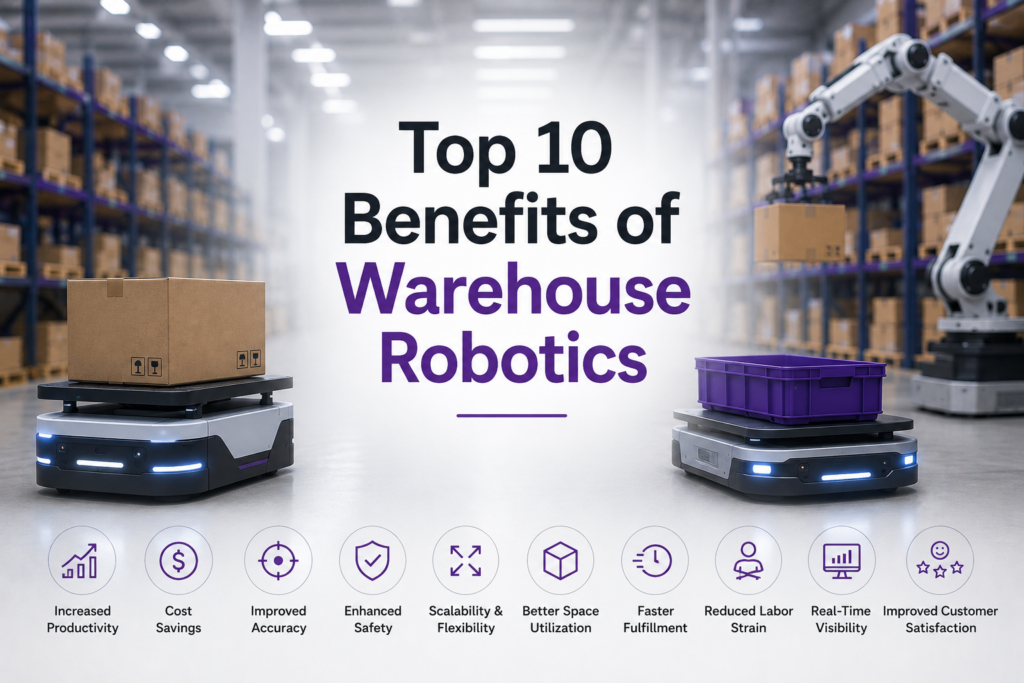
Warehouse robotics helps businesses increase throughput, reduce manual movement, improve safety, and make warehouse operations more scalable. Robots support picking, sorting, transporting, replenishment, packing, and storage workflows, giving leaders a practical way to improve performance without relying only on labor expansion.
Adoption is rising as robotics becomes a core logistics capability. About 102,900 professional service robots were sold for transportation and logistics in 2024, up 14% year over year. These robots mainly support the transport and handling of goods, which makes them directly relevant to warehouse and distribution operations.
In this blog, we cover the top benefits of warehouse robotics, including productivity improvements, cost savings, warehouse safety, and the growing role of AI-connected robotic systems in modern warehouse operations.
Suggested Read: AI in Warehouse Management
1. Increased Efficiency and Productivity
Warehouse robots improve efficiency by reducing non-productive movement inside the warehouse.
For instance, robotics helps warehouses increase throughput without depending entirely on overtime, temporary labor, or facility expansion. It also improves workflow consistency because robotic systems follow standardized movement and routing patterns across shifts.
Some of the operational enhancements include:
- Reducing travel time between pick locations
- Increasing the number of picks completed per labor hour
- Lowering congestion across high-traffic warehouse zones
- Improving workstation utilization during peak periods
In addition, robotics creates a more predictable warehouse flow because repetitive transport and staging tasks move through system-directed execution instead of manual coordination. When connected with Synkrato’s Enterprise Mobility, businesses can further improve task orchestration, real-time inventory visibility, and warehouse workflow execution across mobile operations.
Suggested Read: Future of AI in Logistics
2. Cost Savings and ROI
Robotic warehouse systems lower operating costs by improving labor efficiency, reducing rework, increasing equipment utilization, and minimizing delays across fulfillment workflows. The financial impact becomes stronger when automation is connected to specific operational bottlenecks such as long pick paths, high overtime dependency, manual sortation, or inconsistent dock flow.
Walmart’s automation strategy highlights how robotics can improve long-term warehouse economics. By fiscal year 2026, around 65% of the company’s stores could be serviced through automation, approximately 55% of fulfillment center volume could move through automated facilities, and average unit costs could improve by roughly 20%.
As operations become more system-directed, businesses can improve cost control across multiple warehouse functions simultaneously, including:
- Lowering overtime dependency during peak demand
- Reducing fulfillment delays caused by manual bottlenecks
- Improving dock and staging flow consistency
- Minimizing rework from handling or sorting errors
Suggested Read: AI in Inventory Management
3. Improved Accuracy and Reduced Errors
Robotic systems improve operational accuracy by creating system-directed inventory movement across picking, sorting, replenishment, and staging workflows. Without depending heavily on paper-based instructions, memory, or manual verification, these systems use barcode scanning, sensors, routing logic, and automated validation to move inventory according to predefined rules.
FedEx’s AI-powered sorting robot can sort up to 1,000 packages per hour while managing up to 100 destinations simultaneously. The system uses barcode recognition to decode destination data and reduce manual sorting errors during demand spikes.
Such operational visibility helps improve fulfillment consistency by:
- Reducing misroutes during sorting and staging
- Improving pick and replenishment accuracy
- Lowering rework caused by manual handling errors
- Supporting faster exception tracking and resolution
Additionally, integrating robotics with Synkrato AI slotting recommendations improves inventory positioning, reduces picking inefficiencies, and identifies workflow bottlenecks through simulation-driven warehouse optimization.
4. Enhanced Warehouse Safety
Automation with robotics improves workplace safety by reducing exposure to repetitive lifting, excessive walking, awkward reaches, and heavy material transport. Although automation does not eliminate the need for safety governance, it changes how physically demanding tasks are handled inside the warehouse.
Workers can face musculoskeletal disorder risks from lifting, bending, reaching overhead, pushing heavy loads, awkward postures, and repeated physical tasks. Thus, ergonomic improvements can help reduce muscle fatigue and lower the severity of work-related musculoskeletal disorders.
Some of the warehouse safety improvements include:
- Lowering worker exposure to repetitive strain tasks
- Reducing congestion in high-traffic warehouse areas
- Minimizing manual transport of heavy inventory
- Supporting safer picking and palletizing workflows
- Improving ergonomic conditions during fulfillment operations
- Reducing operational disruption linked to injuries or restricted-duty work
Suggested Read: Using Simulation to Reduce Warehouse Bottlenecks
5. Scalability and Flexibility
Robotic automation gives warehouses more flexible capacity because many systems can be expanded gradually instead of requiring one large fixed deployment from the beginning. Businesses can add robots, workstations, picking zones, or automated workflows as order volume, SKU complexity, and fulfillment demand change over time.
This flexibility helps as warehouse operations face unpredictable demand patterns across e-commerce, omnichannel fulfillment, seasonal spikes, and faster delivery expectations. For example, robot-as-a-service adoption in transportation and logistics grew by 42%, which shows that more companies are prioritizing scalable deployment models instead of only large upfront investments.
A few of the scalability advantages of warehouse robots include:
- Expanding automation in phases instead of full facility replacement
- Adding robotic capacity during seasonal demand spikes
- Supporting new fulfillment workflows without major infrastructure disruption
6. Better Space Utilization
Warehouse robotics implementation benefits space utilization by supporting denser storage layouts, higher vertical storage usage, narrower travel paths, and faster goods-to-person movement.
Walmart’s next-generation fulfillment centers show how robotics can improve both storage density and fulfillment efficiency simultaneously. Its automated high-density storage system reduces a manual 12-step process to five steps, while also doubling storage capacity and doubling the number of customer orders fulfilled daily.
Such an operational redesign can help businesses:
- Increase storage density without expanding facility footprint
- Reduce unnecessary travel across warehouse zones
- Improve slotting efficiency for high-demand inventory
- Support faster pick, pack, and ship workflows
Suggested Read: Warehouse Digitalization
7. Integration with AI and IoT
Connected warehouse systems become significantly more effective when robotics is integrated with AI, IoT devices, WMS platforms, scanners, cameras, sensors, and real-time operational data. In modern fulfillment environments, the robot is only one part of the execution layer. The real advantage comes from coordinated decision-making across inventory movement, task prioritization, traffic management, and warehouse flow.
This connected approach helps warehouses to manage higher order volumes, faster fulfillment expectations, and more dynamic inventory movement. Amazon deployed its one millionth robot across more than 300 facilities and introduced a generative AI foundation model designed to improve robotic fleet travel efficiency by 10%.
At the same time, IoT-connected infrastructure helps robotic systems respond to real warehouse conditions continuously. Sensors, scanners, RFID devices, connected conveyors, and machine vision systems can track inventory location, equipment activity, congestion levels, temperature conditions, and movement across fulfillment zones in real time.
This integration helps businesses improve operations by:
- Coordinating robotic traffic across warehouse zones
- Prioritizing fulfillment tasks dynamically based on workload
- Reducing congestion during peak processing periods
Synkrato’s AI Agents can help businesses convert warehouse data into actionable operational insights, recommendations, and faster decision-making across fulfillment activities.
8. Innovation and Competitive Edge
Robotic automation modernizes warehouse execution without depending entirely on labor expansion or manual process coordination.
This momentum is accelerating as robotics adoption continues to grow across manufacturing and logistics operations. For instance, the industrial robot installations are expected to increase by 6% to 575,000 units in 2025, while annual installations are projected to surpass the 700,000-unit mark by 2028.
For business leaders, robotics can support a competitive advantage by:
- Improving response speed during demand spikes
- Supporting expansion into new fulfillment channels
- Increasing operational consistency across warehouse networks
- Reducing dependency on highly variable manual workflows
- Enabling faster testing of new warehouse processes
- Supporting scalable regional fulfillment growth
Suggested Read: Warehouse Robotics
9. Real-Time Data and Analytics
Connected robotic systems create a continuous operational data layer across warehouse workflows. Every robot movement, scan, tote transfer, pick confirmation, delay, and exception can be captured as part of real-time warehouse intelligence. As a result, businesses move beyond retrospective reporting and make faster operational decisions based on live warehouse conditions.
Moreover, real-time operational data can help businesses:
- Detect congestion across fulfillment zones
- Improve labor and workstation planning
- Identify underutilized storage or picking areas
- Optimize replenishment timing and inventory flow
At the same time, continuous warehouse data improves long-term operational planning because businesses can measure workflow performance with greater consistency across facilities.
10. Customer Satisfaction
Customer satisfaction is improved by making warehouse execution faster, more accurate, and more reliable. Although customers may never directly interact with warehouse robots, they experience the operational impact through better product availability, fewer fulfillment errors, faster shipping, and more consistent delivery performance.
This connection between warehouse execution and customer experience is becoming more important as delivery expectations continue to tighten. Walmart stated that four of its next-generation fulfillment centers could support next- or two-day shipping coverage for 75% of the U.S. population across millions of items.
Some of the customer-facing benefits include:
- Faster order processing and shipment execution
- Fewer incorrect or delayed deliveries
- Better product availability across fulfillment channels
Suggested Read: Warehouse Digital Twins
How Synkrato Supports Warehouse Robotics Operations
As warehouse robotics becomes more connected, businesses need better visibility, coordination, and operational control across fulfillment workflows. Synkrato helps businesses improve warehouse execution by connecting robotics, operational data, inventory movement, and warehouse decision-making into a more intelligent workflow environment.
Its solutions help businesses improve robotics-enabled warehouse operations through:
- Faster Operational Decision-Making with AI agents for real-time warehouse insights and workflow recommendations
- Smarter Inventory Positioning through AI slotting recommendations to reduce picking inefficiencies and improve warehouse flow
- Simulation-Driven Warehouse Optimization using 3D digital twin for workflow testing and bottleneck identification
- Connected Mobile Warehouse Execution with enterprise mobility for real-time inventory visibility and operational coordination
Conclusion
Successful robotics adoption starts with identifying the right operational problem. Businesses must first understand where fulfillment delays, congestion, labor inefficiencies, inventory movement issues, or service gaps exist across warehouse workflows. Once these bottlenecks are identified, robotics can be deployed more strategically to improve warehouse execution and operational consistency.
As robotics adoption continues to grow, Synkrato can help businesses improve warehouse flow, operational visibility, and fulfillment coordination across connected warehouse environments.
Ready to take warehouse performance to the next level? Get in touch with Synkrato to optimize processes, improve inventory visibility, and create a foundation for scalable warehouse automation. Book a demo with Synkrato today.
Suggested Read: Types of Warehouse Robots
FAQs
What are the main benefits of warehouse robotics?
Warehouse robotics helps businesses improve productivity, fulfillment accuracy, warehouse safety, scalability, and operational visibility. Combined with Synkrato, businesses can also improve workflow coordination, inventory visibility, and warehouse decision-making across robotics-enabled operations.
Why are warehouses investing in robotic automation solutions?
Warehouses are investing in robotics to handle rising order volumes, labor shortages, faster delivery expectations, and increasing operational complexity. Robotic automation also helps businesses improve fulfillment consistency without depending entirely on workforce expansion or larger warehouse footprints.
What types of warehouse operations benefit the most from robotics?
High-volume fulfillment operations, e-commerce warehouses, distribution centers, and facilities with repetitive picking, sorting, transport, or palletizing tasks often benefit the most from robotics. Synkrato can help these operations improve inventory movement, workflow visibility, and fulfillment coordination through AI-driven warehouse intelligence.
What challenges should businesses consider before implementing warehouse robotics?
Businesses should evaluate integration complexity, warehouse layout compatibility, workflow bottlenecks, operational readiness, and long-term scalability before implementing robotics. Synkrato reduces implementation inefficiencies through digital twins, AI slotting recommendations, and simulation-driven warehouse optimization.
How can Synkrato help businesses maximize the benefits of warehouse robotics?
Synkrato helps businesses improve robotics-enabled warehouse execution through AI-driven operational visibility, workflow coordination, simulation, and warehouse optimization. Its tools support better inventory movement, fulfillment planning, and real-time operational decision-making across connected warehouse environments.
Why do some warehouse robotics implementations fail to deliver expected efficiency gains without platforms like Synkrato?
Robotics alone cannot solve inefficient workflows, poor inventory visibility, or disconnected warehouse systems. Synkrato helps businesses improve operational coordination through digital twins, AI slotting recommendations, enterprise mobility, and AI-driven warehouse insights that support more efficient robotic execution.
What warehouse processes can Synkrato optimize alongside robotic automation systems?
Synkrato can help optimize inventory slotting, warehouse flow, task execution, fulfillment coordination, inventory visibility, labeling workflows, and operational planning. Its solutions also support workflow simulation, bottleneck identification, and faster warehouse decision-making across robotics-enabled operations.