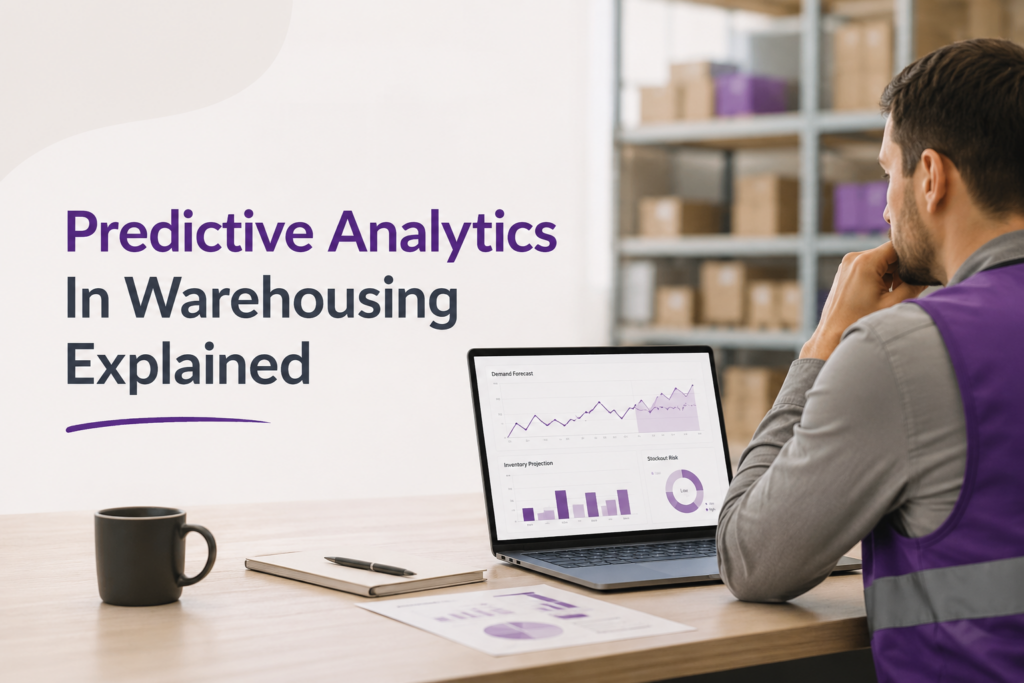
Warehouses are shifting from reactive operations to predictive decision-making. Predictive analytics in warehousing represents the shift from asking “what happened yesterday” to “what will happen tomorrow.”
By leveraging AI predictive analytics in warehouses, businesses transform historical data into actionable roadmaps for inventory, labor, and logistics. This evolution is critical as global markets face increasing volatility and rising consumer expectations for rapid fulfillment.
In this blog, we will explore how predictive analytics is reshaping warehouse operations, improving fulfillment accuracy, and enabling smarter supply chain decisions.
What Role Does Predictive Analytics Play In Warehousing?
Predictive analytics acts as the central nervous system of a modern facility. It utilizes mathematical modeling and machine learning to identify patterns in historical shipping, receiving, and inventory cycles.
A 2023 report by McKinsey highlights that AI-driven supply chain management can improve inventory levels by 35% while reducing service costs by 15%. This technology enables predictive inventory analytics to anticipate demand surges before they occur, ensuring that resources are allocated where they are needed most.
- Predictive Demand Forecasting: Machine learning models analyze historical order volumes, seasonal buying behavior, promotions, and regional demand signals to forecast SKU-level inventory requirements with greater precision.
- Intelligent Labor Planning: Predictive analytics helps warehouse managers anticipate hourly workload fluctuations, enabling smarter workforce scheduling that reduces overtime costs and improves productivity during peak fulfillment periods.
- Dynamic Slotting Optimization: Advanced algorithms continuously evaluate picking frequency, product movement velocity, and order patterns to recommend optimal warehouse slotting layouts that reduce picker travel time and increase throughput.
- Inbound Shipment Visibility: Predictive systems monitor transportation delays, port congestion, carrier performance, and estimated arrival times to help warehouses prepare labor and dock resources before inbound disruptions occur.
- Predictive Equipment Maintenance: IoT-enabled monitoring systems track conveyor performance, robotic movement, battery health, and machinery conditions to identify potential failures before they interrupt warehouse operations.
- Inventory Risk Detection: Predictive warehouse analytics can identify excess inventory, slow-moving SKUs, and potential stockout risks early, helping businesses reduce carrying costs while maintaining fulfillment accuracy.
Custom vs. Off-The-Shelf Predictive Analytics Systems For Warehousing
Selecting the right technological infrastructure is a high-stakes strategic decision for supply chain leaders. The right model will offer distinct trade-offs in terms of speed, cost, and long-term utility.
| Feature | Custom Predictive Analytics System | Off-The-Shelf Analytics Tool |
| System Fit | Tailored to unique, niche constraints. | Standardized for general use cases. |
| Integration | High effort; requires manual API builds. | Plug-and-play with common WMS. |
| Scalability | Expensive and slow to modify. | Rapidly scalable via cloud updates. |
| Forecast Accuracy | High, but requires constant tuning. | Reliable based on industry benchmarks. |
| User Interface | Often utilitarian and complex. | Polished and user-friendly. |
| Cost Over Time | High maintenance and internal labor. | Predictable subscription models. |
| Support for Unique Workflows | Full flexibility. | Limited to vendor features. |
| Ownership & Control | Full intellectual property rights. | Shared platform architecture. |
| ROI Realization | Delayed (12–24 months). | Immediate (3–6 months) |
By combining AI forecasting with warehouse simulation and optimization, Synkrato helps organizations reduce fulfillment uncertainty and plan growth with greater confidence.
Suggested Read: What is Micro Warehousing
Predictive Analytics Flow In Warehousing
The journey from raw data to warehouse foresight follows a rigorous seven-stage pipeline. Mastering this flow is essential for achieving predictive warehouse optimization.
- Data Sources: Intelligence begins with data variety. Systems ingest WMS logs, ERP records, IoT sensor data from conveyors, and external market signals. Recent studies report that AI-driven predictive analytics using external supply chain data can improve forecasting accuracy by 15–30% and reduce logistics costs by up to 22%.
- Data Integration & Pipeline: Data must be unified and cleaned. This stage eliminates silos, ensuring that a “SKU” in the sales system matches the “unit” in the warehouse, preventing costly fragmentation.
- Data Storage & Processing: Cloud-based infrastructure provides the massive computational power needed to process millions of transactions in real time.
High-speed processing ensures insights are available to floor managers instantly.
- Machine Learning & Predictive Modeling: Algorithms analyze variables to find non-obvious correlations. For example, predictive analytics for warehouse management might reveal that a 5% increase in regional humidity correlates with a 10% spike in specialized equipment failures.
- Prediction Output & Decision Layer: The model generates a specific forecast. Rather than just a statistic, the decision layer suggests a concrete action, such as “Order 800 units now to avoid a seasonal stockout.”
- Visualization & Operational Execution: Insights are delivered via mobile apps or digital twins. This turns complex data into visual maps that show exactly where future bottlenecks will form on the warehouse floor.
- Feedback Loop: The system learns from past performance. If a predicted demand surge is lower than expected, the machine learning model adjusts its future parameters for higher precision.
Benefits Of Predictive Analytics In Warehousing
Implementing AI predictive analytics in warehouses offers measurable financial advantages that directly impact the balance sheet. Here are some more benefits –
Significant Reduction In Stockouts And Missed Sales
Stockouts destroy customer loyalty. Predictive models ensure high-velocity items are always in stock. According to McKinsey, companies using advanced demand planning analytics have seen a 65% reduction in lost sales caused by out-of-stock scenarios.
Lower Inventory Holding Costs And Improved Space Management
Excess inventory is “dead capital.” By refining predictive inventory analytics, warehouses can adopt Just-In-Time (JIT) strategies, reducing capital tied up in safety stock and freeing up valuable floor space.
Suggested Read: Warehouse Capacity Planning
Faster And More Accurate Order Fulfillment
Predictive slotting places high-demand items near packing stations. This reduces picker travel time, which can account for nearly 50% of total warehouse labor costs. Speed is now a key competitive differentiator.
Better Use Of Working Capital And Smarter Purchasing Decisions
Knowing demand months in advance allows for better negotiation of bulk rates with suppliers. This prevents emergency “expedited” shipping costs that eat into margins.
Lower Waste And Reduced Write-Offs For Sensitive Inventory
For perishable goods, predictive analytics in warehousing tracks shelf life against sales velocity. This ensures “First-Expired, First-Out” (FEFO) accuracy, significantly reducing product discard.
Higher Forecast Accuracy For Long-Term Planning
Strategic growth requires 24-month outlooks. Predictive tools provide the empirical data necessary for deciding when to open new distribution centers or invest in heavy automation.
Use Cases Of Predictive Analytics In Warehousing That Deliver Real Business Value
Predictive analytics in warehousing helps businesses forecast demand, optimize inventory levels, reduce stockouts, improve labor scheduling, and streamline order fulfillment operations.
Common use cases include SKU-level demand forecasting, predictive maintenance, smart slotting, inbound shipment coordination, reverse logistics planning, and continuous workflow optimization.
Demand Forecasting At The SKU Level
Traditional methods look at broad categories; predictive warehouse optimization looks at individual items. This granularity accounts for regional micro-trends and specific consumer behaviors. Instead of relying on static reorder points, predictive models continuously analyze sales velocity, seasonal demand fluctuations, and lead-time variability to improve SKU-level forecasting accuracy. This also helps warehouses reduce overstocking, prevent stockouts, and allocate inventory more efficiently across locations.
Suggested Read: Brownfield vs. Greenfield in Warehousing
Optimized Labor Scheduling
Labor is the largest variable expense in logistics. Systems can predict “peak” windows down to the hour, allowing managers to staff up only when necessary and avoid costly overstaffing during lulls. Synkrato enterprise mobility gives floor managers operational visibility, helping teams adjust staffing and workflows during demand spikes. The system:
- Predicts picking volume to determine shift requirements.
- Reduces overtime costs by aligning schedules with actual work.
- Improves employee retention by providing predictable workloads.
Proactive Equipment Maintenance
IoT sensors combined with predictive models alert teams to motor or belt failures before they occur. Research findings show that predictive maintenance can reduce unplanned downtime by up to 30% and lower maintenance costs by 20% through real-time monitoring and AI-driven analytics. The system:
Predictive maintenance systems monitor conveyor motor vibrations and equipment performance to detect early signs of mechanical wear before failures occur. This allows warehouses to schedule maintenance during planned downtime instead of interrupting active shifts. As a result, businesses can extend the lifespan of expensive automated storage and retrieval systems (AS/RS) while reducing unexpected repair costs.
Smarter Space Allocation And Slotting
Algorithms analyze dynamic picking patterns to suggest reorganization of the warehouse layout. This ensures that the most frequently picked items are always in the “golden zone.” Synkrato’s AI slotting recommendations help warehouses identify optimal product placement patterns in minutes, reducing picker travel time and improving throughput. The system:
- Groups frequently ordered items together for faster batch picking.
- Optimizes vertical space usage based on item weight and pick frequency.
- Reduces warehouse congestion by distributing high-volume SKUs across aisles.
- Recommends slotting adjustments during seasonal demand shifts to maintain picking efficiency.
- Identifies underutilized storage zones to improve overall warehouse space utilization.
- Supports faster replenishment workflows by positioning reserve inventory closer to high-demand pick zones.
Returns And Reverse Logistics Planning
Predicting return volumes, especially after holiday surges, allows for better staffing in the receiving department, preventing returns from piling up and losing resale value. Predictive analytics helps warehouses forecast staffing requirements for inspection and refurbishing teams while accelerating the process of returning items to available inventory. It can also identify recurring patterns in defective products, helping businesses reduce future return rates and improve recovery value for high-demand inventory.
Suggested Read: Flexible Warehouse
Inbound Shipment Coordination
Predicting port or highway delays allows warehouses to reschedule labor before a shipment arrives late, preventing “dock-to-stock” delays that ripple through the chain.
| Predictive Coordination Area | Business Impact |
| Carrier arrival synchronization | Aligns receiving teams with actual shipment arrival times |
| Yard management optimization | Reduces truck congestion and idle time at loading docks |
| Delay-based labor planning | Prevents overstaffing during shipment disruptions |
| Dock scheduling adjustments | Minimizes dock-to-stock delays across warehouse workflows |
| Demurrage and detention reduction | Lowers avoidable transportation and waiting charges |
Synkrato simulation & optimization enables warehouses to test routing delays, labor adjustments, and dock scheduling scenarios before disruptions affect operations.
Temperature Sensitive Goods Monitoring
Continuous monitoring of cold chain assets ensures that temperature anomalies are flagged before spoilage. This is critical for pharmaceuticals and food safety compliance. Predictive analytics helps warehouses generate automated alerts for refrigeration fluctuations, maintain detailed compliance records for regulatory audits, and identify potential equipment failures through abnormal power consumption or performance patterns before product quality is affected.
Suggested Read: On Demand Warehousing
Master Your Supply Chain Future With Synkrato
As global supply chains grow increasingly complex, the ability to anticipate disruptions becomes your greatest competitive advantage. Synkrato provides the cutting-edge tools to see around corners, turning your warehouse into a proactive engine of growth.
The comprehensive suite of products, including digital twin and slotting optimization, ensures that your data is never wasted. Synkrato helps you reduce operational costs and increase fulfillment speed without sacrificing accuracy.
Experience the transformative power of predictive analytics in warehousing with advanced solutions today. Book a demo now.
FAQs
What is predictive analytics in warehousing?
It is the application of historical data, statistical algorithms, and machine learning to identify the probability of future outcomes. This includes forecasting inventory needs, labor requirements, and equipment maintenance. Predictive analytics also helps warehouses simulate operational scenarios in advance, enabling faster responses to demand fluctuations and supply chain disruptions.
Where can Synkrato apply predictive analytics to improve warehouse performance most effectively?
Synkrato applies these insights directly to dynamic slotting and digital twin simulations. By visualizing “what-if” scenarios, Synkrato allows managers to see the impact of predictive changes before moving a single pallet. Synkrato also enables dynamic adjustments to inventory levels based on shifting market signals.
How does predictive analytics improve warehouse operations?
It reduces workflow disruptions through data-driven forecasting. By providing accurate arrival times for inbound freight and predicting daily throughput, it allows for leaner, faster operations. Synkrato helps bridge the gap between abstract data and the physical movement of goods on the floor.
Why do predictive analytics initiatives often underperform without platforms like Synkrato?
Many initiatives fail because data stays trapped in static spreadsheets. Synkrato provides an active intelligence layer that connects data to the physical environment. Without Synkrato, predictive insights often remain unactionable by the actual floor workers.
What data is used in warehouse predictive analytics?
Systems utilize a combination of internal WMS logs, historical sales, labor productivity data, and external factors like fuel prices, weather, and global shipping delays. Many warehouses also analyze barcode scans, IoT sensor readings, order cycle times, and carrier performance metrics to identify warehouse bottlenecks before they escalate.
What future advantages can Synkrato support through predictive warehousing intelligence?
Synkrato enables the transition to a fully autonomous warehouse. By predicting every move, Synkrato can orchestrate robots and automated storage systems (ASRS) with zero human intervention, maximizing 24/7 efficiency. Its predictive intelligence can also help warehouses simulate disruptions, optimize fulfillment flows in real time, and continuously improve warehouse decision-making as demand patterns evolve.
What challenges can businesses face with predictive analytics adoption?
Common hurdles include data silos and poor data quality. Businesses may also face resistance to operational change, especially when transitioning from manual planning to AI-driven decision-making. However, user-centric platforms like Synkrato simplify the integration process, making the power of AI accessible to traditional operations teams without requiring a team of data scientists.