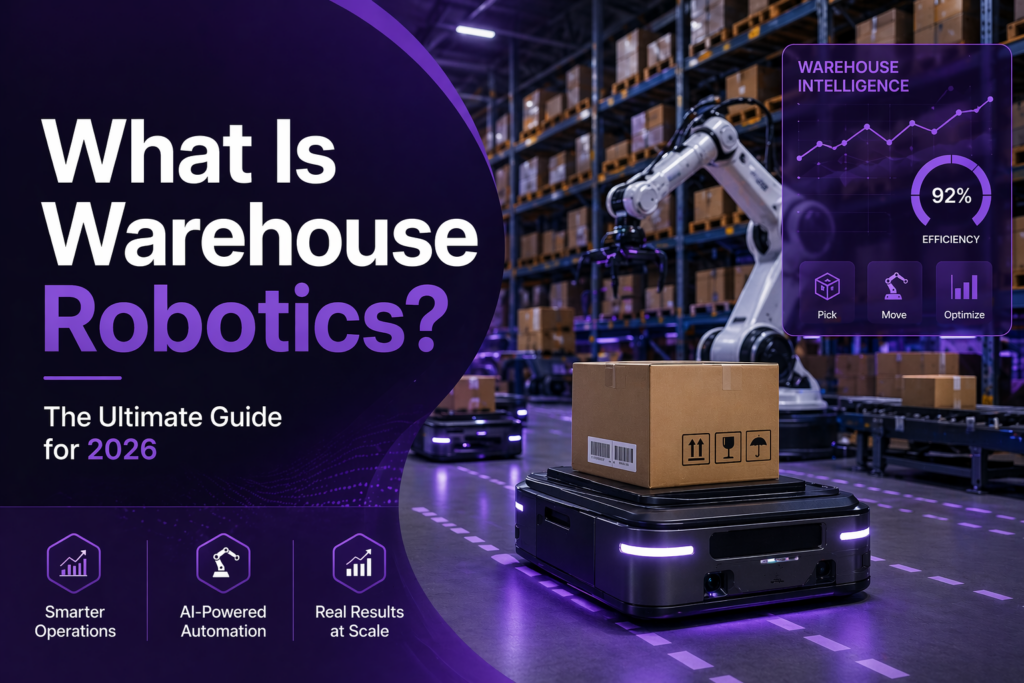
Warehouse robotics refers to the use of autonomous or semi-autonomous machines, powered by AI, sensors, and software. They execute physical warehouse tasks such as picking, packing, sorting, and inventory movement.
These systems operate in coordination with warehouse management systems (WMS) and with AI-driven decision layers, turning warehouses into real-time, adaptive environments. In this blog, we’ll explore how warehouse robotics is transforming logistics, boosting efficiency, and redefining the future of work behind the scenes.
Why Is Warehouse Robotics So Popular?
Warehouse robotics addresses the fundamental operational constraint in modern logistics. It includes the need to scale throughput, speed, and accuracy without proportionally increasing labor and costs.
What makes this shift significant is the scale and speed of adoption:
- The global warehouse robotics market is expected to reach ~$15.18 billion in 2026, growing at 18.73% compound annual growth rate (CAGR) through 2035.
- Robot shipments in warehouse and logistics environments are projected to grow by up to 50% annually through 2030.
- Organizations implementing warehouse automation see 15-20% reductions in operational costs within the first year.
- Storage capacity utilization with warehouse automation improves by around 30%.
Suggested Read: AI in Warehouse Management
Types of Warehouse Robotics
Warehouse robotics includes a range of specialized systems designed to handle specific operational challenges across different stages of warehouse workflows. Each type of robot serves a distinct function, from inventory movement to picking and sorting, enabling more efficient and accurate execution.
Automated Guided Vehicles (AGV):
AGVs are designed for predictable, repeatable material movement across fixed warehouse routes. They follow predefined paths using markers, wires, or visual cues, making them highly reliable in stable environments where workflows do not frequently change.
Autonomous Mobile Robots (AMR):
Autonomous mobile robots (AMRs) operate with greater flexibility by using simultaneous localization and mapping (SLAM) to navigate dynamically. They adapt to changing layouts and real-time conditions, making them ideal for order picking and workflows with variable movement patterns.
Aerial Drones:
Aerial drones capture inventory data without physical contact using imaging systems and RFID technology. This allows warehouses to conduct faster and more accurate inventory checks, even in hard-to-reach or visually obstructed locations.
Unmanned Aerial Vehicles (UAV):
UAVs extend drone capabilities with advanced sensing and autonomous decision-making. In warehouses, they support broader operational visibility, including infrastructure inspection, condition monitoring, and security surveillance.
Automated Guided Carts (AGC):
AGCs are compact robots built for short-distance transport of lightweight materials. They move bins, totes, or components efficiently between workstations, reducing manual handling in repetitive internal flows.
Suggested Read: Future of AI in Logistics
Automated Storage & Retrieval Systems (AS/RS):
AS/RS automate high-density inventory storage and retrieval using cranes, shuttles, or robotic carriers. They maximize vertical space utilization and enable faster, more precise inventory access in large-scale warehouses.
Collaborative Robots (Cobots):
Cobots work alongside human operators to enhance productivity without replacing human input. They assist in tasks like picking, packing, and sorting, improving consistency while allowing humans to handle more complex decisions.
Articulated Robotic Arms:
Articulated robotic arms are multi-axis robots designed for precision-driven tasks such as picking, palletizing, and packaging. Their flexibility allows them to handle complex movements and varied item types with high accuracy.
Goods-to-Person (G2P):
Goods-to-person (G2P) systems reduce operator travel by bringing inventory directly to workers. This significantly improves picking speed, reduces fatigue, and increases throughput in high-volume environments.
Palletizing and Depalletizing Robots:
Palletizing and depalletizing robots automate the stacking and unstacking of goods. They handle repetitive lifting tasks with consistency, improving safety and ensuring stable load configurations for storage and shipping.
Sorting Robots:
Sorting robots identify and route items to the correct destination within the warehouse. They improve sorting speed and accuracy, especially in high-throughput fulfillment operations.
Automated Labeling Robots:
Automated labeling robots apply labels to packages, cartons, or pallets as part of the fulfillment process. This reduces labeling errors and ensures accurate routing and delivery.
With Synkrato’s unified labeling platform, businesses can centralize label creation and ensure consistent, up-to-date templates across warehouses and suppliers without added complexity.
Packaging Robots:
Packaging robots automate shipment preparation, including box selection, item placement, and sealing. They adapt packaging decisions based on order details, improving efficiency while reducing material waste and errors.
Suggested Read: AI in Inventory Management
Benefits of Warehouse Robotics
Robotic warehouse automation delivers measurable impact across operations, workforce dynamics, and overall facility performance. These benefits typically show up across multiple areas of warehouse execution, including:
- Improved worker safety: Robotics reduces human exposure to high-risk zones such as transport paths, loading docks, and elevated storage areas. It also minimizes physical strain from repetitive motion, long travel distances, and manual lifting, leading to safer and more sustainable working conditions.
- Increased productivity: Workflows shift from human-paced execution to system-driven coordination. Robotics enables parallel task execution, reduces idle time between processes, and maintains consistent throughput regardless of workload fluctuations.
- Optimized storage: Inventory placement becomes demand-driven rather than static. Fast-moving items are positioned closer to dispatch zones, while slower-moving stock is stored deeper, improving space utilization without impacting accessibility.
- Automated replenishment: Replenishment moves from fixed schedules to real-time triggers. Systems continuously monitor inventory levels and proactively reposition stock based on actual consumption patterns, reducing stockouts and excess inventory.
Suggested Read: Using Simulation to Reduce Warehouse Bottlenecks
What Industries Use Warehouse Robots?
Warehouse robotics is being adopted across a wide range of industries where operational complexity, scale, and speed directly impact business outcomes.
E-commerce and Retail
E-commerce and retail rely heavily on warehouse robotics to handle high order volumes, fast fulfillment expectations, and frequent inventory turnover. Robots enable faster picking, sorting, and packing, helping businesses keep up with demand while maintaining accuracy.
Third-Party Logistics (3PL)
Third-party logistics providers use robotics to handle complex, multi-client operations with varying service requirements. AI-driven layers and enterprise mobility platforms coordinate robotic and human workflows, ensuring consistent execution across fluctuating volumes and contract-specific needs.
Manufacturing and Industrial Warehousing
Robotics ensures continuous and synchronized material flow between production, storage, and outbound logistics. The focus is on just-in-time movement, where materials arrive exactly when needed, minimizing delays and excess inventory.
Food and Beverage
Robotics enables efficient handling of high-volume, time-sensitive goods where freshness and shelf life are critical. It maintains consistent product flow while reducing manual handling in temperature-controlled and hygiene-sensitive environments.
Suggested Read: Warehouse Digitalization
Warehouse Robotics Use Cases
These use cases highlight how robotics is embedded into day-to-day warehouse activities, enabling faster decision cycles, smoother coordination, and more consistent output across operations.
- Picking: Amazon uses its Kiva robots (now Amazon Robotics) to bring shelving units (pods) directly to stationary pickers, reducing movement and accelerating order fulfillment.
- Sorting: FedEx uses robotic arms and AI-powered vision systems to detect package dimensions, labels, and destinations, allowing automated diversion across multiple conveyor paths.
- Loading and unloading: DHL has deployed a Boston Dynamics Stretch robot to unload trucks, using advanced vision systems to handle boxes of varying sizes directly from containers.
- Palletizing and depalletizing: Coca-Cola uses robotic palletizing in its bottling and distribution facilities to create stable, uniform pallet configurations for storage and shipping.
- Packaging: Zara (Inditex) uses automation in its distribution centers to enable rapid store replenishment and faster inventory turnover.
- Transportation: Walmart uses autonomous mobile robots (AMRs) to move inventory efficiently within distribution centers, supporting continuous operations.
- Delivery: Macy’s uses automated warehouse systems to process orders faster, improving delivery timelines across its network.
- Replenishment: Decathlon includes robotic storage and retrieval systems in warehouses to optimize inventory flow, improve product availability, and reduce manual intervention.
Suggested Read: Warehouse Digital Twins
How Do Warehouse Robots Navigate Warehouses?
Different navigation methods offer different trade-offs between precision, flexibility, infrastructure requirements, and scalability. Thus, most modern warehouses use a mix of approaches depending on the use case.
- Rail navigation: Rail navigation enables highly precise and repeatable robotic movement by constraining robots to fixed tracks on the warehouse floor. It is best suited for stable, repetitive workflows such as transport between fixed production lines or storage zones.
- Wire-guided navigation: Wire-guided systems provide consistent and reliable robot movement by following electrical signals from embedded floor wires. This approach is ideal for environments where accuracy and operational stability are critical.
- Magnetic tape-based navigation: Magnetic tape navigation offers flexible path definition using adhesive strips on the warehouse floor. It allows quick deployment and easy route changes, making it suitable for operations that require frequent layout adjustments.
- Label-based navigation: Label-based navigation enables position tracking using QR codes or RFID tags placed across the warehouse. Robots use these markers to align precisely at key points such as pick stations, transfer zones, or docking areas.
- Laser-based navigation: Laser navigation delivers high-precision positioning by using reflectors and emitted laser signals to calculate location. It eliminates the need for physical floor paths while maintaining accurate and consistent movement.
- Vision-based navigation: Vision-based navigation allows robots to move dynamically by interpreting their surroundings through cameras and computer vision. It is effective in complex environments where layouts may change or obstacles are unpredictable.
- Geo-Guidance: Geo-guidance enables flexible navigation by mapping natural warehouse features such as walls and columns. Robots continuously compare real-time surroundings with this map to determine optimal movement paths.
- LiDAR (Light Detection and Ranging): LiDAR enables advanced navigation by creating detailed 2D or 3D maps using laser pulses. It allows robots to detect obstacles, measure distances, and navigate complex environments with high accuracy and real-time awareness.
Suggested Read: Benefits of Warehouse Robotics
Future Trends in Warehouse Robotics
The trends below reflect how warehouses are shifting from isolated robotic deployments to integrated, AI-driven environments that combine execution, decision-making, and optimization into a single system. Let’s look at the key innovations that are set to define the next phase of warehouse transformation:
Fully Autonomous Warehouses
Future warehouses will operate with minimal human intervention, using interconnected robots, AI systems, and automated workflows to manage end-to-end operations. This will significantly improve speed, consistency, and scalability in high-demand environments.
AI as the Operational Control Layer
AI acts as the decision layer that guides robotic operations across the warehouse. It analyzes workflows, predicts disruptions, and recommends real-time actions, enabling warehouses to operate as adaptive, continuously optimized systems rather than static setups.
Swarm Intelligence and Fleet Coordination
Robotics is shifting from individual control to coordinated fleet management. AI-driven swarm intelligence allows multiple robots to distribute tasks dynamically, avoid congestion, and optimize movement collectively, improving overall system efficiency.
Suggested Read: Types of Warehouse Robots
Rise of Flexible, Infrastructure-Free Robotics
Warehouses are moving away from fixed-path automation toward robots that operate without physical guides. This reduces setup time, lowers infrastructure dependency, and allows faster adaptation to layout or process changes.
Robotics + Digital Twins for Simulation and Planning
Digital twins enable warehouses to simulate operations before making physical changes. Teams can test layouts, demand scenarios, and workflows virtually, reducing implementation risk and improving execution accuracy.
Edge Computing Integration
Warehouse robots will rely more on edge computing for faster, localized data processing. This reduces latency, enables real-time responses, and improves reliability in high-speed, mission-critical fulfillment operations.
Robotics-as-a-Service (RaaS) Models Expanding Adoption
RaaS enables companies to adopt robotics through usage-based pricing instead of large upfront investments. Material handling applications are driving this shift, with the market projected to grow from $849.8 million in 2025 to $7.85 billion by 2035.
Looking to move from automation to intelligent operations? Book a demo with Synkrato and unlock real-time visibility, optimized workflows, and data-driven warehouse performance.
FAQs
How do warehouse robots improve efficiency?
Warehouse robots reduce delays between tasks, improve execution consistency, and enable parallel workflows across operations. With Synkrato, this efficiency is further enhanced through real-time visibility and AI-driven insights that continuously refine how work gets executed.
How does Synkrato support warehouse robotics optimization?
Synkrato acts as the intelligence layer on top of the warehouse management system, connecting data across WMS, ERP, and execution tools. It enables simulation, optimization, and real-time decision-making to ensure robots operate at peak efficiency.
What warehouse processes can be automated with robotics?
Robotics automates key workflows such as picking, sorting, transportation, packaging, and replenishment. Synkrato complements this by managing these processes, ensuring they stay aligned with demand patterns and operational priorities.
Can Synkrato improve efficiency in robotic warehouse operations?
Yes, Synkrato improves efficiency by turning operational data into actionable insights, allowing teams to identify bottlenecks and optimize workflows in real time. This ensures robotic systems are continuously performing at their best.
Are warehouse robotics suitable for high-volume operations?
Warehouse robotics is highly effective in high-volume environments where consistency and speed are critical. Synkrato enhances this by enabling dynamic planning, load balancing, and performance monitoring across large-scale operations.
Does Synkrato integrate with warehouse robotics systems?
Synkrato is designed to integrate seamlessly with existing warehouse systems, including robotics platforms, WMS, and ERP solutions. This ensures smooth data flow and coordinated execution across all operational layers.
What challenges can warehouse robotics help solve?
Warehouse robotics addresses challenges such as labor dependency, operational delays, and execution variability. Synkrato amplifies operational impact by providing a unified platform to manage complexity, improve decision-making, and maintain operational control at scale.