You already have visibility into inventory across systems, locations, and SKUs. Yet performance gaps persist, such as inaccurate forecasts, inefficient replenishment, and delayed responses to disruptions. These are not system failures; they are decision failures.
Static planning cycles and rule-based thresholds cannot keep up with real-time variability in demand and supply. This is where AI in inventory management changes the operating model. It introduces a continuous decision layer that recalibrates forecasts, reorder points, and exception responses in real time, aligning inventory decisions with actual operating conditions.
This blog explores the rise of AI in inventory management and how it’s shaping the future of WMS.
Suggested Read: AI in Warehouse Management
AI in Inventory Management as a Decision System
Traditional inventory platforms, and even many AI-powered inventory management systems, are designed to improve visibility and automate workflows. However, they still fall short in continuous, real-time decision-making. They provide visibility into stock levels, movements, and demand patterns, but they do not continuously optimize decisions.
As inventory networks scale, decision complexity increases across:
- Multi-location stock positioning
- Demand variability at the SKU level
- Supplier lead time uncertainty
Manual or rule-based decision-making cannot evaluate these variables simultaneously or adapt quickly enough.
AI addresses this by converting inventory signals into continuous decision loops. Instead of periodic planning, decisions are recalculated in real time based on current system conditions.
Synkrato operates within this model as a decision intelligence layer on top of existing WMS and ERP systems. It combines real-time data, optimization models, and digital twin simulation to continuously evaluate and improve inventory decisions without requiring system replacement.
Suggested Read: Future of AI in Logistics
Core Decision Levers in AI for Inventory Management
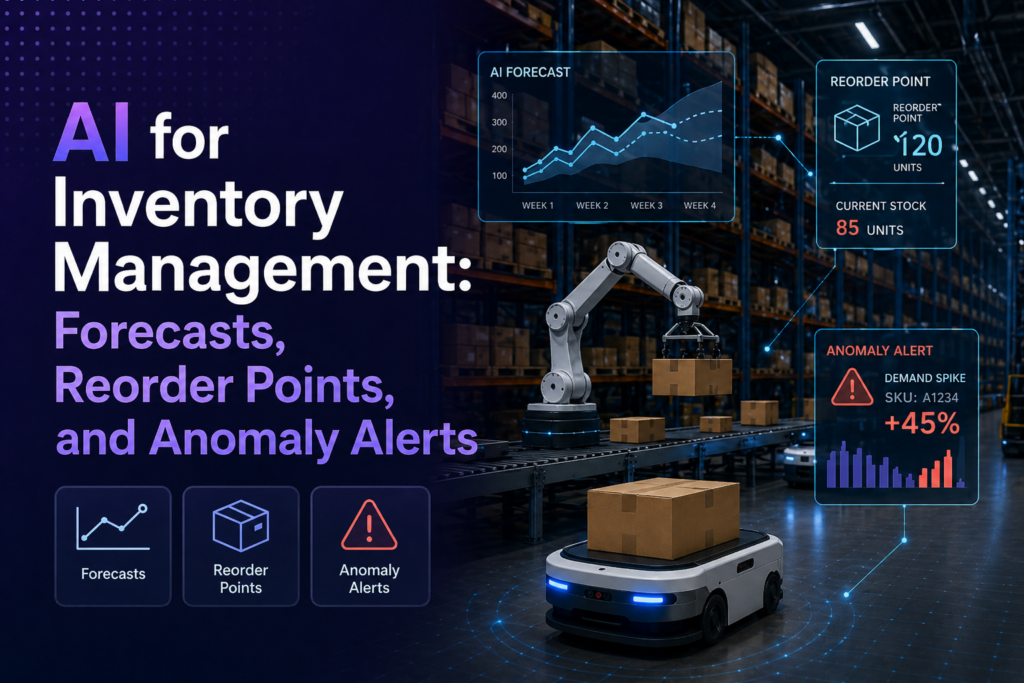
Deploying Artificial Intelligence for inventory management does not deliver impact through isolated features, but through a set of interconnected decision levers that continuously shape outcomes. Forecasting, replenishment, anomaly response, and prioritization work together to align inventory with real-time demand, risk, and business objectives.
AI Demand Forecasting (From Static Planning to Continuous Prediction)
Traditional forecasting models rely on historical averages and periodic updates. This approach breaks down when demand patterns shift due to external factors, product variability, or network scale.
AI-driven forecasting uses machine learning models such as time-series forecasting, regression models, and neural networks to continuously update demand predictions. These models incorporate historical demand patterns, seasonality, trend shifts, and external signals, such as market conditions.
Instead of producing static forecasts, AI enables probabilistic forecasting, where demand is modeled as a range of outcomes rather than a single estimate. This allows you to align inventory decisions with risk tolerance and service level targets.
AI-Driven Reorder Points (From Static Thresholds to Dynamic Control)
Traditional reorder points are based on fixed assumptions around average demand, fixed lead times, and static safety stock. These assumptions rarely hold in real operations.
AI replaces static thresholds with dynamic reorder point models that continuously adjust based on real-time inputs.
These models evaluate:
- Demand variability distributions
- Lead time fluctuations
- Service level targets
- Network-wide inventory dependencies
Instead of triggering replenishment at a fixed minimum level, AI calculates reorder decisions based on stockout risk probability and business impact.
Synkrato strengthens this capability using digital twin simulation, allowing you to test reorder strategies under different scenarios, such as supplier delays or demand spikes, before execution. This ensures replenishment decisions are not only dynamic but also validated against operational constraints.
Suggested Read: Using Simulation to Reduce Warehouse Bottlenecks
Anomaly Alerts and Automated Response Systems
Inventory disruptions rarely follow predictable patterns. They appear as deviations like unexpected demand spikes, abnormal consumption, or sudden stock imbalances.
Traditional systems rely on static thresholds, which either miss critical anomalies or generate excessive false alerts. Whereas, AI-driven anomaly detection establishes a dynamic baseline of normal behavior and identifies statistically significant deviations in real time.
These models monitor demand fluctuations, inventory movement patterns, and replenishment inconsistencies
However, detection alone is insufficient. The real value lies in linking alerts to automated decisions. Once an anomaly is detected, the system works across different stages:
| Stage | What the System Does | Outcome |
| Impact Evaluation | Assesses operational impact, service-level risk, and available mitigation options | Determines severity and prioritizes response |
| Decision Execution | Selects the most effective action based on constraints and demand conditions | Ensures response is aligned with business objectives |
| Response Activation | Triggers actions such as accelerated replenishment, inventory reallocation, and order reprioritization | Reduces disruption and stabilizes fulfillment performance |
A major building products distributor improved fill rates by 5-8% by implementing an AI-enabled supply chain control tower that proactively managed inventory across its warehouse network, identified issues early, and enabled faster cross-functional decision-making.
Synkrato integrates anomaly detection with decision intelligence, ensuring that alerts lead directly to optimized actions rather than manual review cycles.
AI-Driven Inventory Segmentation and Prioritization
Traditional segmentation methods, such as ABC classification, rely on static rules and periodic analysis. These approaches fail to capture real-time shifts in demand, margin contribution, and service-level importance.
AI enables dynamic segmentation by continuously evaluating SKU performance across demand variability, profitability, and fulfillment priority. Instead of fixed categories, inventory is prioritized based on current business impact.
This allows you to allocate inventory based on service-level criticality, prioritize high-impact SKUs dynamically, and align stock decisions with revenue and operational goals.
Suggested Read: Warehouse Digitalization
Technologies Enabling AI Inventory Optimization
AI in inventory management is not a single capability. It is a combination of technologies working together to enable continuous decision-making.
| Technology | Role in Inventory Management | Business Impact |
| Machine Learning Models | Forecast demand and detect patterns | Improved accuracy and adaptability |
| Optimization Engines | Solve multi-variable inventory decisions | Balanced cost and service levels |
| Digital Twins | Simulate decisions before execution | Reduced operational risk |
| Real-Time Data Streaming | Process events instantly | Faster decision cycles |
These technologies collectively enable real-time inventory optimization with AI, ensuring decisions remain aligned with current conditions rather than historical assumptions.
Suggested Read: Warehouse Robotics
Implementation Challenges in AI for Inventory Management
While the value of AI in inventory management is increasingly clear, implementation remains a constraint for many organizations. The challenge is not access to algorithms, but aligning data, systems, and operational workflows to support continuous decision-making. Without addressing these foundational gaps, even advanced AI models fail to deliver consistent business impact.
85% of AI projects fail to deliver expected results, largely due to data, integration, and operational readiness issues rather than model limitations.
Data Fragmentation and Quality
Inventory data is often distributed across ERP, WMS, and planning systems. Inconsistent data structures and quality issues can reduce model accuracy. A unified data layer is essential for reliable AI-driven decisions.
Model Trust and Adoption
Operational teams may hesitate to rely on AI decisions without understanding how they are generated. Lack of transparency can limit adoption. Explainable models and clear visibility into decision logic are critical for building trust.
Integration with Existing Systems
Replacing core systems is not practical in most enterprises. AI solutions must integrate without disrupting existing workflows. Synkrato addresses this by operating as a non-disruptive decision layer, enabling AI-driven optimization without replacing current infrastructure.
Suggested Read: Warehouse Digital Twins
Business Impact of AI in Inventory Management
AI-driven inventory systems can reduce stockouts and excess inventory, directly improving availability and working capital efficiency. At the same time, organizations adopting AI in supply chains report 20-50% reductions in errors, reflecting measurable network-wide optimization gains.
Supply Chain Optimization (Beyond Inventory Silos)
AI in inventory management extends beyond warehouse-level efficiency into network-wide optimization. Instead of managing stock in isolation, you can continuously balance inventory across locations based on demand variability, lead times, and fulfillment priorities.
This reduces inter-warehouse transfers, enables better utilization of existing inventory and aligns inventory positioning with fulfillment strategy.
Better Customer Experience Through Smarter Inventory
Customer experience is directly impacted by how accurately inventory decisions match demand. Stockouts, delayed fulfillment, and inconsistent availability are often the result of delayed or inaccurate decision-making.
AI improves inventory performance by continuously aligning stock levels with real-time demand signals, ensuring that placement and replenishment reflect actual consumption patterns rather than static forecasts. It reduces stockouts through dynamic replenishment decisions that respond to variability as it occurs, while simultaneously prioritizing orders based on service-level impact to ensure that limited inventory is allocated where it matters most.
Suggested Read: Benefits of Warehouse Robotics
From Cost Center to Strategic Lever
Traditional inventory management operates in planning cycles that limit responsiveness and lock capital into inefficient stock positions. AI transforms inventory from a static cost center into a strategic lever that directly influences working capital, service levels, and supply chain resilience.
Synkrato harnesses AI capabilities to serve as a decision intelligence layer on top of your existing systems. It enables continuous optimization across forecasting, replenishment, and exception handling without disrupting your current infrastructure. Instead of periodic adjustments, you move toward a system that continuously aligns inventory decisions with real-world conditions.
Ready to move from periodic planning to continuous inventory optimization? See how Synkrato enables real-time decision intelligence across your inventory operations, improving service levels while reducing excess stock.
Suggested Read: Types of Warehouse Robots
FAQs
What is AI in inventory management?
AI in inventory management uses machine learning, optimization models, and real-time data to continuously improve forecasting, replenishment, and exception handling. Platforms like Synkrato extend this by enabling decision intelligence, where inventory decisions are simulated, validated, and optimized before execution.
How does Synkrato support AI in inventory management?
Synkrato acts as a decision intelligence layer above your existing systems, using AI, digital twins, and simulation to continuously optimize inventory decisions. It transforms static planning into continuous decision-making by validating forecasts, reorder strategies, and anomaly responses before they impact operations.
What are common use cases of AI in inventory management?
Common use cases include demand forecasting, dynamic reorder optimization, anomaly detection, and inventory prioritization. Synkrato enhances these by running simulations on real warehouse data, allowing you to test decisions and understand their operational impact before execution, reducing risk across the network.
Can Synkrato improve inventory optimization with AI?
Yes. Synkrato improves AI inventory optimization by combining predictive models with digital twin simulation. Instead of relying on static rules, it evaluates multiple inventory scenarios and recommends decisions that optimize service levels, reduce excess stock, and align with real operational constraints.
How does AI support inventory forecasting?
AI improves forecasting by analyzing historical demand, variability patterns, and external signals to generate probabilistic predictions. Synkrato enhances this by connecting forecasts with downstream decisions, allowing you to test how forecast changes impact inventory, labor, and fulfillment before execution.
Does Synkrato integrate with existing inventory management systems?
Yes. Synkrato is designed to integrate with ERP, WMS, and other systems without disruption. It sits above these platforms, using their data to generate AI-driven recommendations and simulations, eliminating the need to replace existing infrastructure.
What should businesses consider before adopting AI for inventory management?
Organizations should assess data quality, system integration readiness, and how decisions are executed operationally. Synkrato addresses these challenges by unifying data into a digital twin environment, enabling simulation-driven decision-making without requiring major system changes.