In high-volume warehouses, picking time compounds. Small inefficiencies in SKU placement, movement, and workflow coordination get repeated across thousands of picks every hour, gradually slowing down the entire operation.
As SKU counts expand and order profiles become more fragmented, the problem is movement inefficiency at scale. Static slotting systems, designed for stable environments, cannot keep up with rapid shifts in SKU velocity, demand spikes, and dense picking zones. Dynamic slotting optimization for high-volume warehouses to reduce picking time is one of the most-implemented approaches.
This blog delves into how dynamic slotting reduces picking time in high-demand environments by continuously aligning inventory placement with real-time demand and order flow.
Suggested Read: Micro Slotting Optimization for Ecommerce to Reduce Picking Time
Why Picking Time Problems in High-Volume Warehouses Often Start With Slotting
Research shows that order picking accounts for a majority of warehouse effort, with travel time as the dominant component.
In high-volume environments, picking inefficiencies rarely originates at the point of execution. They are structurally embedded in how inventory is positioned relative to demand. As SKU counts increase and order patterns fragment, even small misalignments between placement and picking behavior expand into longer travel paths, lower pick density, and inconsistent workflows.
What appears as slower picking is often a downstream effect of slotting decisions that no longer reflect how work actually moves through the warehouse. Until placement is aligned with real demand, labor is forced to absorb inefficiencies through additional movement.
How Poor Slotting Decisions Create Hidden Picking Delays
Picking delays are rarely visible as discrete disruptions. They accumulate across every order through micro-inefficiencies introduced by poor slotting. When high-frequency SKUs are dispersed or placed away from high-access zones, pickers are forced into fragmented paths with frequent interruptions.
The absence of SKU affinity further breaks flow in multi-line orders, increasing touches and slowing completion rates. At the same time, poorly positioned forward locations trigger additional replenishment movement, indirectly affecting picking continuity. These delays compound silently, reducing throughput without a clear operational failure point.
Why Demand Volatility Breaks Fixed Slotting Logic
High-volume warehouses operate in a state of constant demand variability driven by promotions, seasonality, and shifting order mixes. Fixed slotting logic, built on historical averages, cannot keep pace with these changes.
As demand shifts, SKU velocity profiles change, but physical placement remains static. High movers drift away from optimal locations, while slower items occupy prime zones. This creates a persistent mismatch between where inventory is stored and how it is accessed. Over time, the system becomes increasingly inefficient, not because of execution gaps, but because slotting fails to adapt to real-time conditions.
Suggested Read: Micro Slotting Optimization for 3pl Warehouses to Reduce Labor Costs
How Dynamic Slotting Addresses Speed Constraints Static Models Miss
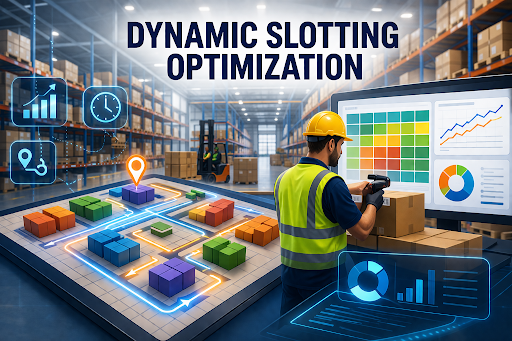
Dynamic slotting resolves these constraints by continuously aligning SKU placement with live demand signals and picking behavior. Instead of optimizing layout in isolation, it optimizes how work actually moves through the warehouse. At a system level, dynamic slotting:
- Maintains high pick density by positioning frequently accessed SKUs for the fastest retrieval
- Reduces path variability by aligning placement with current order structures
- Adapts continuously to demand changes, eliminating placement lag
This ensures that high-frequency SKUs remain in high-access zones, frequently co-picked items stay clustered, and pick paths remain compact as demand evolves. By addressing inefficiencies at the source, dynamic slotting reduces non-value-added movement, stabilizes flow, and improves picking speed without increasing labor effort.
At scale, this transforms slotting from a static configuration into a continuous optimization layer that directly governs picking efficiency.
Continuous Re-slotting Based on Order Patterns
Order patterns define how work flows through the warehouse. As SKU combinations and order structures evolve, slotting must adapt to maintain efficient pick paths.
Dynamic slotting for fast-moving SKU optimization continuously recalibrates placement based on live order behavior, ensuring that frequently picked items remain accessible and that pick sequences remain efficient over time.
SKU Velocity and Affinity Driven Positioning
Beyond individual SKU movement, dynamic slotting considers relationships between items. Frequently co-picked SKUs are positioned closer together, reducing fragmentation in multi-line orders.
This improves pick density and reduces unnecessary movement by improving how picks are grouped and executed.
Suggested Read: Micro Slotting Optimization for High Sku Warehouses to Improve Pick Efficiency
High Impact Slotting Strategies to Reduce Picking Time
In high-volume warehouses, efficiency gains come from targeted interventions at the SKU and workflow level.
| Strategy | What It Does | Operational Impact |
| Forward pick optimization | Positions high-velocity SKUs in the closest, most accessible locations | Shorter pick paths and faster cycles |
| Cluster-based slotting | Groups frequently co-picked SKUs together | Reduced cross-aisle movement and higher pick density |
| Dynamic zone adjustment | Redistributes workload based on demand spikes | Lower congestion and stable throughput |
AI-Driven Slotting Optimization
As warehouse complexity increases, the limiting factor is no longer data availability; it is decision speed and execution alignment.
Traditional slotting relies on periodic analysis and manual updates, creating delays between insight and action. AI-driven slotting removes this lag by continuously processing operational data and generating real-time placement decisions.
This fundamentally changes how slotting operates:
- From periodic updates → continuous optimization
- From reactive adjustments → predictive positioning
- From manual decisions → system-driven execution
AI systems evaluate SKU velocity shifts, order patterns, and zone activity in real time, ensuring that placement decisions are always aligned with current conditions.
Suggested Read: Dynamic Slotting Optimization for Ecommerce Warehouses to Improve Fulfillment Speed
Real-Time Slotting Recommendations Using AI
AI-driven systems detect changes in SKU behavior as they happen and adjust placement logic accordingly. This ensures that slotting decisions reflect actual demand, not historical assumptions.
The result is consistent picking efficiency across shifts, even as conditions change. Synkrato uses AI agents to analyze order history, inventory, and demand patterns, allowing warehouses to validate impact before execution and avoid costly rework.
Simulation-Based Validation Before Execution
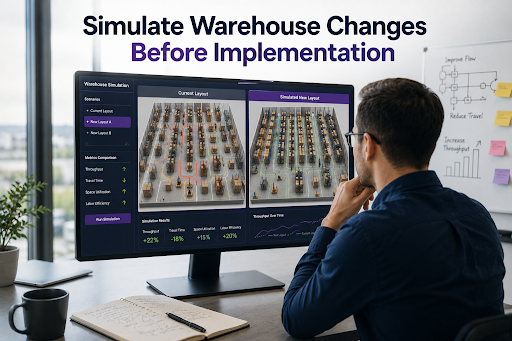
One of the biggest risks in slotting is implementing changes without understanding the downstream impact. Simulation environments address this by allowing warehouses to test slotting scenarios before execution.
This ensures that decisions are not only optimal in theory but practical within real operational constraints, reducing disruption and improving confidence in execution. Synkrato’s simulation and optimization solution was built exactly for that.
Business Impact on Warehouse Performance
Dynamic slotting improves performance by removing structural inefficiencies in movement and workflow design.
| Impact Area | What Changes | Business Outcome |
| Picking time | Shorter and more predictable pick paths | Faster order completion |
| Throughput | Higher picks per hour | Ability to handle more volume |
| Labor efficiency | Reduced non-value-added movement | Lower cost per order |
A significant portion of picking effort is spent on non-value-added movement, highlighting the need to reduce unnecessary travel rather than increase labor. Reducing movement at scale directly translates into faster operations and better resource utilization.
Suggested Read: Dynamic Slotting Optimization for 3pl Operations to Reduce Labor Costs
When to Implement Dynamic Slotting
Dynamic slotting becomes necessary when performance declines without any structural change in operations. Early indicators include:
- Rising picking time despite stable volumes
- Increasing congestion in specific zones
- Declining picks per hour across shifts
- Growing imbalance in workload distribution
These signals indicate that SKU placement is no longer aligned with demand, and inefficiencies are being absorbed by labor.
Implementation Approach for High Volume Warehouses
Dynamic slotting strategies for high SKU warehouses introduce controlled, high-impact changes that align placement with execution.
- Focus on High Impact SKUs and Zones: A small percentage of SKUs drives the majority of picking activity. Prioritizing these areas delivers immediate efficiency gains without large-scale disruption.
- Integrate Slotting with Execution Systems: Slotting decisions must translate directly into picking workflows. Integration with WMS ensures that updated placement logic is reflected in real-time execution.
- Establish a Continuous Optimization Loop: Dynamic slotting is an ongoing process. Performance data must continuously feed back into slotting logic, ensuring that placement evolves with demand.
Enabling Dynamic Slotting at Scale with Synkrato
Platforms like Synkrato enable dynamic slotting at scale by adding a decision-intelligence layer above the WMS. Using a 3D digital twin, warehouses can simulate slotting changes, validate impact on picking time, and execute only the most effective strategies.
AI-driven recommendations continuously optimize SKU placement based on real-time demand, ensuring faster decisions, reduced travel, and consistent picking efficiency without disrupting live operations.
Suggested Read: Real Time Slotting Optimization for High Sku Environments to Improve Efficiency
Final Perspective
In high-volume warehouses, picking efficiency is not limited by labor. It is constrained by how intelligently work is structured and executed.
Dynamic slotting transforms this by continuously aligning placement with demand, eliminating inefficiencies before they compound. At scale, it becomes a core capability for maintaining speed, consistency, and operational control in complex environments.
Is your operation scaling throughput or just scaling effort? Reach out to Synkrato to ensure that your warehouse operates with structural efficiency, not incremental fixes.
Suggested Read: Slotting Optimization for Robotic Fulfillment Centers to Increase Throughput
FAQs
How do I know if my warehouse is losing productivity due to poor slotting?
Productivity loss from poor slotting rarely shows up as a single issue. It appears as a pattern. If picking time is increasing despite stable volumes, pick rates are declining, or certain zones consistently experience congestion while others remain underutilized, it indicates that SKU placement is no longer aligned with demand. The system is forcing labor to compensate for structural inefficiencies. Platforms like Synkrato make these patterns visible by analyzing execution data and highlighting where slotting misalignment is driving hidden labor waste.
What is the measurable impact of dynamic slotting on picking time and labor cost?
Dynamic slotting reduces non-value-added movement, which directly lowers picking time per order and increases picks per hour. At scale, this improves labor productivity and reduces cost per order without increasing headcount. The impact compounds across high volumes, where even small reductions in travel distance translate into significant cost savings.
What data is required to implement dynamic slotting effectively in high-volume warehouses?
Effective dynamic slotting depends on continuous visibility into how work flows through the warehouse. This includes SKU velocity trends, real-time order inflow, SKU affinity (co-picking patterns), zone-level activity, and labor performance metrics. Without these inputs, slotting decisions become reactive rather than aligned with actual execution conditions. Systems like Synkrato unify these data streams and convert them into actionable slotting recommendations aligned with real-world constraints.
How quickly can dynamic slotting show ROI in real warehouse operations?
Initial improvements can appear within weeks when high-impact SKUs and zones are optimized first. More substantial gains, such as consistent reductions in picking time and labor effort, typically materialize over one to three months as the system stabilizes and continuously adapts to demand patterns. Platforms like Synkrato accelerate this timeline by enabling the simulation of slotting changes before execution, ensuring faster and more predictable gains.
Can dynamic slotting be implemented without disrupting ongoing warehouse operations?
Yes, when executed correctly, dynamic slotting is introduced incrementally rather than through large-scale changes. High-impact adjustments are prioritized, and updates are often triggered by demand thresholds instead of constant movement. When integrated with execution systems, platforms like Synkrato ensure that slotting changes align with ongoing workflows, minimizing disruption while maintaining operational stability.
What are the key signs that static slotting is no longer working for my warehouse?
Static slotting breaks down when variability increases. Key signs include frequent re-handling of inventory, misalignment between fast-moving SKUs and their locations, rising congestion in specific zones, and inconsistent picking performance across shifts. These indicate that placement is no longer synchronized with actual demand patterns.
How does dynamic slotting integrate with existing WMS or warehouse systems?
Dynamic slotting operates as a decision layer that connects to existing systems rather than replacing them. It integrates with WMS to access real-time data, update SKU locations, and align with picking and replenishment workflows. Platforms like Synkrato extend this by creating a continuous feedback loop between planning and execution, ensuring that slotting decisions adapt based on actual warehouse performance.