
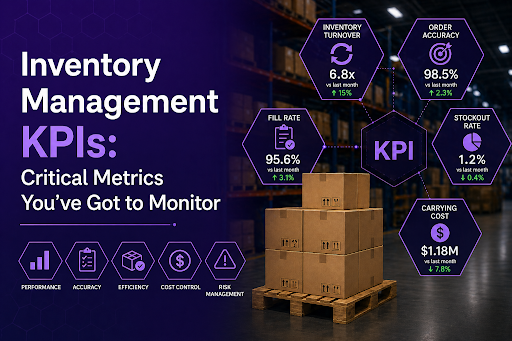
Inventory performance is no longer a back-office metric as it directly impacts working capital, service levels, and operating margin. Studies show that inventory holding costs can account for 20-30% of total stock value, making KPI visibility a financial priority, not just an operational one.
In 2026, the focus is shifting from static reporting to real-time, decision-driven inventory management KPIs where accuracy, responsiveness, and execution alignment define performance.
Why Inventory Management KPIs Are Critical in 2026
Inventory complexity has increased across industries due to SKU proliferation, demand volatility, and multi-node supply chains. Traditional warehouse inventory KPI tracking, built on periodic reporting, cannot keep pace with real-time execution requirements.
You are no longer measuring performance after the fact. You are using inventory management KPIs to actively control outcomes.
- Working capital pressure is rising: Inventory carrying costs typically range between 20-30% of inventory value annually
- Service expectations are tightening: Companies with high inventory accuracy (>98%) achieve significantly higher order fulfillment performance
- Execution gaps are measurable: Up to 50% of warehouse labor time is still spent on non-value-added activities like travel.
This shifts the role of KPIs from reporting tools to operational control mechanisms. However, most organizations still face three structural limitations:
- KPIs are lagging indicators, not decision inputs
- Metrics are siloed across systems (WMS, ERP, OMS)
- There is no closed loop between KPI insight and execution
This is where platforms like Synkrato shift the approach, from static KPI tracking to simulation-led decision-making. Using its digital twin and scenario-based optimization capabilities, Synkrato translates inventory KPIs into validated execution decisions that improve turnover, availability, and space utilization before changes are deployed.
Suggested Read: What is Virtual Warehousing
10 Inventory Management KPIs You Can’t Ignore in 2026
These are not reporting metrics. Each KPI below is a decision variable that directly influences working capital, service levels, and execution efficiency. The value comes from how you act on them, not just how you measure them.
Inventory Turnover Ratio
The inventory turnover ratio measures how efficiently inventory is sold and replenished over a period. It reflects how well you are converting inventory into revenue.
Formula: Inventory Turnover = Cost of Goods Sold (COGS) / Average Inventory
Application
A low turnover indicates excess stock, poor demand alignment, or slow-moving SKUs tying up capital. A high turnover suggests efficient inventory flow but may also signal risk of stockouts if not balanced.
Leading organizations no longer treat this as a static KPI. They segment turnover by SKU category, location, and demand volatility to identify where capital is locked vs. where availability risk exists.
With platforms like Synkrato, turnover is continuously optimized by aligning SKU placement and replenishment decisions with real-time demand signals, ensuring faster inventory movement without compromising service levels.
Suggested Read: Warehouse Inventory Management
Days Sales of Inventory (DSI)
DSI represents the average number of days it takes to sell inventory. It indicates how long capital remains tied up before conversion into revenue.
Formula: DSI = (Average Inventory / COGS) × Number of Days
Application
Higher DSI reflects slower inventory movement and increased holding cost exposure. Lower DSI improves liquidity but may increase replenishment pressure. In practice, DSI must be analyzed alongside demand variability. Reducing DSI blindly can lead to service degradation in volatile environments.
Advanced systems monitor DSI dynamically across SKU clusters and adjust replenishment and slotting strategies in real time, ensuring optimal balance between availability and capital efficiency.
Suggested Read: What is Warehouse Mapping
Weeks Inventory on Hand (WOH)
Weeks Inventory on Hand or WOH indicates how many weeks current inventory can support expected demand.
Formula: WOH = Current Inventory / Average Weekly Demand
Application
WOH is critical for planning buffer levels across supply chains. Excess WOH increases carrying cost, while insufficient WOH exposes operations to stockouts. In multi-node networks, WOH must be managed at a granular level rather than aggregated globally.
Modern inventory systems use demand sensing and short-term forecasting to continuously recalibrate WOH targets, ensuring inventory is positioned where it is most needed.
Sell-Through Rate
Sell-Through Rate measures the percentage of inventory sold compared to what was received over a given period.
Formula: Sell-Through Rate = (Units Sold / Units Received) × 100
Application
This key inventory performance indicator helps identify demand alignment at the SKU level. Low sell-through indicates overstocking or weak demand signals, while high sell-through may indicate missed sales opportunities due to understocking.
In high-velocity environments, sell-through is used to dynamically adjust replenishment cycles and inventory allocation across locations.
Real-time analytics platforms improve this by detecting demand shifts early and triggering corrective actions before imbalance becomes systemic.
Stock-to-Sales Ratio
The stock-to-sales ratio compares available inventory to sales volume, indicating whether inventory levels are aligned with demand.
Formula: Stock-to-Sales Ratio = Inventory Value / Sales Value
Application
A high ratio suggests overstocking, while a low ratio signals potential stockouts. This KPI is particularly useful for category-level planning and demand alignment across business units.
Organizations increasingly use this metric in conjunction with predictive analytics to proactively rebalance inventory before inefficiencies impact revenue or cost.
Suggested Read: Warehouse Planning
Lost Sales Rate
Lost Sales Rate measures the percentage of demand that could not be fulfilled due to stock unavailability.
Formula: Lost Sales Rate = (Lost Sales / Total Demand) × 100
Application
Lost sales directly impact revenue and customer experience but are often underreported due to a lack of visibility. Research indicates that stockouts can reduce sales by 4% in retail and distribution environments.
Modern systems estimate lost sales using demand inference models, enabling you to quantify revenue leakage and adjust inventory strategies accordingly.
Warehouse Space Utilization
Warehouse Space Utilization measures how effectively available storage capacity is used within the warehouse.
Formula: Space Utilization = (Used Storage Space / Total Available Space) × 100
Application
Low utilization indicates wasted capacity, while excessive utilization leads to congestion, reduced picking efficiency, and operational bottlenecks. Optimal utilization is not about maximizing occupancy, but balancing accessibility and throughput.
Dynamic slotting and space optimization engines continuously adjust SKU placement to maintain efficient storage density while preserving pick efficiency.
Suggested Read: Warehouse Management System Cost
Supplier Quality Index (SQI)
Supplier Quality Index (SQI) evaluates supplier performance based on quality, reliability, and compliance metrics.
Formula: SQI = (Accepted Units / Total Received Units) × 100
Poor supplier quality leads to downstream inefficiencies, including rework, delays, and inaccurate inventory records.
High-performing supply chains integrate SQI into procurement and replenishment decisions, prioritizing suppliers that consistently meet quality and delivery standards.
Advanced systems incorporate supplier performance into inventory planning models, reducing variability at the source.
Order Fulfillment Rate
Order Fulfillment Rate measures the percentage of customer orders fulfilled completely and on time.
Formula: Order Fulfillment Rate = (Orders Fulfilled / Total Orders) × 100
Application
This KPI reflects the combined effectiveness of inventory availability, picking efficiency, and order processing.
Best-in-class operations achieve fulfillment rates above 95-99%, directly impacting customer retention and SLA compliance.
Improving this metric requires synchronization across inventory positioning, picking workflows, and replenishment cycles, areas where real-time optimization systems deliver measurable gains.
Suggested Read: Inventory Management vs. Warehouse Management
Inventory Accuracy Rate
Inventory Accuracy Rate measures how closely recorded inventory matches actual physical inventory.
Formula: Inventory Accuracy = (Accurate Inventory Records / Total Inventory Records) × 100
Application
Low accuracy leads to incorrect decisions across replenishment, picking, and order fulfillment.
Industry benchmarks show that leading warehouses maintain inventory accuracy above 99%, which directly correlates with improved operational efficiency.
Real-time tracking, cycle counting automation, and system synchronization are critical to maintaining high accuracy levels.
Platforms like Synkrato enhance this by using digital twin simulation and AI-driven analysis to align inventory data with real-time warehouse conditions, helping reduce discrepancies and improve decision accuracy.
From KPI Tracking to KPI Control with Synkrato
Inventory Management KPIs are no longer just indicators of past performance. They are levers that directly influence cost, service levels, and operational stability. The real constraint in 2026 is not visibility. It is the ability to act on KPIs in real time and at scale.
Most systems still treat KPIs as reporting outputs. The next step is turning them into decision inputs.
This is where Synkrato fits, not as a replacement for your WMS, but as a decision intelligence layer that sits above it, using your existing data to continuously optimize operations.
Suggested Read: Benefits of Warehouse Management System
With Synkrato, you can:
- Build a digital twin of your warehouse to simulate inventory, layout, and workflow decisions before execution
- Use AI slotting recommendations to continuously optimize SKU placement based on demand, inventory, and order patterns
- Run simulation and optimization scenarios to evaluate KPI impact (turnover, space utilization, fulfillment) before making changes
- Leverage AI agents (Trinity) to analyze warehouse data and generate actionable insights for inventory and operational decisions
- Improve execution efficiency by reducing travel, optimizing workflows, and aligning decisions with real-time warehouse conditions
Are you ready to move beyond static KPI tracking? Use Synkrato’s AI-driven decision intelligence to turn your inventory management KPIs into real-time, actionable improvements.
FAQs
What are inventory management KPIs?
Inventory management KPIs are measurable metrics used to evaluate how efficiently inventory is planned, stored, and moved across operations. These include key inventory performance indicators such as turnover, accuracy, fulfillment rate, and stock availability, all of which directly impact working capital and service levels.
Why do traditional inventory KPIs fail to reflect real-time warehouse performance?
Traditional inventory performance measurement KPIs are typically based on periodic reports, which creates a lag between what is happening on the warehouse floor and what is measured. In dynamic environments, this delay hides demand shifts, congestion, and execution inefficiencies, making KPIs reactive instead of actionable.
Why are KPIs important in inventory management?
Inventory management KPIs translate operational activity into measurable business outcomes. They help you control inventory costs, improve service levels, and identify inefficiencies across storage, picking, and replenishment. Without KPI-driven visibility, inventory decisions are based on assumptions rather than real performance data.
Why is Synkrato useful for improving inventory KPI accuracy and visibility?
Synkrato enhances inventory management analytics metrics by connecting real-time warehouse signals, such as SKU velocity, order flow, and congestion, with KPI tracking. Instead of relying on static reports, it enables continuous KPI monitoring and improves accuracy by aligning system data with actual execution conditions.
What are the most common inventory KPIs?
The most commonly used warehouse inventory KPIs include inventory turnover ratio, days sales of inventory (DSI), weeks on hand (WOH), sell-through rate, stock-to-sales ratio, inventory accuracy, and order fulfillment rate. These metrics provide a comprehensive view of inventory efficiency, availability, and operational performance.
Why will AI-driven platforms like Synkrato redefine how inventory KPIs are measured?
AI-driven platforms shift inventory optimization KPIs from static measurement to continuous decision-making. Synkrato, for example, uses real-time data and simulation to dynamically adjust inventory positioning and workflows, ensuring KPIs are not just tracked but actively improved through automated, data-driven actions.
How is inventory turnover KPI calculated?
Inventory turnover is calculated by dividing Cost of Goods Sold (COGS) by average inventory over a given period: Inventory Turnover = COGS / Average Inventory. With platforms like Synkrato, this KPI can be continuously monitored and improved by optimizing SKU movement, reducing excess stock, and aligning inventory flow with real-time demand patterns.