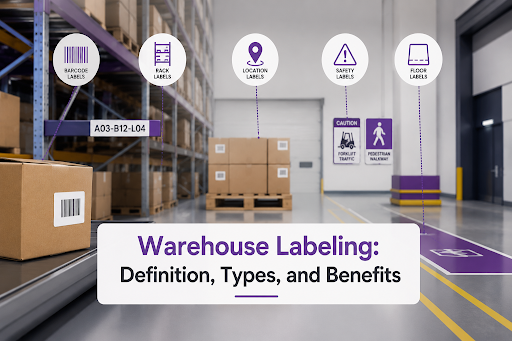
Warehouse labeling is the system used to identify inventory, storage locations, racks, aisles, pallets, floor zones, safety areas, and inventory movement points inside a warehouse. It helps connect physical warehouse activity with the digital systems that manage inventory, picking, replenishment, shipping, compliance, labor, and automation workflows.
An effective warehouse labeling system helps warehouses answer operational questions quickly, such as:
- What inventory is this?
- Where should it be stored?
- What process should happen next?
- Is the inventory compliant, traceable, and safe to handle?
This blog covers the different types of warehouse labels, their operational and compliance benefits, common challenges, and best practices for technology-ready warehouse labeling systems.
Suggested Read: Warehouse Replenishment
Types of Warehouse Labels
The right label type depends on where it is placed, how often the location changes, what information must be captured, and whether workers, scanners, forklifts, or automation systems need to read it. Here are some of the types of warehouse labels.
Rack Labels
Rack labels identify warehouse racks, bays, levels, and positions. For example, A03-B12-L04-P02 can tell the worker and system that the item belongs in aisle 3, bay 12, level 4, position 2. This is easier to scale than instructions such as “top rack near dispatch” or “back aisle.”
Common rack label types include:
- Multi-level rack labels: Used when one rack has several vertical storage levels.
- Shelving labels: Used for shelves, bins, cartons, small parts, spare parts, and each-pick zones.
- Retro-reflective rack labels: Reflective labels designed for long-range barcode scanning, with some supporting read distances of up to 45–50 feet.
Floor Labels
Floor labels identify warehouse zones, staging lanes, dock areas, forklift routes, quarantine sections, return areas, cross-dock lanes, and temporary holding spaces. They are especially useful in fast-moving warehouses where pallets, carts, totes, and containers shift throughout the day.
Common floor label types include:
- Heavy-duty adhesive labels: Used for warehouse floors exposed to forklift traffic, pallet jacks, abrasion, and industrial cleaning.
- Drive-through and staging labels: Designated for pallet loading zones, staging lanes, dock-door positions, safe-clearance areas, and temporary holding spaces.
- Color-coded floor labels: These labels separate inbound, outbound, returns, hazardous materials, quality hold, pedestrian walkways, and forklift lanes. For instance, yellow is commonly used for aisleways, traffic lanes, and work cells.
- Directional floor labels: These labels use arrows, symbols, or text to guide movement across receiving, picking, packing, dispatch, and return areas.
Location Labels
Location labels identify fixed storage points inside a warehouse, including racks, shelves, bins, totes, drawers, mezzanine locations, dock doors, and pick faces. Location labels usually include:
- Zone: Identifying the larger warehouse area, such as receiving, reserve storage, forward pick, returns, or cold storage.
- Aisle: Directing workers to the correct row or traffic path.
- Bay: Showing the rack section or shelving section.
- Level: Identifying the vertical storage level.
- Position, bin, or slot: Pointing to the exact storage space.
Additionally, global location numbers can identify locations at any organizational or physical level. These labels can be encoded in barcodes or EPC/RFID tags to support the identification and management of warehouse locations.
Barcode Labels
Barcode labels capture key information such as SKU IDs, lot numbers, serial numbers, purchase order references, pallet IDs, carton IDs, expiration dates, and handling instructions. Common warehouse barcode labeling types include:
- 1D barcodes: Linear barcodes that convert numbers or short alphanumeric strings into a scannable format.
- 2D barcodes: Include QR codes and Data Matrix codes.
- GS1-128 labels: Used in general distribution and logistics, and can hold up to 48 symbol characters. They can carry data such as GTINs, Serial Shipping Container Codes (SSCCs), best-before dates, batch or lot numbers, quantity, and weight.
Suggested Read: Wave Picking in Warehouses
Hazard and Safety Labels
Hazard and safety labels identify risks inside the warehouse so workers can understand what is dangerous, restricted, heavy, flammable, chemical-based, or equipment-controlled before they act. Common hazard and safety label types include:
- Chemical hazard labels: Identify chemicals that may be flammable, corrosive, toxic, reactive, or harmful to health.
- Forklift and traffic labels: Mark forklift routes, pedestrian walkways, blind corners, loading docks, and restricted vehicle areas.
- Weight capacity labels: Communicate safe working loads for racking structures, shelves, mezzanines, and storage equipment.
- Flue space labels: Mark the required gaps between racks and pallets so sprinkler water can reach stored inventory during a fire. About 6-inch transverse flue spaces are expected between loads and at rack uprights in rack storage systems.
- Emergency and fire safety labels: Identify exits, fire extinguishers, fire hose stations, evacuation routes, eyewash stations, and first-aid areas. ISO 7010:2019 is relevant for multinational warehouses to standardize safety signs.
Magnetic Labels
Magnetic labels are removable warehouse labels used on metal racks, shelves, bins, totes, and temporary storage locations. They are useful when warehouse layouts change often, seasonal SKUs rotate, or slotting plans need frequent updates without scraping adhesive labels or reprinting the entire location system.
However, they may not perform well on non-metal fixtures, rough surfaces, cold storage areas, or locations where repeated impact can shift the label out of position.
Pallet Labels
Pallet labels identify inventory at the pallet level so warehouses can track grouped goods through receiving, putaway, replenishment, cross-docking, shipping, returns, and traceability workflows. Pallet label information includes:
- Pallet ID or License Plate Number (LPN)
- SKU and quantity
- Lot number and expiration date
- Supplier and receiving details
- Destination or dock information
- Handling instructions
Some of the common pallet label types include:
- LPN labels: These labels act as a unique identifier for a pallet, carton, container, or grouped inventory unit inside the warehouse management system (WMS).
- SSCC pallet labels: An SSCC is an 18-digit identifier assigned to a logistics unit, such as a pallet or case, and acts like a license plate for tracking shipments through the supply chain.
- Bin and tote labels: These smaller labels identify modular storage such as totes, bins, drawers, small-parts containers, and case-picking locations.
Custom Labels
Custom labels are used when standard rack, floor, barcode, or pallet labels do not capture the handling instruction, storage condition, system data, or risk information needed at the point of work.
Some of these types include:
- Freezer-grade labels: Used for cold chain storage, frozen inventory, refrigerated zones, and temperature-sensitive products where standard adhesives may fail.
- Wash-resistant labels: Used on reusable totes, crates, bins, and containers exposed to cleaning, moisture, handling, or repeated circulation.
- RFID-enabled labels: Used when warehouses need item-level visibility without direct line-of-sight scanning. 100% of Decathlon products carried RFID tags, with more than 50,000 RFID readers used across factories, warehouses, and stores.
- Compliance labels: Used for hazardous materials, regulated products, food traceability, chemical handling, or customer-mandated documentation.
- Return and reverse logistics labels: Used for return merchandise authorization, refurbishment, repair, resale, disposal, or supplier return workflows.
Suggested Read: Multi Warehouse Management
Benefits of Effective Warehouse Labeling
Effective warehouse labeling improves inventory visibility, operational accuracy, traceability, compliance, workforce productivity, and fulfillment efficiency by creating a standardized identification system across warehouse operations. For instance,
- Streamlined Inventory Management: When racks, pallets, bins, totes, staging lanes, and cartons have standardized identifiers, WMS validates inventory movement in real time across receiving, putaway, replenishment, picking, cross-docking, and shipping workflows. RFID-enabled labeling expands this visibility further because inventory can be identified without direct line-of-sight scanning.
- Enhanced Accuracy and Reduced Errors: Inventory identification improves operational performance. It helps warehouse managers increase inventory accuracy and productivity.
- Improved Safety and Compliance: Safety labeling identifies forklift traffic zones, hazardous materials, PPE requirements, rack load limits, battery charging stations, emergency exits, flue spaces, and restricted-access areas directly at the point of work. This reduces dependency on verbal instructions in fast-moving operational environments.
- Optimized Space Utilization: Warehouse labeling supports slotting optimization by making storage density, pick velocity, replenishment frequency, and location utilization measurable at a granular level. Accurate aisle, bay, level, and slot labeling allows warehouses to separate fast-moving and slow-moving inventory more efficiently while reducing congestion across staging, reserve storage, and forward-pick areas.
- Facilitated Employee Training and Productivity: Workers can follow location hierarchies, barcode prompts, zone identifiers, and workflow labels without relying heavily on supervisor intervention.
- Scalability and Adaptability: Scalable warehouse labeling systems allow businesses to expand SKU counts, automation infrastructure, compliance workflows, and fulfillment complexity without redesigning the entire warehouse identification structure.
- Enhanced Customer Satisfaction: Accurate labels reduce mispicks, shipment mismatches, inventory substitutions, and return-processing delays that can damage customer trust.
Synkrato improves labeling accuracy and warehouse visibility by connecting label-driven inventory movement with real-time operational data, warehouse workflows, and system-level execution insights.
Suggested Read: Warehouse Receiving Process
Challenges & Solutions of Warehouse Labeling
Warehouse labeling challenges appear when labels cannot support real warehouse conditions, which change inventory requirements, automation systems, compliance rules, or high-volume operational movement.
Challenge 1: Durability and Legibility
Warehouse labels often operate in environments exposed to moisture, dust, freezer temperatures, oil, abrasion, UV exposure, industrial cleaning chemicals, and continuous forklift movement. Over time, labels may fade, peel, smudge, scratch, or become unreadable, reducing scan accuracy and operational visibility.
Solution: Common examples include:
- Polyester or polypropylene labels for general warehouse durability
- Freezer-grade adhesives for cold storage environments
- Metal-compatible RFID tags for metal surfaces
- UV-resistant labels for outdoor or dock areas
Challenge 2: Accurate and Up-to-Date Information
Many warehouses struggle with labels generated from old SKU masters, disconnected spreadsheets, incorrect supplier data, or outdated slotting structures.
Solution: Key practices include:
- Defining a single source of truth for inventory and label data
- Standardizing mandatory label fields across warehouse operations
- Controlling who can create, edit, or approve labels
Challenge 3: Efficient Placement and Layout
Warehouses commonly face problems such as labels hidden behind pallets, barcode labels positioned at poor scanning angles, dock labels not visible from staging lanes, or floor labels damaged by forklift traffic.
Solution: Common placement strategies include:
- Aligning rack labels with natural picking paths
- Using overhead signs in high-bay storage areas
- Combining floor markings with hanging location signage
- Using retro-reflective or long-range barcode labels where needed
Challenge 4: Integration with Technology
Modern warehouse labels must work across scanners, mobile devices, RFID readers, printers, automation systems, warehouse management systems, and analytics platforms. If labels are poorly integrated, warehouses continue relying on manual keying, duplicate data entry, and disconnected workflows.
Solution: Important technology validation and integration practices include:
- Ensuring scanner compatibility and print resolution accuracy
- Standardizing label sizing and quiet-zone spacing
- Mapping labels correctly to WMS fields and operational workflows
- Validating RFID tag frequency, read range, and encoding rules
- Preparing infrastructure for 2D barcode adoption and Sunrise 2027 requirements
Synkrato can integrate warehouse labeling workflows with WMS, mobility systems, barcode scanning, and operational data sources to improve real-time visibility, traceability, and workflow synchronization across warehouse operations.
Challenge 5: Training and Adaptability
A warehouse labeling system fails when workers do not understand how to interpret location structures, barcode rules, color coding, or exception-handling procedures. Training becomes more difficult in facilities with seasonal labor, multilingual teams, temporary workers, or frequently changing warehouse layouts.
Solution: Effective training practices include:
- Explaining location hierarchy and warehouse code structures
- Standardizing color meanings across warehouse zones
- Teaching quarantine and quality-hold label handling processes
- Using visual SOPs, onboarding maps, and scanner prompts
Challenge 6: Cost Management
Aggressively reducing labeling costs can create higher downstream expenses through failed scans, picking errors, relabeling work, safety incidents, and customer claims.
Solution: Cost optimization strategies should include:
- Prioritizing durable labels for safety and compliance workflows
- Reserving temporary labels for short-life applications
- Tracking scan failure rates, replacement frequency, and labeling-related errors to measure ROI
Warehouse Labeling Best Practices
Effective warehouse labeling depends on consistency, operational alignment, technology compatibility, and long-term maintainability across warehouse workflows.
- Understand Your Needs and Layout: Warehouse labeling should reflect how inventory physically moves through receiving, putaway, replenishment, picking, packing, shipping, returns, and quality-control workflows.
- Use Durable and Appropriate Materials: Label materials should be selected based on environmental conditions, scan distance, surface type, and expected label life instead of using one specification across all warehouse zones.
- Implement Clear and Consistent Labeling: Consistent location codes, barcode placement, naming structures, fonts, and color logic reduce operational confusion and improve scan reliability across warehouse workflows.
- Incorporate Technology for Efficiency: Barcodes, RFID, QR, and 2D labels help reduce manual entry, improve inventory traceability, and support real-time warehouse validation.
- Strategically Place Labels for Accessibility: Labels should be positioned where workers naturally look and where scanners can read them quickly during movement.
- Regularly Update and Maintain Labels: Warehouse labels should be reviewed continuously during cycle counts, slotting updates, safety audits, compliance reviews, layout redesigns, and automation projects.
- Train Staff on the Labeling System: Training should include barcode workflows, location hierarchy, damaged-label procedures, exception handling, and quarantine or quality-hold processes using real warehouse examples.
- Stay Compliant with Regulations: Labeling systems should align with OSHA, food traceability, hazardous materials, and industry-specific compliance requirements.
- Continuously Evaluate and Improve: Businesses should monitor metrics such as scan success rates, mispick frequency, cycle count variance, label replacement rates, and compliance exceptions to identify operational gaps and improve warehouse execution over time.
Suggested Read: What is the Correct Product Flow in a Warehouse
How Synkrato Supports Warehouse Labeling Operations?
As warehouses adopt more automation, RFID, 2D barcodes, and AI-driven workflows, connected warehouse intelligence becomes important for maintaining labeling accuracy, traceability, and execution consistency across operations. Synkrato enables connected warehouse workflows through AI-driven slotting, digital twin visibility, and operational intelligence capabilities that support more accurate, traceable, and synchronized warehouse execution.
- AI slotting recommendations that help optimize inventory positioning, storage allocation, and rack-level movement visibility
- 3D digital twin capabilities that help warehouses visualize layouts, storage zones, and workflow movement before operational changes are implemented
- Connected warehouse workflows that improve synchronization between WMS data, barcode scanning, mobility systems, and operational execution
Book a demo with Synkrato to explore how connected warehouse intelligence can improve labeling visibility, slotting accuracy, and warehouse execution performance.
FAQs
What is warehouse labeling?
Warehouse labeling is the system used to identify inventory, storage locations, racks, pallets, bins, floor zones, and operational movement points inside a warehouse. It helps workers, scanners, warehouse management systems, and automation platforms track inventory accurately across receiving, putaway, picking, shipping, and compliance workflows.
Why is warehouse labeling important for warehouse efficiency?
Warehouse labeling improves inventory visibility, picking accuracy, replenishment speed, and workflow consistency across warehouse operations. Synkrato enhances efficiency through AI-driven warehouse intelligence, connected operational workflows, and real-time visibility across inventory movement and execution processes.
What types of labels are commonly used in warehouses?
Common warehouse labels include rack labels, floor labels, location labels, barcode labels, pallet labels, hazard and safety labels, magnetic labels, RFID labels, and custom compliance labels.
What challenges can poor warehouse labeling create?
Poor warehouse labeling can create inventory mismatches, picking delays, shipment inaccuracies, compliance risks, rescanning issues, and operational inefficiencies. Synkrato helps reduce these risks through centralized labeling workflows, warehouse intelligence, AI-driven slotting recommendations, and real-time operational visibility.
How can Synkrato help businesses improve warehouse labeling efficiency?
Synkrato helps businesses improve warehouse labeling efficiency through enterprise labeling, AI slotting recommendations, digital twin capabilities, and connected warehouse workflows. The platform centralizes label lifecycle management, reduces label misprints, improves traceability, and supports more accurate inventory movement across warehouse operations.
Why do warehouses still experience inventory and picking errors despite using labeling systems without platforms like Synkrato?
Many warehouses still experience errors because labeling systems alone may not connect slotting logic, warehouse execution, inventory movement, and operational data in real time. Without Synkrato, warehouses may continue operating with disconnected workflows, outdated storage decisions, and limited operational visibility.
What operational improvements can Synkrato support alongside warehouse labeling systems?
Synkrato supports operational improvements such as AI-driven slotting optimization, digital twin simulation, real-time inventory visibility, mobility workflows, warehouse execution insights, and more accurate pick, putaway, replenishment, and receiving processes. The AI agents also help businesses convert warehouse data into actionable operational recommendations.