
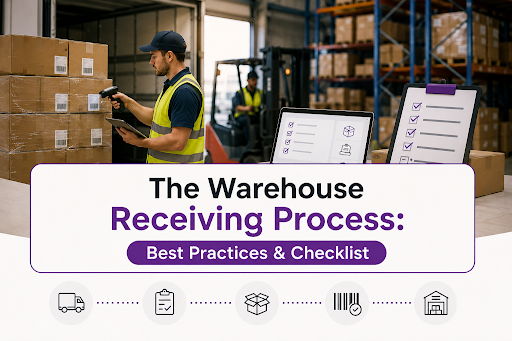
The warehouse receiving process controls how inventory enters the warehouse, gets verified, and becomes available for storage, replenishment, picking, or shipping. It improves inventory accuracy, reduces delays, and helps warehouses maintain better operational visibility.
Inventory accuracy also has a direct business impact. Inaccurate inventory records can cost retailers approximately 4% of annual sales, which shows why receiving accuracy matters beyond the warehouse floor.
In this blog, we cover the warehouse receiving process steps, common mistakes, best practices, and a receiving checklist.
Steps in the Warehouse Receiving Process
Each step in the warehouse receiving procedure helps warehouses maintain inventory accuracy, prevent receiving errors, and improve visibility across inbound operations.
Proper Documentation
Warehouse receiving starts before the shipment arrives. The receiving team reviews ASNs, purchase orders, delivery notes, supplier records, carrier details, and dock schedules to prepare labor, equipment, staging space, and unloading capacity in advance.
Synkrato helps warehouses connect inbound shipment data, dock schedules, and operational workflows to improve receiving visibility before inventory reaches the warehouse.
Essential Documentation Requirements
Warehouse receiving documentation should include:
- Purchase Order (PO) details, including SKU, quantity, supplier, and delivery terms.
- ASN details, including shipment, pallet, carton, carrier, and arrival information.
- Bill of Lading or delivery note for transport verification.
- Packing lists for item-level validation.
- Inspection records for damaged, missing, expired, or non-conforming inventory.
- WMS or ERP receiving records showing accepted, rejected, quarantined, or held inventory.
Receiving and Unloading Shipments
The receiving and unloading stage confirms that inbound shipments match scheduled deliveries before inventory enters warehouse storage. The receiving team checks dock appointments, carrier paperwork, seal condition, safety requirements, and assigned unloading areas before unloading begins.
Verifying Shipment Details
Warehouse teams should compare received inventory against the PO, ASN, packing list, and delivery documentation. Key verification checks include:
- Supplier name and shipment reference.
- PO number and ASN number.
- SKU, item description, quantity, batch, lot, serial, or expiry details.
- Carton count, pallet count, and packaging structure.
- Visible damage, shortages, overages, or incorrect items.
Best Practices for Unloading
Warehouse unloading should be planned around dock flow, labor availability, and shipment priority to reduce congestion and delays across inbound operations.
Common unloading best practices include:
- Assigning dock doors based on shipment type and urgency.
- Using clearly marked staging lanes by supplier, shipment, or temperature zone.
- Separating damaged or questionable inventory immediately.
- Using barcode or scan-based verification instead of manual paperwork.
Suggested Read: Warehouse Replenishment
Inventory Counting
Inventory counting verifies whether received inventory matches expected quantities before stock becomes available in the warehouse system. Counting may happen at the pallet, carton, item, batch, or serial level depending on product type, compliance requirements, inventory value, and supplier reliability.
Matching Received Items with Documentation
Warehouse teams should compare received inventory against the PO, ASN, packing list, and delivery note before confirming receipt. If the shipment matches, the WMS can update inventory records and trigger putaway tasks. If discrepancies appear, the warehouse receiving system should flag the exception before inventory becomes available for operations.
Using Technology for Accuracy
Barcode scanning, RFID, mobile receiving applications, dock tablets, and WMS-directed workflows help warehouses reduce manual counting errors and improve receiving speed. For instance, RFID can increase item-level inventory accuracy to more than 95% and can reduce retail out-of-stocks by up to 50%.
Synkrato strengthens receiving visibility by connecting inventory movement, operational data, and warehouse workflows into one decision-making layer.
Inventory Inspection
Inventory inspection verifies whether the received goods are suitable for the available warehouse stock. During this stage, warehouse teams check for product damage, incorrect inventory, contamination risks, expiry issues, packaging defects, labeling errors, quantity mismatches, and supplier compliance problems before inventory moves to storage.
Quality Control Measures
Quality checks should happen before inventory enters storage or becomes available in the WMS. The receiving team typically inspects:
- Visible transport damage
- Crushed cartons, broken seals, leaks, or moisture exposure
- Expiry dates, batch codes, and lot numbers
- Product specifications, sizes, models, colors, or variants
Handling Non-Conforming Items
Non-conforming inventory should be separated from normal receiving and staging areas immediately. Warehouses move these goods to a quarantine or exception zone with clearly defined statuses such as damaged, short received, over received, wrong item, quality hold, or awaiting supplier approval.
Inventory Storage
Inventory storage begins after goods are verified, counted, inspected, logged, and labeled. At this stage, the WMS should assign the correct storage location based on operational requirements, not only available space.
Categorizing and Labeling Items
Warehouse labels connect physical inventory with digital inventory records. Barcodes, RFID tags, pallet license plates, carton labels, and location labels help teams identify, track, and manage inventory accurately throughout warehouse operations.
Clear labeling is important because receiving errors can create downstream issues in picking, replenishment, cycle counting, and inventory reconciliation. Barcodes help supply chain operations automatically identify and track products as they move across warehouses, transportation networks, and retail environments.
Optimizing Storage Locations
Putaway should follow system-directed logic whenever possible.
- Fast-moving inventory should be stored closer to picking and replenishment zones to reduce travel time and improve throughput.
- Heavy or oversized inventory should be placed in equipment-accessible locations, while expiry-controlled products should follow FEFO inventory rules.
- High-value or regulated inventory may also require secured storage areas.
Technology is also improving post-receiving inventory validation. For instance, IKEA uses more than 250 AI-powered drones across 73 warehouse locations to run inventory checks and improve real-time inventory accuracy.
Suggested Read: Wave Picking in Warehouses
Common Mistakes in Warehouse Receiving
A weak receiving process in warehouses creates hidden operational debt. The warehouse may look productive because trucks are unloaded quickly, but the real cost appears later as stockouts, duplicate counts, picking errors, supplier disputes, replenishment delays, and inventory write-offs.
Common mistakes include:
- Receiving goods without checking the ASN, PO, and delivery note first.
- Scheduling too many inbound deliveries at the same dock window.
- Mixing verified and unverified goods in the same staging area.
- Updating inventory before inspection is complete.
- Allowing damaged or non-conforming items to enter available stock.
- Using handwritten count sheets that are later re-entered into the WMS.
Suggested Read: Multi Warehouse Management
Best Practices for an Optimized Receiving Process
Optimizing the warehouse receiving process helps improve inventory accuracy, reduce inbound delays, strengthen inventory visibility, and prevent downstream operational errors.
- Deploy a Proven WMS: A WMS helps warehouses standardize inbound receiving from appointment scheduling through putaway. Instead of relying on disconnected spreadsheets or manual receiving logs, the WMS connects inspection workflows, labeling, staging, and putaway into one controlled process. This improves inventory visibility while reducing receiving delays, duplicate entries, and manual reconciliation work.
- Track Key Metrics: Metrics such as dock-to-stock time, receiving accuracy, ASN compliance, putaway cycle time, damage rate, shortage frequency, and manual correction rates help warehouses identify where receiving issues originate and how they affect downstream operations. Synkrato gives warehouse teams better visibility into how receiving performance affects staging efficiency, labor coordination, replenishment flow, and downstream fulfillment operations
- Use Clear Labeling: Clear labeling improves inventory traceability from the moment goods enter the receiving zone. Barcode labels, RFID tags, pallet license plates, and location identifiers help warehouses connect physical inventory with digital inventory records accurately and consistently.
- Double-Check Documentation: Receiving documentation should be validated at multiple stages during the inbound process, including before shipment arrival, during unloading, and before inventory becomes available in the system. Warehouses should compare ASN details, carrier paperwork, POs, inspection status, and count results to prevent discrepancies from entering inventory records.
- Train Warehouse Staff: Warehouse receiving teams should be trained on inventory validation, scanning discipline, inspection procedures, exception handling, and putaway logic rather than focusing only on unloading activities. Receiving errors often happen when teams bypass workflows under dock pressure or peak inbound conditions.
- Efficient Labor Scheduling: Receiving labor planning should align with dock appointments, ASN visibility, shipment complexity, and inspection requirements. Not all inbound shipments require the same labor allocation. Mixed-SKU shipments, serialized inventory, temperature-sensitive goods, and compliance-controlled products often require additional verification and inspection time.
- Carry Out Regular Inspections: Regular inspections help warehouses maintain both inventory quality and process accuracy. Warehouses should continuously audit staging lanes, labeling quality, scanner compliance, quarantine handling, supplier packaging standards, and exception workflows to identify recurring operational issues early.
Suggested Read: Warehouse Labeling
Warehouse Receiving Process Checklist
A warehouse receiving checklist standardizes inbound workflows, improves inventory accuracy, reduces receiving errors, and maintains better control across unloading, inspection, labeling, and putaway operations.
Preparation
Before inbound shipments arrive, warehouses should prepare receiving resources, dock schedules, labor allocation, and staging capacity by:
- Reviewing ASNs, POs, delivery notes, and carrier appointments
- Assigning dock doors based on shipment type and warehouse capacity
- Confirming labor, equipment, pallets, labels, scanners, and staging space
- Identifying shipments needing quality inspection, temperature control, or quarantine
- Pre-planning putaway zones for high-volume or high-priority receipts
Shipment Arrival
When shipments arrive, warehouses should validate inbound delivery details and confirm receiving readiness by:
- Confirming carrier, appointment, vehicle, seal, and shipment reference
- Checking whether the shipment is early, late, partial, or unexpected
- Recording arrival time for dock-to-stock and supplier performance tracking
- Directing the vehicle to the assigned loading dock
Unloading Shipment
During unloading, warehouses should maintain inventory control and prevent receiving discrepancies by:
- Using the correct equipment for pallets, cartons, containers, or loose goods
- Staging goods in a designated receiving area
- Keeping verified, unverified, damaged, and quarantined goods separate
- Scanning pallet, carton, barcode, RFID, or license plate identifiers where available
- Recording visible damage immediately with notes and images
Verification of Goods Received
Before inventory becomes available in the system, warehouses should validate shipment accuracy by:
- Identifying shortages, overages, wrong items, and substitutions
- Checking supplier and carrier details
- Confirming whether goods should be accepted, rejected, partially received, or placed on hold
- Escalating discrepancies before the inventory is released
Documentation
Accurate receiving documentation helps warehouses maintain inventory traceability and supplier accountability by:
- Updating the WMS or ERP with received quantities and status
- Attaching proof of delivery, inspection notes, images, and discrepancy codes
- Recording non-conforming items separately
Inventory Organization and Storage
After verification and inspection, warehouses should organize and store inventory systematically by:
- Applying barcode, RFID, carton, pallet, or license plate labels
- Assigning storage locations based on WMS logic
- Prioritizing putaway by product type, velocity, expiry, weight, and demand urgency
- Scanning the location and item to confirm the correct putaway
Post Receiving Maintenance
Ongoing receiving reviews help warehouses maintain inventory accuracy and improve inbound operations over time by:
- Reviewing receiving accuracy, dock-to-stock time, and discrepancy trends
- Auditing supplier documentation and ASN compliance
- Investigating repeated damage, shortage, or labeling problems
- Reconciling held, quarantined, rejected, and returned goods
Suggested Read: What is the Correct Product Flow in a Warehouse
How Synkrato Improves the Warehouse Receiving Process?
The warehouse receiving workflow depends on accurate inventory validation, smooth inbound coordination, and real-time operational visibility. Synkrato enables warehouses to improve receiving accuracy, inbound visibility, and operational coordination by connecting warehouse data, workflows, and AI-driven decision-making into one operational layer.
Key warehouse receiving improvements supported by Synkrato include:
- Improving inbound visibility across ASNs, receiving status, staging flow, and putaway operations
- Helping warehouses identify congestion risks across docks, staging lanes, labor allocation, and equipment usage
- Supporting AI-driven recommendations for inventory movement, slotting, and storage decisions
- Enabling digital twin simulations to evaluate receiving flow, staging utilization, and operational bottlenecks before changes are deployed
Book an appointment with Synkrato to see how AI-driven warehouse decision-making can optimize your receiving operations.
Final Thoughts
The warehouse receiving process shapes the accuracy of every inventory decision that follows. Wrong quantities, missing documentation, poor labeling, or weak inspection controls can create stock discrepancies, replenishment delays, picking errors, and supplier disputes across warehouse operations.
With Synkrato, warehouses can connect inbound workflows, inventory visibility, and operational decision-making to identify bottlenecks faster and improve receiving coordination across the warehouse.
FAQs
What is the warehouse receiving process?
The warehouse receiving process is the workflow used to receive, verify, inspect, label, record, and store inbound inventory before it becomes available for warehouse operations. It typically includes ASN validation, unloading, inventory counting, quality inspection, WMS updates, and putaway activities.
Why is the warehouse receiving process important?
The warehouse receiving process directly affects inventory accuracy, replenishment flow, fulfillment speed, and supplier compliance across warehouse operations. Synkrato connects warehouse data, inbound workflows, and operational visibility to help warehouses identify receiving bottlenecks earlier and improve inventory coordination across inbound operations.
What challenges commonly affect warehouse receiving operations?
Common warehouse receiving challenges include inaccurate ASNs, dock congestion, manual documentation errors, inventory discrepancies, delayed inspections, and poor staging coordination. Synkrato reduces operational blind spots by connecting staging activity, labor allocation, dock flow, and putaway visibility into one operational workflow.
Which warehouse metrics are important for measuring receiving performance?
Important warehouse receiving metrics include dock-to-stock time, receiving accuracy, ASN compliance, putaway cycle time, shortage frequency, damage rates, and receiving labor productivity. Synkrato supports KPI-driven warehouse decision-making by connecting inbound receiving metrics with broader warehouse execution and inventory movement visibility.
How can Synkrato help businesses optimize warehouse receiving operations?
Synkrato optimizes warehouse receiving operations by connecting inbound workflows, warehouse data, and AI-driven operational insights into one operational layer. This allows warehouse teams to improve receiving coordination, identify bottlenecks faster, optimize putaway decisions, and maintain better inbound inventory visibility.
Why do warehouse receiving delays occur even with warehouse systems in place without Synkrato?
Many warehouse systems record inventory activity but lack real-time visibility into staging congestion, labor bottlenecks, dock coordination, or inbound operational delays. Synkrato addresses these visibility gaps by connecting operational workflows, inventory movement, and receiving activity to support faster issue identification and warehouse coordination.
What operational improvements can Synkrato support in warehouse receiving processes?
Synkrato supports warehouse receiving improvements through connected operational visibility, AI-driven recommendations, and coordinated inventory workflows. This includes better dock coordination, staging flow management, inventory movement visibility, labor allocation, and putaway optimization across inbound warehouse operations.