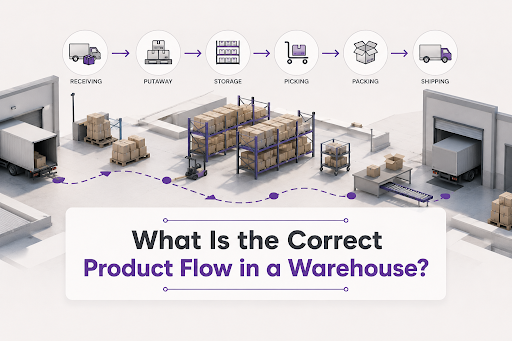
The correct product flow in a warehouse is the organized movement of goods from receiving to putaway, storage, picking, packing, and shipping. Each step should be supported by accurate inventory data, clear task sequencing, and real-time visibility.
The cost impact becomes clear in picking-heavy warehouse operations flow. Order picking can contribute more than 55% of total warehousing costs, and walking time in low-level picker-to-parts warehouses can account for 50-70% of total order picking time. These numbers show how layout, storage decisions, and routing directly affect warehouse cost and throughput.
To understand where these costs come from and how to control them, this blog answers what the correct product flow in a warehouse is. It highlights the main areas of warehouse product flow, types of warehouse flow, layout models, and technologies that improve product movement.
Suggested Read: Warehouse Replenishment
Main Areas of Warehouse Product Flow
Warehouse product flow usually follows this sequence:
Receiving → Putaway → Storage → Order Picking → Packing/Shipping
Each stage should move products forward with fewer touches, fewer manual decisions, and cleaner inventory data.
Receiving
Receiving confirms what entered the facility and whether the shipment matches the purchase order or advanced shipping notice (ASN). It also determines whether the goods are ready for storage, cross-docking, quarantine, replenishment, or further inspection before they move deeper into the warehouse.
A receiving process should include:
- Scheduled dock appointments based on labor, door capacity, and storage availability
- Scan-based receipt confirmation at the pallet, case, or item level
- Exception handling for shortages, overages, damage, temperature variance, or supplier labeling issues
- Fast routing rules for cross-dock, quarantine, value-added services, replenishment, and storage
Amazon’s Sequoia system shows why receiving now depends on storage identification. It helps identify and store inventory up to 75% faster and can reduce order processing time by up to 25% when used with other technologies. This shows why receiving should connect each product to its next best location instead of creating a waiting zone.
Putaway
Putaway determines where products should move after receiving and how efficiently they can be accessed later for replenishment, picking, or shipping. Correct putaway places inventory in the right storage, forward-pick, reserve, cold storage, hazmat, oversized, or cross-dock location based on demand patterns, dimensions, handling requirements, expiry dates, and order profiles.
An effective putaway flow should automatically determine:
- Where the product should go next
- Whether it belongs in reserve, pick face, quarantine, or cross-dock areas
- Whether it requires expiry, lot, serial, or compliance tracking
- Whether the location will reduce future travel and replenishment effort
This is where AI slotting becomes important. It helps warehouses place fast movers, co-ordered SKUs, fragile items, and seasonal inventory based on demand patterns, travel distance, and replenishment frequency instead of only available space.
Synkrato uses AI slotting recommendations and digital twin simulations to improve storage placement, reduce picker travel, and optimize replenishment flow.
Storage
Storage controls where inventory stays before it moves to picking, replenishment, or shipping.
Correct storage flow separates products based on movement patterns, not only by category. High-velocity SKUs may need forward-pick locations close to dispatch areas, reserve inventory may move into higher-density racking, and fragile or regulated products may require dedicated zones.
A storage flow should support:
- Clear zoning for fast, medium, slow, bulky, fragile, regulated, and returned inventory
- Storage density without blocking access to high-demand products
- Location-level inventory accuracy
- Replenishment triggers before pick faces run empty
- FEFO, FIFO, or batch tracking rules where expiry and traceability matter
The biggest storage mistake is maximizing density without considering movement. A warehouse may store more inventory but still reduce throughput if teams face long travel paths, constant replenishment interruptions, or narrow-aisle congestion.
Order Picking
Order picking is the stage where warehouse product flow directly affects labor efficiency, order accuracy, and shipping speed.
Picking methods should match the order profile and product movement patterns. Warehouses handling pallets, cases, eaches, subscription boxes, spare parts, or grocery orders may use different approaches, such as:
- Single-order picking
- Batch picking
- Zone picking
- Wave picking
- Cluster picking
- Goods-to-person picking
- Hybrid picking models
A picking flow helps reduce:
- Search time
- Empty walking
- Backtracking
- Mis-picks
- Picker congestion
- Replenishment interruptions
- Manual decisions at the pick face
Shipping
Shipping confirms that the correct items, quantities, labels, packaging, documents, and carrier instructions are ready before orders leave the facility.
Walmart’s AI Pallet Builder shows how outbound flow is becoming more data-driven. The system uses order data, product dimensions, weight, destination, and handling requirements to optimize how products are grouped, stacked, and shipped.
A strong shipping flow should support:
- Packing validation against order data
- Automated label generation
- Carrier- or route-based staging
- Load planning by sequence, weight, cube, and handling requirements
- Final scan confirmation before dispatch
Suggested Read: Wave Picking in Warehouses
Types of Warehouse Flow and Their Importance
Warehouse product flow depends on three connected layers, namely material flow, information flow, and documentation flow. These layers work together to keep inventory moving accurately through receiving, storage, picking, packing, and shipping.
Material Flow
Warehouse material flow refers to the physical movement of products through the warehouse. It includes unloading, putaway, storage movement, replenishment, picking, packing, staging, loading, and returns handling.
Material flow planning usually depends on:
- Inbound volume and receiving schedules
- SKU velocity
- Product dimensions and handling requirements
- Picking methods
- Replenishment frequency
- Outbound shipping schedules
- Space availability
- Equipment movement and safety paths
Information Flow
Information flow controls the movement of inventory data across warehouse systems and operations. It tells teams and systems what the product is, where it is located, whether it is available, and what action should happen next.
This is why technologies such as barcode scanning, RFID, WMS, ERP, OMS, and TMS are central to warehouse flow. Synkrato helps connect these systems into a more unified warehouse workflow process by turning warehouse data into real-time visibility, AI-driven recommendations, automations, and execution decisions.
A strong information flow should track:
- Item identity
- Quantity
- Location
- Inventory status
- Lot, batch, serial, or expiry details
- Ownership
- Order allocation
- Pick priority
- Shipment status
Documentation Flow
Documentation flow manages the records and compliance information that move with products throughout warehouse operations. This includes labels, shipping papers, customs records, inspection reports, returns documentation, and proof-of-delivery data.
A proper documentation flow should ensure:
- Inbound receipts match purchase orders or ASNs
- Product labels match item master records
- Lot, batch, serial, and expiry information is captured correctly
- Shipping labels and carrier documents are generated from validated order data
- Returns remain connected to the original order and disposition records
- Audit trails show who moved inventory, when it moved, and where it moved
Suggested Read: Multi Warehouse Management
Optimizing Warehouse Layouts for Product Flow
Warehouse layout decides whether products move in a clean path or keep crossing, reversing, and blocking each other. The right layout depends on building shape, dock placement, SKU mix, order profile, automation level, equipment type, and inbound-outbound balance.
U-Shaped Layout for Product Flow
A U-shaped layout places receiving and shipping on the same side of the building. Products enter through one side of the dock area, move through storage or processing, and return toward the outbound dock for shipping.
A U-shaped flow is useful for warehouses with:
- Limited dock frontage
- Shared inbound and outbound teams
- Frequent cross-docking
- High SKU movement
- Flexible dock usage across shifts
A U-shaped layout can create congestion when inbound unloading and outbound dispatch peak at the same time. Trucks, pallets, forklifts, and staging lanes may compete for the same space.
L-Shaped Layout for Product Flow
An L-shaped layout places receiving and shipping on adjacent sides of the building. Products enter from one side, move through storage, picking, or processing, and then turn toward the outbound side for shipping.
An L-shaped layout is useful for:
- Facilities with corner dock access.
- Warehouses with different inbound and outbound vehicle routes.
- Operations that need processing or inspection between receiving and shipping.
- Sites that want a clearer separation between receiving and dispatch.
However, an L-shaped layout may increase travel time if fast-moving SKUs are stored too far from the main picking or shipping path. In some operations, workers may spend more time walking than picking.
I-Shaped Layout for Product Flow
An I-shaped layout, also called through-flow, places receiving on one side of the building and shipping on the opposite side. Products move in a straighter path from inbound to outbound.
An I-shaped layout is useful for:
- High-throughput distribution.
- Cross-docking.
- Bulk pallet movement.
- Manufacturing inbound-to-line supply.
- Warehouses with strong inbound and outbound separation.
An I-shaped layout can create longer travel distances in deep warehouses or when slow-moving inventory blocks the primary product flow path.
Suggested Read: Warehouse Receiving Process
Tools and Technologies Enhancing Product Flow
Technology improves warehouse product flow when it reduces blind spots, improves warehouse inventory flow visibility, and helps teams make faster operational decisions.
Warehouse Management Systems (WMS)
A WMS controls and coordinates warehouse product flow. It helps warehouses assign tasks, validate inventory movement, manage storage locations, sequence picks, trigger replenishment, generate labels, and support shipping execution.
A modern WMS should help operations answer questions such as:
- What inventory arrived?
- Where should it be stored?
- Is it available for allocation?
- What should be picked first?
- Which zone, picker, or automation system should handle the task?
- Which dock, carrier, or staging lane should receive the shipment?
- Which exceptions require immediate attention?
Synkrato extends traditional WMS functionality by turning warehouse data into real-time operational decisions. Its platform helps warehouses identify bottlenecks, optimize product movement, improve replenishment flow, and simulate operational changes before execution.
Automation in Warehousing Operations
Automation improves product flow by reducing repeated travel, manual handling, slow movement between zones, and labor-intensive warehouse activities. The goal is to remove operational bottlenecks that delay product movement.
Common warehouse automation technologies include:
- Conveyors
- AMRs and AGVs
- Automated storage and retrieval systems
- Robotic palletizers
- Sortation systems
- Goods-to-person systems
- Automated label application
- Dimensioning and weighing systems
- AI-based routing and task orchestration
Walmart connects automation directly to product flow optimization. In Q3 FY25, more than 50% of fulfillment center volume was automated, which contributed to the third consecutive quarter of approximately 40% reduction in U.S. net delivery cost per order.
Inventory Tracking
Inventory tracking gives warehouses real-time visibility into where products are, what status they are in, and what action should happen next. Without accurate tracking, warehouses may struggle with misplaced inventory, delayed replenishment, shipping errors, or incorrect stock availability.
Common inventory tracking technologies include:
- Barcodes
- 2D barcodes
- RFID
- RTLS
- IoT sensors
- Computer vision
- Mobile scanning
- Voice-directed workflows
- Digital twins and warehouse control towers
For instance, GS1’s Sunrise 2027 initiative supports the transition from traditional 1D UPC barcodes to 2D barcodes that can carry richer product data, stronger traceability information, and improved supply chain visibility.
Suggested Read: Warehouse Labeling
How Synkrato Optimizes Product Movement
Correct product flow is about moving inventory through the warehouse with fewer delays, fewer unnecessary touches, and better decisions at every stage. Synkrato helps warehouses improve product flow by turning WMS and warehouse data into real-time recommendations, simulations, and operational decisions. Its optimization capabilities can help increase warehouse productivity by 25%. Synkrato can help teams:
- Identify operational bottlenecks
- Improve inventory placement with AI slotting
- Reduce picker travel and replenishment delays
- Test layout and staffing changes with digital twins
- Connect warehouse data for faster decision-making
Final Takeaway
The correct product flow in a warehouse connects the movement of goods, inventory data, and documentation from receiving to shipping with fewer delays, fewer manual decisions, and better operational visibility.
Synkrato helps warehouses improve product movement by identifying operational bottlenecks, improving inventory placement, reducing picker travel, and helping teams make faster decisions using connected warehouse data.
As a result, when warehouse flow is optimized, inventory becomes easier to track, replenishment happens faster, and shipping operates as a confirmation step instead of a problem-solving zone.
Request an appointment with Synkrato to see how AI-driven warehouse decision-making can improve product flow across your operation.
FAQs
What is the correct product flow in a warehouse?
The correct product flow in a warehouse is the organized movement of goods from receiving to putaway, storage, picking, packing, and shipping. It connects physical movement with accurate inventory data and documentation at each stage.
Why is product flow important in warehouse operations?
Product flow helps reduce delays, double handling, mis-picks, congestion, and shipping errors across warehouse operations. Synkrato improves flow visibility by turning warehouse data into real-time operational recommendations and decisions.
What factors influence warehouse product flow design?
Warehouse product flow design depends on SKU velocity, order profiles, dock placement, storage type, labor availability, replenishment frequency, and shipping schedules. With connected warehouse data, Synkrato helps teams evaluate how these factors affect movement efficiency and operational bottlenecks.
Which warehouse layouts support better product flow?
U-shaped, L-shaped, and I-shaped layouts can support better product flow depending on inbound volume, outbound demand, product movement, and facility design. Digital twin simulations from Synkrato help warehouses test layout changes before making physical adjustments on the warehouse floor.
How can Synkrato help businesses optimize warehouse product flow?
Synkrato helps businesses optimize warehouse product flow through AI-driven recommendations, workflow simulations, and connected operational visibility. This leads to reduced picker travel, improved slotting decisions, and faster replenishment execution.
Why do warehouses still experience bottlenecks despite having warehouse systems without platforms like Synkrato?
Many warehouse systems capture activity data but do not always convert it into real-time operational actions. Without platforms like Synkrato, issues such as congestion, replenishment delays, poor slotting, and inefficient product movement may remain difficult to identify early.
What operational improvements can Synkrato support for warehouse flow optimization?
Warehouse teams use Synkrato to improve inventory placement, replenishment timing, picker movement, bottleneck visibility, and workflow coordination. These improvements help products move through the warehouse with fewer delays and fewer manual decisions.