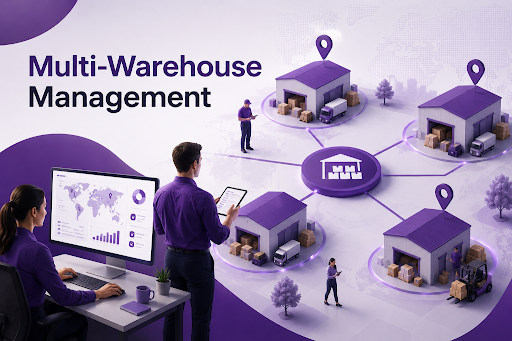
Multi-warehouse management relies on advanced strategies like real-time inventory orchestration, predictive demand forecasting, intelligent slotting, and automated fulfillment coordination to improve network-wide efficiency.
These levers help organizations reduce inventory imbalances, optimize labor productivity, maintain adherence to fulfillment SLAs, and scale distributed warehouse operations more effectively.
In this blog, we will explore advanced strategies, operational levers, and intelligent execution frameworks for optimizing multi-warehouse operations at scale.
Most Common Challenges with Managing Multiple Warehouses
Multi-warehouse management fails when organizations treat independent nodes as isolated silos rather than a unified, continuous intelligence loop. Legacy WMS platforms lack the centralized visibility needed to manage these operational dependencies efficiently.
- Inventory Management: Inventory fragmentation across distributed nodes creates a severe multi-warehouse inventory tracking blind spot that drives up carrying costs. Research on inventory management systems shows that weekly inventory costs increased from $62.38 to $120.85 as supply chain conditions became more constrained and difficult to manage, highlighting the severe cost impact of inventory imbalance and demand uncertainty.
- Transportation and Logistics: Inbound and outbound logistics networks suffer from severe travel distance inflation and execution variance when node placement is misaligned with regional demand spikes. According to freight network research, inefficient routing and poorly optimized consolidation strategies can increase total transportation costs by up to 20.9% across expanding logistics networks.
- Communication Gaps: Workflow fragmentation occurs when disconnected data systems cause extreme decision latency between corporate planning groups and floor-level operations teams. When promotional events or unexpected demand shifts occur, the lack of an orchestration layer prevents immediate execution adjustments.
- Workforce Management: Labor productivity degrades rapidly when variable regional order volumes collide with rigid, static shift scheduling. Key workforce challenges include:
- Uneven labor allocation across facilities
- Rising overtime dependency
- Multi-zone congestion buildup
- Reduced throughput stability
- Underutilized regional labor capacity
- Cost Management Constraints: Reactive operational models increase fulfillment costs through redundant safety stock, expedited shipping fees, and inefficient resource allocation across multi-warehouse operations. Weak governance and poor optimization also reduce profit margins across regional distribution networks.
- Security Gaps: Distributed inventory exposure increases shrinkage risk, compliance issues, and product traceability gaps across multi-warehouse operations. Fragmented security systems and weak data governance also increase inventory write-offs and operational disruption risks.
Suggested Read: Warehouse Replenishment
Top Tips for Effective Multi-Warehouse Management
Maximizing asset utilization across a distributed network requires moving away from static rules and implementing active operational levers. True efficiency is unlocked by focusing on network resilience, workflow synchronization, and dynamic data-driven execution frameworks.
Optimize Inventory Levels Across Locations
Effective multi-warehouse inventory management relies on a velocity-tier reclassification framework to dynamically balance stock across all fulfillment nodes. By evaluating localized order patterns and historical consumption data, operators can position high-velocity SKUs closer to regional demand clusters.
Leverage Data and Analytics
Advanced multi-warehouse order management systems use a continuous measurement-to-action loop to track key performance metrics across distributed fulfillment networks. Logistics labeling solutions strengthen this loop by standardizing label generation, shipment data, and compliance workflows across warehouse nodes, reducing errors in outbound execution and improving cross-facility visibility.
- Zone Utilization: Helps identify workload imbalances and underutilized operational zones
- Throughput Stability: Tracks execution consistency during demand spikes and peak-volume periods
- Congestion Density: Reveals bottleneck buildup within high-volume picking areas
- Labor Productivity: Improves workforce balancing and reduces labor cost scaling issues
Use Automation and Technology Tools
Deploying an advanced multi-warehouse management system provides a single orchestration layer to synchronize order profiles with live facility capacities. Automated routing engines eliminate manual decision latency by instantly directing orders to the optimal node based on stock availability and shipping distances.
Suggested Read: Wave Picking in Warehouses
Establish Communication Channels
Workflow fragmentation increases rapidly when facilities operate with disconnected execution systems.
- Cause → Operational Impact
- Delayed inventory visibility → Replenishment instability
- Disconnected planning → Queue amplification
- Poor coordination → Stock imbalances
- Slow response times → Operational disruption
Monitor and Analyze Performance
Evaluating warehouse KPIs across all operational nodes requires a standardized dashboard focused on picks per hour, congestion density, and slotting ROI. Continuous cross-facility benchmarking reveals execution variances, allowing leaders to export best practices from top-performing nodes to struggling facilities.
Continuously Evaluate and Refine Strategy
Growing SKU counts, seasonal demand shifts, and evolving customer expectations continuously reshape execution requirements across distributed facilities. For this reason, multi-warehouse automation strategies should function as continuous intelligence loops rather than fixed operational models.
Synkrato’s simulation & optimization helps operators test and optimize AI-driven warehouse adjustments in real time to maintain throughput stability during periods of volatility.
Suggested Read: Warehouse Receiving Process
Features for Managing Multiple Warehouses
An enterprise-grade multi-warehouse management system must go beyond basic transaction recording to serve as an intelligent execution architecture. The platform should actively orchestrate workflows, balance resources, and mitigate scale complexities automatically.
- Inventory Management: Advanced multi-warehouse inventory tracking provides real-time inventory visibility and automated stock rebalancing across fulfillment nodes. Synkrato’s AI Agents continuously evaluate fulfillment conditions across facilities and dynamically recommend execution decisions based on changing operational priorities.
- Order Management: Intelligent multi-warehouse order management uses automated routing to optimize inventory allocation, labor capacity, and shipping efficiency.
- Integrations: A modern multi-warehouse management system should integrate with WMS, ERP, and TMS platforms to maintain connected operational data flows.
- Reporting and Analytics: Advanced analytics tools track warehouse KPIs to identify inefficiencies and improve resource allocation.
- Scalability: Enterprise-grade systems must support expanding order volumes, SKU counts, and fulfillment nodes without disrupting operations.
- Mobile Compatibility: Mobile-native applications give warehouse teams real-time access to inventory, labor, and operational data.
- Support and Training: Structured onboarding and technical support help teams adopt advanced warehouse systems more effectively.
Suggested Read: Warehouse Labeling
Technologies to Improve Multi-Warehouse Management
Integrating smart intelligence solutions like digital twins, autonomous drones, and demand forecasting tools allows supply chain executives to turn volatile operational challenges into predictable, repeatable performance.
Demand Forecasting Tools
Traditional historical planning models struggle to respond accurately to regional demand volatility and seasonal order fluctuations. Predictive demand forecasting engines improve multi-warehouse inventory tracking by analyzing:
- Regional order histories
- Market trends
- Seasonal consumption patterns
McKinsey research indicates that early adopters of AI-enabled supply chain management achieve a 15% reduction in logistics costs, a 35% decrease in inventory levels, and a 65% improvement in service levels compared to slower-moving competitors
Digital Twin Technology
Digital twin environments create real-time virtual models of fulfillment networks, allowing operators to test velocity-tier changes, identify bottlenecks, optimize slotting plans, and validate operational strategies before live deployment. Synkrato’s digital twin layer enables real-time simulation, predictive orchestration, and continuous multi-warehouse optimization.
Mobile Applications
Mobile-native warehouse applications connect floor workers directly to central optimization layers, providing optimized, real-time picking paths and task guidance. These mobile systems help organizations:
- Reduce wasted travel distance per order through real-time task updates based on live facility conditions
- Minimize picking errors while improving labor productivity and order cycle speed through mobile execution visibility
Blockchain Technology
Distributed ledger technology provides immutable, end-to-end traceability for premium products moving through complex multi-warehouse networks. Blockchain tracking creates an unalterable record of custody, serial numbers, and compliance data from initial manufacturing through final customer delivery.
Autonomous Drones
Autonomous drones equipped with advanced computer vision sensors automate inventory scanning, cycle counting, and rack auditing processes. Using autonomous drones removes workers from hazardous high-elevation tasks, eliminates costly manual counting errors, and maintains near-perfect inventory accuracy.
Suggested Read: What is the Correct Product Flow in a Warehouse
Unleash Next-Gen Multi-Warehouse Efficiency With Synkrato
Managing multiple distribution centers with static systems leads to rising fulfillment costs, uneven inventory placement, and missed delivery SLAs. To maintain operational efficiency at scale, warehouse leaders need real-time orchestration instead of outdated manual planning models.
Synkrato helps optimize complex multi-warehouse networks through automated slotting, real-time asset visibility, and predictive demand intelligence. Book a demo with Synkrato to improve fulfillment stability, lower labor costs, and strengthen network-wide operational resilience.
FAQs
What is multi-warehouse management?
Multi-warehouse management is the centralized orchestration of inventory, labor, orders, and logistics across a distributed network of multiple fulfillment facilities. It requires an advanced intelligence layer to synchronize disparate nodes, balance regional SKU volatility, and optimize the total cost-to-serve while maintaining high throughput stability.
Why do businesses use multi-warehouse management strategies?
Organizations deploy these strategies to place inventory closer to regional demand clusters, significantly reducing travel distance per order and transit times. This distributed architecture helps supply chain leaders minimize outbound shipping expenses, meet strict customer fulfillment SLAs, and build a resilient multi-warehouse network capable of handling unexpected localized supply disruptions.
What challenges are common in multi-warehouse management?
The biggest multi-warehouse challenges include congestion, fragmented multi-warehouse inventory management data, inventory imbalances, and rising labor costs. Without unified orchestration, facilities face decision delays, split-shipment inefficiencies, and poor zone utilization that reduce profitability. Synkrato helps optimize distributed warehouse operations through real-time orchestration and predictive multi-warehouse optimization.
Which businesses benefit the most from multi-warehouse management?
High-volume enterprise operations, fast-growing e-commerce merchants, and B2B distributors handling high SKU volatility benefit most from these multi-warehouse inventory tracking strategies. Companies managing seasonal demand variations, strict delivery deadlines, and complex omni-channel logistics networks require these advanced frameworks to maintain structural efficiency and scale smoothly.
How can Synkrato help businesses optimize multi-warehouse management operations?
Synkrato acts as an AI decision layer that optimizes multi-warehouse operations through digital twin simulation, real-time orchestration, and threshold-based re-slotting. By aligning live order profiles with warehouse capacities, the platform reduces operational blind spots, improves pick density, lowers labor costs per order, and stabilizes high-volume fulfillment performance.
Why do multi-warehouse operations become difficult to scale without platforms like Synkrato?
Without Synkrato’s real-time orchestration capabilities, multi-node supply chains depend on static planning models that fail under demand volatility. This creates decision latency, inventory imbalances, split shipments, and facility congestion. As network complexity grows, businesses experience rising labor costs, declining fulfillment efficiency, and reduced scalability across distributed warehouse operations.
What operational improvements can Synkrato support in multi-warehouse environments?
Deploying Synkrato as a centralized optimization layer improves key warehouse KPIs by reducing travel distance per order, increasing picks per hour, and optimizing zone utilization. Its predictive engines balance inventory using real-time consumption data, helping organizations lower safety stock, reduce fulfillment errors, and maintain stable SLA performance across distributed facilities.