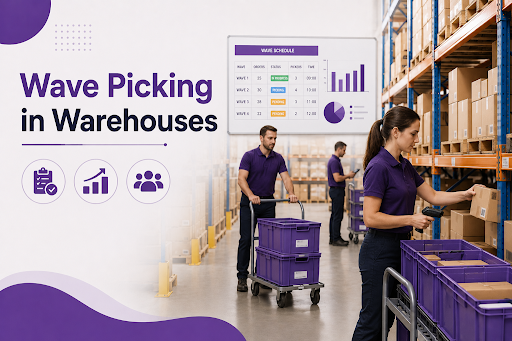
Wave picking in warehouses is an order fulfillment method that groups orders into scheduled waves based on shipping priorities, carrier requirements, or warehouse zones. Releasing tasks in controlled batches, it reduces congestion, improves labor efficiency, and helps warehouses meet shipping deadlines.
Depending on operational needs, businesses may use time-based, priority-based, zone-based, or hybrid wave picking strategies. However, successful execution requires accurate real-time data, effective scheduling, and efficient staging processes.
In this blog, we cover the exact architectural mechanics, strategic optimization levers, and advanced simulation layers required to scale your fulfillment performance.
How Wave Picking Works in Real Warehouse Operations
Wave picking in warehouses functions as an execution framework that organizes orders into scheduled groups, or “waves,” based on shipping deadlines, order priorities, labor availability, and operational capacity. Instead of releasing orders individually, warehouses process them in coordinated batches to improve efficiency and meet fulfillment targets. Here’s how wave picking works in warehouse operations:
- Order Pool: Aggregates incoming fulfillment requests across channels before sorting them by systemic shipping profiles, carrier constraints, and customer SLAs.
- Wave Planning Layer: Analyzes the accumulated order pool using predictive optimization to group items into controlled, short-duration processing intervals.
- Dynamic Batching: Clusters individual order lines into optimized picking groups based on real-time SKU velocity tiers and geographic proximity.
- Zone Dispatch: Forwards batched tasks to specific physical layout sectors, assigning local picking teams to maximize localized travel efficiency.
- Staging & Carrier Cut-off: Consolidates multi-zone picks at dedicated dock locations, matching internal wave completion directly with scheduled transportation arrival windows.
Order picking remains one of the most resource-intensive warehouse activities, accounting for up to 55% of warehouse operating costs. As order volumes increase, wave picking helps reduce unnecessary travel, improve labor productivity, and maintain consistent fulfillment performance.
Suggested Read: Warehouse Replenishment
Types of Wave Picking Strategies Used in Warehouses
Different warehouse environments require different wave picking approaches depending on order profiles, shipping commitments, labor availability, and operational goals. Here are the four most commonly used wave picking strategies to optimize fulfillment performance:
Time-Based Wave Picking
Time-based wave picking groups orders into rigid, chronological release windows tied directly to daily shipping carrier cut-off schedules.
- For instance, a facility might release an initial wave at 08:00 for morning parcel delivery and a second wave at 13:00 to satisfy regional freight departures.
- Research indicates that more than 80% of warehouse order-picking systems in Western Europe still rely on manual picker-to-parts processes, making them particularly vulnerable to congestion, labor constraints, and fulfillment delays as order volumes increase.
Priority-Based Wave Picking
Priority-based wave picking structures order batches according to customer service level agreements (SLAs), premium shipping tiers, and critical emergency fulfillment orders. High-priority orders bypass standard processing backlogs, prompting immediate wave compilation to guarantee expedited delivery timelines.
While this approach protects critical service parameters, it can severely degrade overall labor efficiency across standard channels by frequently disrupting planned picking paths.
Zone-Based Wave Picking
Zone-based wave picking divides the warehouse into dedicated picking zones, with separate teams assigned to specific storage areas.
Key Characteristics:
- Dedicated picking teams for specific warehouse zones
- Simultaneous picking across multiple storage areas
- Centralized order consolidation before shipping
- Higher pick density and reduced travel time within zones
Challenges:
- Requires accurate coordination between zones
- Increases dependence on efficient sorting and consolidation processes
- Can create downstream congestion if order merging is delayed
Hybrid Wave Picking Strategies
The hybrid wave-picking strategy merges time parameters, regional zoning, and dynamic batch parameters into a single, cohesive operational strategy.
Advanced high-SKU distribution hubs deploy these multi-variable workflows to optimize picking density while balancing labor resources across complex structural layouts. Implementing these multi-tiered strategies helps high-volume facilities adapt smoothly to major daily demand fluctuations without experiencing systemic throughput drops.
Suggested Read: Multi Warehouse Management
Benefits of Wave Picking for High-Volume Warehouses
The benefits of wave picking in warehouses include organizing orders into structured release schedules that improve labor productivity, reduce congestion, optimize resource utilization, and maintain consistent throughput during periods of high demand.
Reduced Picker Travel Time
Minimizing travel distance inflation stands as the primary financial justification for implementing wave picking workflows.
- Geographic Order Clustering
By clustering orders based on geographical proximity within storage aisles, operators eliminate redundant travel across long distribution corridors.
- Data-Driven Path Optimization
Recent research found that blocking and aisle congestion can significantly reduce overall picking optimization, even when storage locations are optimized, highlighting the operational risks of poorly coordinated fulfillment workflows.
Faster Order Fulfillment Cycles
Wave synchronization accelerates the end-to-end warehouse wave planning process, compressing total order cycle times from receipt to staging. Batching orders into disciplined release windows ensures that items move predictably through picking, packaging, and sorting lanes without idling in queue storage.
This streamlined material flow allows high-volume distribution networks to confidently offer tighter shipping windows and meet aggressive modern fulfillment deadlines.
Improved Labor and Resource Utilization
Dividing the daily order workload into balanced, predictable waves allows warehouse managers to align staffing levels more effectively with operational demand.
Key Benefits Include:
- Better workforce planning and resource allocation
- Reduced labor imbalances across picking zones
- Fewer processing delays and operational bottlenecks
- Improved productivity during peak demand periods
- More predictable daily workflow execution
Better Inventory Accuracy and Control
Structured wave processing creates clean, distinct breaks between order batches, allowing inventory tracking systems to validate real-time stock balances systematically.
- This cyclical execution loop reduces picking errors by ensuring operators interact with clearly designated SKUs during scheduled wave windows.
- Maintaining high data precision across picking zones minimizes unexpected stockouts and drastically reduces costly manual inventory reconciliation steps.
Reduced Congestion and Workflow Conflicts
Releasing orders in controlled, sequenced waves helps maintain a balanced fulfillment flow by preventing localized bottlenecks and resource conflicts. This structured approach improves operational consistency and supports smoother order processing throughout the warehouse
Synkrato AI Slotting Recommendations help distribute high-velocity SKUs across multiple aisles to reduce bottlenecks and improve picking completion consistency.
Suggested Read: Warehouse Receiving Process
Challenges of Wave Picking and Operational Limitations
While wave picking for order fulfillment offers major efficiency gains, it introduces four critical challenges: high dependency on real-time data accuracy, extreme wave planning complexity, compounding risk of scheduling delays, and severely limited flexibility for urgent orders.
Dependency on Accurate Data and WMS
If the warehouse management system contains inaccurate inventory records or incorrect bin balances, pickers may arrive at depleted storage locations, disrupting the picking process and delaying the entire wave. Research found that more than 80% of order-picking warehouses still rely on manual operations, increasing their exposure to fulfillment disruptions caused by inaccurate inventory data.
Complexity in Wave Planning and Coordination
Balancing changing carrier cut-off times, shifting order priorities, and variable zone capacities makes wave design highly complex. Manual coordination often misses hidden workflow dependencies, creating labor imbalance and downstream staging bottlenecks.
This often leads to several problems:
- Uneven labor allocation
- Overloaded picking zones
- Delayed replenishment timing
- Dock staging congestion
- Lower throughput stability
- Slower order cycle times
Risk of Delays Due to Poor Scheduling
A single localized disruption, such as an equipment breakdown or an acute labor shortage in a single zone, can stall an entire picking wave. Research found that warehouse disruptions such as aisle blockages and staffing changes can reduce picking efficiency by 20-31%. As a result, compounding delays can cause severe order line backlogs and missed transport cut-offs.
Limited Flexibility for Urgent Orders
Once a specific picking wave is locked and released to the floor, introducing ad hoc changes or emergency orders becomes difficult. Urgent order overrides often disrupt travel paths, labor balance, and picking efficiency, creating operational instability across active fulfillment workflows.
This rigidity can create several problems:
- Wave interruption conflicts: Emergency order injections can force mid-wave rerouting, slowing picker movement and increasing execution variance.’
- Dock scheduling misalignment: Last-minute changes often disrupt outbound staging plans and carrier loading sequences.
- Labor reallocation pressure: Supervisors may need to manually shift teams between zones, reducing workforce utilization efficiency.
- Throughput degradation risk: Continuous overrides weaken wave synchronization, increasing congestion and lowering picks per hour.
Modern operations teams can use Synkrato Digital Twin to identify wave instability risks before execution begins, helping warehouses reduce congestion amplification, labor imbalance, and downstream fulfillment disruption across high-volume environments.
Suggested Read: Warehouse Labeling
Best Practices to Optimize Wave Picking Efficiency
The best way to optimize wave picking efficiency is by improving wave timing, labor distribution, shipping alignment, and real-time execution visibility. High-volume warehouses achieve better throughput when wave planning adapts continuously to changing operational conditions.
Use WMS for Wave Planning and Automation
AI-driven WMS and Digital Twin environments help operators simulate wave structures before execution begins. Synkrato Simulation & Optimization engines forecast congestion risks, reduce travel inefficiencies, and improve throughput using dynamic execution models instead of fixed scheduling logic. This helps warehouses:
- Reduce zone congestion
- Improve picks per hour
- Optimize labor allocation
- Stabilize fulfillment throughput
- Minimize travel distance inflation
Align Waves With Shipping Cut-Off Times
Wave schedules should align directly with carrier departure windows. Completing picking waves 30 to 45 minutes before outbound transport departures can reduce staging congestion and improve shipping SLA adherence.
Balance Workload Across Picking Teams
Balancing item volumes across active zones can help with –
- Workload balancing: Evenly distributing picking tasks across zones improves labor utilization and prevents localized congestion.
- SKU distribution optimization: Spreading high-velocity SKUs across separate aisles reduces traffic buildup and improves picking completion speed
Continuously Monitor and Adjust Wave Schedules
Wave performance requires continuous monitoring of order volumes, labor availability, and inventory conditions. Synkrato AI Agents help operations teams proactively adjust wave schedules to maintain fulfillment stability during demand fluctuations or labor disruptions.
Suggested Read: What is the Correct Product Flow in a Warehouse
Get Advanced Warehouse Orchestration With Synkrato
Transform your fulfillment infrastructure from a reactive workflow into a predictive, data-driven optimization model. Eliminate travel distance inflation, balance zone workloads, and secure predictable throughput stability across your entire network using Synkrato’s AI-driven warehouse operating system.
Our unified platform delivers the continuous intelligence layer required to orchestrate complex high-volume distribution setups, maximizing your picks per hour while cutting operational costs. Secure your competitive edge, eliminate warehouse execution blind spots, and optimize your wave scheduling loops. Book a demo now.
FAQs
What is wave picking in warehouses?
Wave picking in warehouses is an operational execution framework that groups specific orders into logical picking waves based on shipping schedules, carrier profiles, and zone configurations. This warehouse wave picking process minimizes travel distance inflation and prevents dock door congestion by releasing work batches in highly disciplined intervals.
What operational gaps can Synkrato help identify in wave picking workflows?
Synkrato’s digital twin platform identifies hidden system bottlenecks, zone imbalances, and travel path inefficiencies that cause unexpected throughput collapse. By simulating real-time workflows, this advanced optimization layer exposes severe aisle congestion points before they disrupt active floor operations.
Why does wave picking performance often decline without intelligent optimization from platforms like Synkrato?
Wave picking performance often declines without intelligent optimization from platforms like Synkrato because static warehouse rules struggle to adapt to changing order volumes, SKU variability, and multi-zone workflows. This can create labor imbalances, delays, and bottlenecks. Synkrato’s simulation & optimization capabilities help balance workloads and improve fulfillment efficiency.
What is the difference between wave picking and batch picking?
Wave picking groups orders specifically to align with external shipping schedules and transport cut-offs across multiple zones. Batch picking focuses strictly on combining identical SKUs from multiple orders to maximize immediate pick density, regardless of carrier profiles.
Who can benefit most from using Synkrato to improve wave picking performance?
High-volume distribution centers experiencing severe catalog churn, complex multi-zone layouts, and strict customer shipping SLAs benefit the most. Implementing Synkrato’s AI Slotting Recommendations provides the continuous intelligence needed to orchestrate complex labor and inventory movements smoothly.
What challenges can arise with wave picking?
Major challenges include high dependency on real-time data accuracy, complex wave planning coordination, and severe downstream staging bottlenecks from delayed zones. Additionally, static wave configurations offer limited flexibility for integrating urgent, ad hoc orders without causing widespread operational disruption. Synkrato helps operations teams reduce these risks through AI-driven orchestration and effective simulation modeling.