
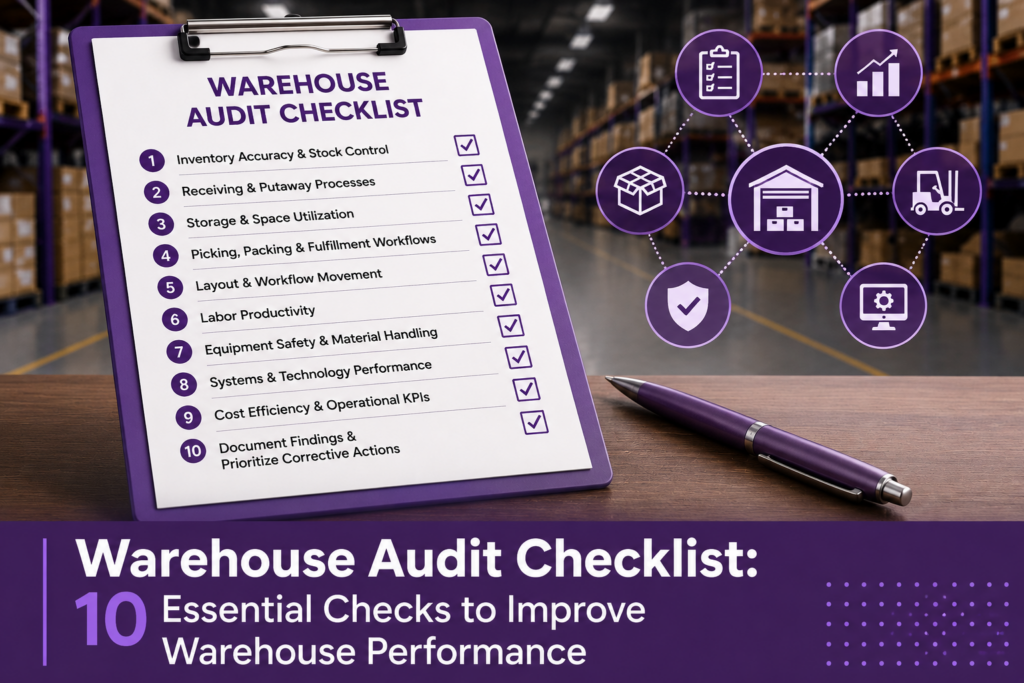
A warehouse audit checklist is a structured way to identify the operational gaps that impact inventory accuracy, fulfillment speed, safety, and cost control. It verifies whether physical stock aligns with system records and whether core warehouse processes are performing as expected.
Industry benchmarks from APQC define inventory accuracy as the variance between physical inventory and recorded inventory, and link higher accuracy to stronger logistics performance, including better order fill rates, fewer expedited shipments, and lower inventory carrying costs.
A well-executed audit converts these gaps into clear, measurable actions. This blog breaks down 10 essential warehouse audit checklist items to uncover inefficiencies and improve overall warehouse performance.
1. Audit Inventory Accuracy and Stock Control
Inventory accuracy should be treated as a financial control rather than just a stock-counting task. Advanced analytics and AI can reduce inventory levels by 20-30% by improving demand forecasting, segmentation, and replenishment decisions.
At the same time, inventory carrying costs average 10% of inventory value across large datasets of 6,468 companies. A well-configured inventory management system plays a central role by ensuring real-time visibility, consistent data across transactions, and accurate tracking of inventory movements across receiving, storage, and fulfillment.
Synkrato’s digital twin allows teams to simulate inventory positions, test slotting strategies, and evaluate replenishment decisions before making changes on the floor.
Audit checks to include:
- Compare system stock, physical stock, and available-to-promise inventory separately to understand how each impacts planning and fulfillment decisions.
- Analyze cycle count variance by SKU velocity, storage zone, and transaction type to pinpoint where errors originate.
- Ensure inventory adjustments are classified by root cause rather than recorded as generic write-offs, so recurring issues can be eliminated.
2. Review Receiving and Putaway Processes
Receiving and putaway should be audited based on how quickly inventory becomes accurate, available, and traceable after it enters the facility. This forms a critical part of an operational procedures audit, where receiving, putaway, and fulfillment workflows are evaluated for speed, accuracy, and process consistency.
Amazon’s Sequoia system demonstrates this by enabling inventory to be identified and stored up to 75% faster in fulfillment centers, which makes dock-to-stock time a critical performance metric. Delays at this stage can:
- hide sellable inventory
- disrupt replenishment cycles
- distort availability signals across the operation
Leading operations use a combination of AI, robotics, and computer vision to move inventory into storage faster while maintaining real-time visibility. This approach reduces manual identification errors and ensures that inventory is ready for picking and replenishment without downstream corrections. For an audit, this means evaluating whether receiving processes are enabling flow or creating bottlenecks that cascade into fulfillment delays.
3. Assess Warehouse Storage and Space Utilization
Warehouse storage audits should evaluate whether space is being used effectively for the right inventory, at the right time, and in the right location. AI-powered warehouse tools can unlock 7-15% additional capacity by identifying underutilized space, inefficiencies in slotting, and variability in resource usage.
This is a key part of an infrastructure & racking audit, where storage systems, rack configurations, and space allocation are evaluated against SKU velocity and throughput requirements.
Walmart is modernizing its U.S. grocery distribution network with high-tech perishable distribution centers that can store double the number of cases and process more than twice the volume of a traditional perishable distribution center.
What to audit:
- Separate storage utilization across reserve storage, forward pick areas, staging zones, and exception areas to identify hidden inefficiencies.
- Evaluate whether high-velocity SKUs are occupying optimal locations or causing excessive replenishment movement.
- Review if slotting logic aligns with demand patterns, packaging types, and handling constraints instead of fixed storage rules.
- Assess whether the warehouse can handle demand spikes without creating temporary overflow zones that disrupt flow.
4. Evaluate Picking, Packing, and Fulfillment Workflows
Picking and packing should be evaluated based on:
- how efficiently labor time is converted into shipped orders
- where it is lost through travel, search, rework, and order consolidation
Fulfillment performance improves when movement is minimized and workflows are designed around flow rather than tasks. DHL Supply Chain’s milestone of 500 million picks using autonomous mobile robots highlights how assisted picking models can reduce walking time and improve throughput without requiring full automation.
Instead of relying only on manual picking, warehouse operations audit checklist includes AMRs to bring work to workers, reduce non-value-added travel, and scale output during peak demand. For an audit, this means connecting picking productivity with accuracy, order cycle time, labor availability, and customer service outcomes.
Key areas to evaluate:
- Track pick rate, travel distance, mis-picks, and replenishment interruptions together to understand trade-offs across performance metrics.
- Review whether packing stations are aligned with order profiles, packaging rules, carrier cutoffs, and dimensional weight considerations.
- Assess whether picking methods (batch, wave, zone, or discrete) match order volume, SKU mix, and demand variability.
5. Audit Warehouse Layout and Workflow Movement
A warehouse layout audit should validate whether the physical flow aligns with current order profiles, SKU velocity, labor structure, and automation plans. AI-powered digital twin models, as offered by Synkrato, show that layout optimization can increase warehouse capacity by nearly 10% without adding new space.
These digital twins enable scenario-based decisions by testing congestion, labor demand, aisle utilization, and equipment movement before making physical changes.
Key layout and flow evaluation points:
- Map travel paths for inbound, replenishment, picking, packing, returns, and outbound separately to identify where mixed flows create congestion.
- Review cross-aisle placement, dock-door assignments, and staging rules against actual shipment patterns and volume variability.
- Identify zones where forklifts, pedestrians, carts, and AMRs operate together without clear traffic control or movement rules.
- Evaluate whether high-traffic areas are aligned with high-velocity SKUs or are creating unnecessary cross-warehouse movement.
- Assess how layout changes impact travel distance, queue formation, and equipment utilization across different shifts and demand conditions.
Suggested Read: Warehouse Safety Checklist
6. Review Labor Productivity and Resource Utilization
Labor productivity should be assessed based on how effectively time is converted into output, instead of just on units per hour. Advanced analytics can reduce labor-related costs by 15-20% by improving visibility into workforce performance, attrition patterns, and operational bottlenecks. This makes labor audits essential for identifying whether teams are focused on value-added work or compensating for inefficiencies in layout, systems, and process design.
Walmart’s automation strategy highlights associates moving from physically intensive roles into positions such as automation equipment operator, control center operator, automation technician, and automation area manager.
Critical labor evaluation areas:
- Compare planned versus actual labor hours by activity to identify where time is being lost across processes, not just shifts or departments.
- Assess whether supervisors have real-time visibility into backlog, idle time, bottlenecks, and exception queues to enable faster decisions.
- Evaluate how labor is allocated across peak and non-peak periods to ensure staffing aligns with demand variability.
7. Inspect Equipment Safety and Material Handling Controls
Equipment safety should be evaluated as both a compliance requirement and an operational risk. Material handling failures can disrupt flow, increase damage claims, and expose the business to high injury-related costs.
Key safety and risk benchmarks:
- Warehousing and storage recorded 4.8 total recordable injury and illness cases per 100 full-time workers in 2024.
- Forklift-related incidents resulted in 84 work-related deaths in 2024 and 25,110 DART cases between 2023 and 2024.
A safety & warehouse compliance audit checklist ensures that material handling practices, safety controls, and incident prevention measures are integrated into daily operations rather than treated as standalone checks.
Forklifts, dock operations, conveyors, material storage, lifting practices, hazard communication, and charging stations are critical risk areas. Also, verify whether pre-use inspections, maintenance issues, and equipment downtime are consistently tracked, resolved, and closed.
8. Audit Warehouse Systems and Technology Performance
Warehouse systems should be audited based on whether they improve execution, visibility, and decision-making. Technology investments are underperforming, with 92% saying expected results have not been fully achieved due to integration complexity and data quality issues.
This falls under a technology & data audit, where system integration, data accuracy, and real-time visibility are assessed across WMS, ERP, and operational tools.
For instance, many warehouses have scanners, dashboards, and automation in place. However, without connected master data, inventory events, labor inputs, and exception workflows, these systems fail to deliver reliable decision intelligence.
Synkrato addresses this by turning warehouse data into connected AI agents, automations, and actionable recommendations.
System performance indicators to review:
- Verify whether the WMS reflects real-time inventory status, task progress, labor activity, and exception queues across operations.
- Test data quality across SKU attributes, storage locations, units of measure, replenishment rules, and carrier configurations.
- Assess whether dashboards provide root-cause insights and actionable decisions rather than only historical performance metrics.
- Evaluate integration between systems to ensure inventory, labor, and order data flows seamlessly without manual intervention.
9. Measure Cost Efficiency and Operational KPIs
Cost efficiency should be evaluated by connecting warehouse operations directly to margin, working capital, and service performance. Most organizations are improving visibility into supply chain costs. 96% of operations leaders report that digital tools have enhanced end-to-end cost visibility. High-performing operations align KPIs with enterprise outcomes.
Cost and KPI evaluation areas:
- Track cost per order, cost per line, cost per unit handled, and cost per return separately to identify distinct cost drivers.
- Segment KPIs by channel, customer type, order profile, and service level to reveal hidden inefficiencies across different demand patterns.
- Have a warehouse performance audit checklist to evaluate whether dashboards connect performance to revenue protection, margin improvement, and customer experience outcomes.
Walmart’s supply chain automation strategy shows this, with plans for:
- 65% of stores to be serviced by automation
- 55% of fulfillment center volume to move through automated facilities
- Overall unit cost averages are expected to improve by around 20% by 2026.
10. Document Findings and Prioritize Corrective Actions
A large share of operations leaders are already adapting to external pressures 91% find that trade policy changes will reshape supply chain strategies. This highlights how warehouses must be designed to respond to demand volatility, supplier shifts, and changing service expectations.
Similarly, 71% of supply chain leaders see AI disrupting operations, while 24% expect this disruption to be transformational. It shows that corrective actions should go beyond physical fixes and include improvements in data, systems, and workforce capabilities.
Corrective action priorities to define:
- Rank findings by financial impact, safety risk, customer impact, implementation effort, and system dependencies to guide decision-making.
- Separate quick wins from long-term structural changes to balance immediate improvements with transformation initiatives.
- Assign each action a clear owner, timeline, KPI, expected outcome, and review cadence to ensure accountability.
Turn audit insights into action with Synkrato. Use digital twins, AI, and real-time data to test improvements, identify bottlenecks early, and prioritize high-impact decisions. Book a demo to see how Synkrato optimizes warehouse performance without disrupting operations.
FAQs
What is a warehouse audit checklist?
A warehouse audit checklist is a structured framework used to evaluate inventory accuracy, processes, safety, and system performance across operations. With Synkrato, this checklist becomes dynamic by using real-time data, digital twins, and AI-driven insights to identify gaps and simulate improvements before execution.
Which operational gaps can Synkrato help reveal beyond traditional warehouse audits?
Traditional audits often identify surface-level issues, but Synkrato uncovers deeper gaps such as slotting inefficiencies, hidden congestion, labor misallocation, and forecasting mismatches. Its Digital Twin and AI Agents analyze real-time and historical data to expose bottlenecks and predict operational risks before they impact performance.
Why is a warehouse audit checklist important?
A warehouse audit checklist ensures that inventory, labor, space, and systems are aligned with business goals such as cost control, service levels, and throughput. Synkrato enhances this by turning audit insights into actionable recommendations, helping teams move from reactive fixes to proactive, data-driven decisions.
Why do manual warehouse audits often miss improvement opportunities without platforms like Synkrato?
Manual audits rely on static observations and historical data, which limits visibility into dynamic issues like demand variability and real-time bottlenecks. Synkrato overcomes this by integrating AI, simulation, and real-time data to continuously evaluate operations and test improvements without disrupting live workflows.
What should be included in a warehouse audit checklist?
A comprehensive checklist should cover inventory accuracy, receiving, storage, picking, labor, safety, systems, and cost performance. With Synkrato, these areas are connected through a unified platform that combines digital twin simulation, AI slotting, and mobility tools to provide a complete, data-driven view of warehouse performance.
Who should consider Synkrato when strengthening warehouse audit and performance review processes?
Business leaders, warehouse managers, 3PL operators, and operations teams managing complex or high-volume facilities should consider Synkrato. It is especially valuable for organizations looking to scale operations, improve decision-making, and optimize performance without increasing labor or infrastructure costs.
What are common issues uncovered during warehouse audits?
Warehouse audits typically reveal issues such as inaccurate inventory, inefficient layouts, excessive travel time, poor slotting, and disconnected systems. Synkrato helps address these by using AI-driven insights, Digital Twin simulations, and automation tools to identify root causes and recommend optimized workflows before implementation.