Warehouse safety directly impacts operational continuity, labor availability, and cost control. In 2024, workplace injuries cost U.S. businesses $181.4 billion and resulted in 102 million lost workdays.
Warehouse environments combine high-risk elements such as forklifts, dense storage systems, dock movement, manual handling, and electrical and fire exposure. Without structured oversight, these risks quickly translate into downtime, compliance violations, and unplanned costs.
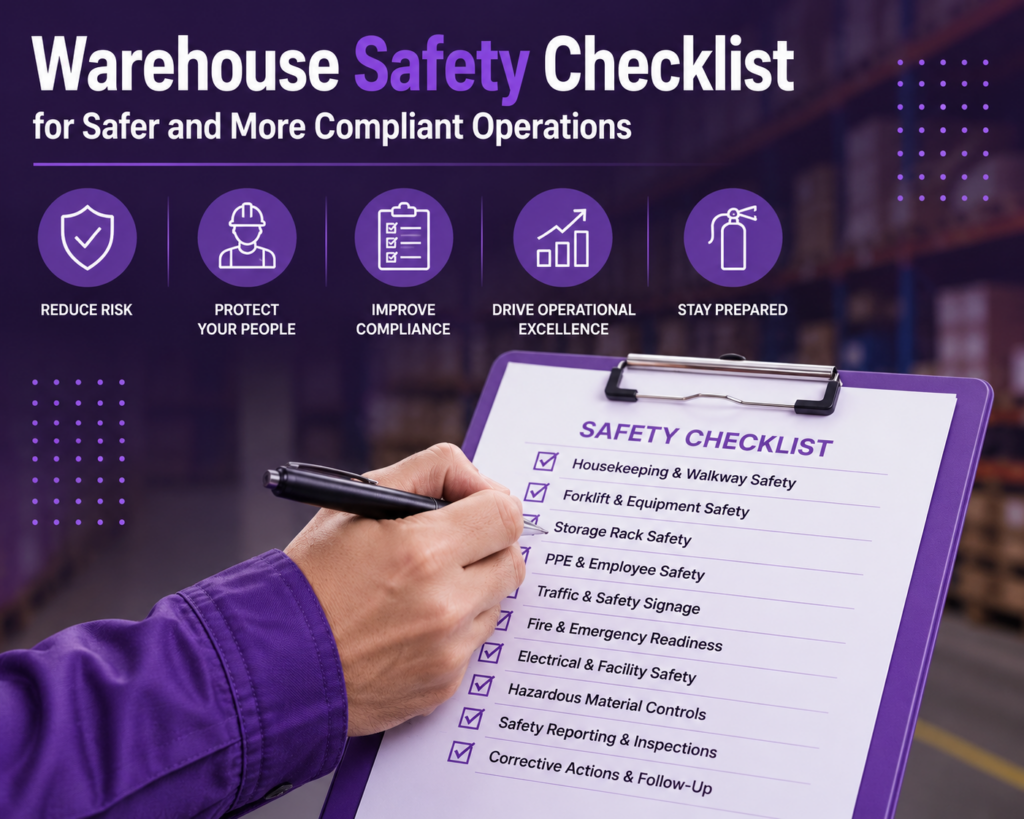
A structured warehouse safety checklist helps teams identify and control risks before they escalate into disruptions. In this blog, we cover such core safety checks every warehouse should review.
1. Housekeeping and Walkway Safety
Housekeeping directly determines how safely and efficiently people and equipment move through the warehouse. It controls the underlying conditions that lead to slips, trips, congestion, and struck-by incidents, which often escalate during peak throughput periods. Falls on the same level cost U.S. companies $10.5 billion as recorded in 2025
The focus should shift from visual cleanliness to flow integrity, whether walkways consistently support safe movement under real operating pressure. This includes how space is allocated during surges, how quickly hazards are removed, and whether layout decisions unintentionally push risk into pedestrian zones.
Warehouse safety audit checklist points:
- Validate that aisle widths align with peak traffic density and equipment turning requirements.
- Check whether cleaning schedules are synchronized with shift transitions and high-traffic windows to prevent buildup during active operations.
- Review if lighting levels are sufficient at floor level and dense storage zones where visibility drops.
- Assess whether floor markings, pedestrian lanes, and hazard zones are consistently maintained and not faded, blocked, or misaligned with current layout changes.
2. Forklift and Equipment Safety
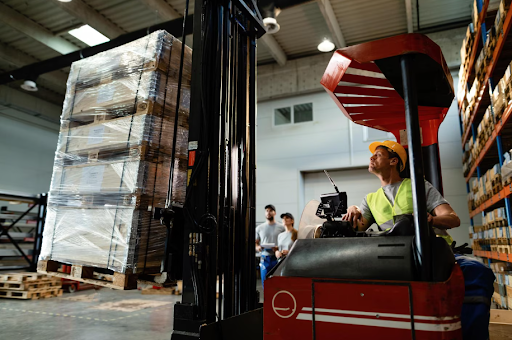
Forklift safety influences both incident severity and operational stability because it includes load handling, movement speed, and human interaction. The risk is not limited to operator error. It comes from:
- How movement is designed
- How visibility is managed
- How consistently are rules enforced across shifts
Synkrato’s digital twin and simulation modules allow teams to test traffic flow scenarios and reduce collision risk without disrupting live operations.
Design and control standards (how the system is built):
- Ensure travel paths are engineered to minimize sharp turns, cross-traffic, and reverse movement in high-volume zones.
- Validate that load handling rules are defined by SKU type, weight, and pallet condition, not left to operator discretion.
- Confirm that dock areas, staging lanes, and replenishment zones have clearly defined entry and exit flows.
- Check whether equipment types are matched to task requirements instead of using a single forklift type across all operations.
Suggested Read: Warehouse Audit Checklist
3. Storage Rack Safety
Rack safety is a structural control that directly affects both asset protection and operational continuity. Storage systems should be treated as active infrastructure that responds to changes in inventory mix, handling frequency, and equipment movement. Mechanical handling, site transport, and working at height are core safety concerns, which makes racking integrity closely tied to daily operations rather than periodic inspection.
A warehouse safety procedures checklist should evaluate whether racks are operating within their designed limits and whether physical condition, load behavior, and handling patterns remain aligned.
Structural integrity and configuration controls:
- Verify that rack installations comply with original design specifications, including anchoring, spacing, and alignment.
- Check whether beam levels are adjusted or modified without formal load validation or engineering approval.
- Confirm that pallet quality is consistent with rack design, especially for high-bay or dense storage systems.
- Review whether rack protection systems such as guards or barriers are installed in high-impact zones and maintained.
4. Personal Protective Equipment (PPE) and Employee Safety
PPE reduces exposure when risks cannot be fully eliminated through design, process changes, or automation. Its usage should reflect actual task conditions, especially in environments where employees shift between picking, handling, loading, and equipment interaction. That’s because overexertion remains the costliest serious workplace injury driver, costing U.S. companies $13.7 billion in the 2025 index.
Protection design and accessibility controls:
- Ensure PPE storage points are located at workflow entry points, not only in centralized safety areas.
- Validate that PPE types are standardized to avoid confusion when workers move across zones or roles.
- Check whether compatibility between PPE items (e.g., gloves, eyewear, headgear) is maintained without restricting movement or visibility.
Workforce behavior and risk exposure signals:
- Monitor task switching frequency to identify where employees may skip PPE due to short-duration activities.
- Track fatigue patterns across shifts that may increase unsafe handling or reduce compliance with protection practices.
- Review onboarding and refresher training effectiveness based on observed behavior, not just completion records.
5. Traffic and Safety Signage
Traffic control systems determine how safely people and equipment move through the warehouse under real operating conditions. Struck-by object or equipment and falls to a lower level together account for nearly $11.6 billion in serious injury costs in the U.S. Evaluate whether traffic controls:
- Reduce uncertainty
- Guide behavior in real time
- Remain effective as layouts, volumes, and workforce composition change
Traffic system design and visibility controls:
- Ensure that travel paths are defined based on actual movement patterns, not legacy layouts that no longer reflect current operations.
- Validate that visual cues such as color coding, zoning, and directional indicators are standardized across the entire facility.
- Check whether dock approach lanes and staging zones have clear movement priority rules to avoid conflicts between inbound and outbound flow.
- Get AI-driven simulation tools as offered by Synkrato that can map real movement patterns and highlight where signage, routes, or barriers fail under peak conditions.
6. Fire and Emergency Readiness
Fire and emergency readiness affects how quickly a warehouse can recover from disruption and resume operations. A single incident can damage inventory, halt throughput, and expose gaps in storage discipline and response systems.
U.S. warehouse fires caused an annual average of two civilian deaths, 17 civilian injuries, and $314 million in direct property damage during 2020-2024. This makes fire readiness a continuity and risk management priority. Moreover, sprinklers reduced the risk of fire-related civilian fatalities by 90% and property damage by up to 69%.
System readiness and infrastructure controls:
- Verify that fire alarm systems, detectors, and suppression systems are tested based on usage intensity.
- Check whether emergency lighting provides adequate visibility across all zones, including high-density storage and dock areas.
- Confirm that fire protection systems are reviewed after layout changes, automation additions, or storage height increases.
- Review whether access to fire-fighting equipment remains unobstructed during active operations.
- Review whether incident simulations include realistic constraints such as reduced visibility, noise, and peak operational load.
7. Electrical and Facility Safety
Electrical and facility safety controls protect the warehouse from low-frequency but high-impact failures that can disrupt operations and create serious risk exposure. These risks are often overlooked because they do not occur frequently, but when they do, they affect both safety and uptime at the same time.
Infrastructure stability and system controls:
- Verify that electrical load distribution matches current equipment usage and has not been exceeded due to added automation or temporary setups.
- Check whether backup power systems or fail-safes are in place for critical operations such as conveyors, sortation, or safety systems.
- Confirm that maintenance zones are clearly defined and isolated from active operations during repair or inspection work.
Operational risk signals and performance indicators:
- Monitor frequency of equipment stoppages or resets that may indicate underlying electrical or system instability.
- Track maintenance response time for facility-related issues to identify delays that could increase exposure risk.
8. Hazardous Material Controls
Hazardous material controls depend on process discipline because most failures are not sudden; they build over time through small gaps in labeling, storage, handling, or inspection. EPA guidance requires both large and small-quantity hazardous waste generators to perform weekly inspections in container storage areas to check for leaks and deterioration.
A warehouse should evaluate whether chemical handling practices are consistent, traceable, and aligned with real storage and movement conditions. This is a governance and risk issue because failures can affect regulatory compliance, insurance exposure, and operational continuity.
Storage discipline and control systems:
- Verify that hazardous material inventories are regularly reconciled to detect discrepancies, expired stock, or unaccounted movement.
- Check whether storage conditions such as temperature, ventilation, and humidity are maintained within required limits for each material type.
- Confirm that access to hazardous zones is restricted based on role and training, not open to all warehouse personnel.
9. Safety Reporting and Inspections
Safety reporting transforms warehouse safety from a periodic warehouse workplace safety checklist into a continuous management system. It ensures that risks are identified, tracked, and addressed before they escalate into incidents, downtime, or compliance issues. Work injuries caused 69 million lost days from injuries that occurred in 2024, which highlights how quickly unresolved risks can reduce available capacity.
Check whether inspections are structured, prioritized based on risk, and consistently reviewed at the leadership level. Synkrato’s AI Agents convert structured and unstructured safety data into actionable insights, helping teams prioritize risks and track resolution in real time.
Visibility and measurement controls:
- Ensure that leading indicators are defined, tracked, and reviewed regularly to detect risk before incidents occur.
- Verify that inspection frequency is adjusted based on risk exposure, not treated as a fixed schedule across all zones.
- Check whether safety data is integrated with operational metrics such as throughput, downtime, or error rates.
10. Corrective Actions and Follow-Up
Corrective actions determine whether warehouse safety improves over time or remains a reporting exercise. The average cost per medically consulted work injury was $48,000 in 2024, while the cost per death was $1.54 million. This makes delayed or incomplete follow-up both a safety and financial risk.
Find issues if they are not moving from identification to resolution in a structured and accountable way. This includes clear ownership, defined timelines, risk prioritization, and validation of outcomes. The priority is to treat open safety actions as operational exceptions that require the same level of visibility, escalation, and closure discipline as service or throughput issues.
Ownership and execution controls:
- Ensure that corrective actions are prioritized based on risk severity and potential operational impact, not only order of reporting.
- Verify that cross-functional teams are involved when issues span operations, maintenance, and safety functions.
- Check whether action plans include clear steps, dependencies, and resource allocation before initiation.
With Synkrato, you can simulate warehouse scenarios, identify risks before they escalate, and optimize decisions using real operational data. Book a demo to see how your warehouse can improve safety, reduce risk, and operate with greater control.
FAQs
What is a warehouse safety checklist?
A warehouse safety checklist is a structured list of safety checks used to identify risks, ensure compliance, and maintain safe operations. Synkrato enhances this by turning checklist-based inputs into real-time insights using AI agents and digital twins, enabling proactive risk management instead of periodic reviews.
What operational risks can Synkrato help surface beyond traditional warehouse safety checklists?
Traditional checklists capture visible risks, but Synkrato uncovers deeper operational issues such as congestion patterns, unsafe travel paths, workflow bottlenecks, and inefficient slotting. Its digital twin and AI agents simulate operations to identify hidden risks before they impact safety or performance.
Why is a warehouse safety checklist important?
A warehouse safety checklist helps standardize inspections, reduce accidents, and support compliance across operations. Synkrato builds on this by connecting safety data with real-time operational insights, helping teams move from reactive checks to continuous safety improvement.
Why can static safety checklists fall short without intelligence platforms like Synkrato?
Static checklists rely on periodic reviews and may miss dynamic risks that develop during operations. Synkrato addresses this gap by using AI-driven monitoring and simulation to continuously evaluate workflows and highlight emerging safety risks in real time.
Can a warehouse safety checklist help with compliance?
Yes, safety checklists support compliance by ensuring that required inspections and protocols are followed consistently. Synkrato strengthens compliance by centralizing data, automating tracking, and providing auditable insights through its enterprise platforms and AI-driven systems.
When should businesses consider Synkrato as part of a broader warehouse safety improvement strategy?
Businesses should consider Synkrato when safety issues are recurring, visibility is limited, or operations are becoming more complex. Synkrato helps by combining digital twins, AI agents, and simulation to proactively improve safety alongside productivity and efficiency.
What are common warehouse safety risks a checklist can identify?
Common risks include blocked aisles, unsafe lifting practices, equipment misuse, congestion, and poor visibility in high-traffic zones. Synkrato goes further by analyzing these patterns over time and recommending improvements to layout, workflows, and labor movement to reduce risk at the source.