
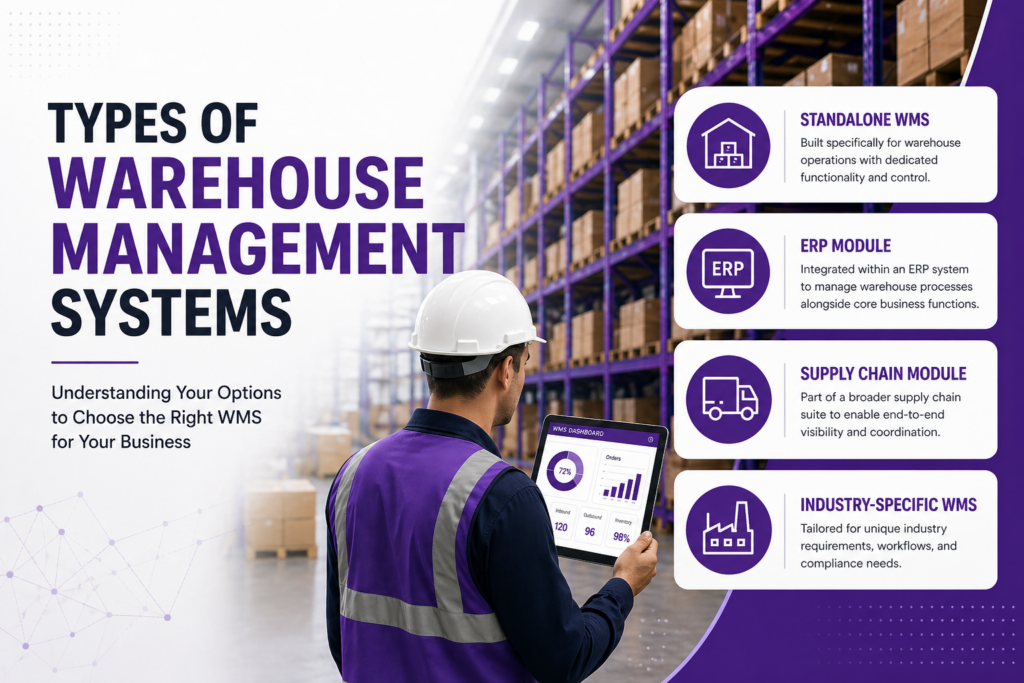
Warehouse management systems and their benefits are not one-size-fits-all. Each type is designed to support different operational models, integration needs, and growth paths. Research shows that companies using advanced warehouse systems can improve inventory accuracy to over 99% and increase labor productivity by 20-30%.
If you are evaluating warehouse management systems, the key is understanding how each system is structured, where it performs well, and where it breaks down under operational complexity. This blog explores different warehouse management system types and their features.
The 4 Types of Warehouse Management Systems
Warehouse management systems are not just differentiated by features, but by architecture, scope, and how they fit into your broader technology stack. Each type reflects a different trade-off between control, flexibility, integration, and scalability.
Understanding these differences is critical when choosing the right warehouse management system for your business, especially as operations become more complex and data-driven.
Suggested Read: How to Choose a Wms System
Standalone System
A standalone WMS is a dedicated warehouse execution system focused purely on managing core operations such as inventory tracking, picking, putaway, and replenishment. It operates independently from ERP or broader supply chain systems and is often deployed to gain immediate control over warehouse processes.
Advantages of a Standalone System
- Focused execution performance: Designed specifically for warehouse workflows, enabling higher picking efficiency and process control
- Faster implementation timelines: Compared to large ERP or SCM systems, standalone WMS solutions are typically quicker to deploy
- Lower upfront complexity: Suitable for organizations looking to improve warehouse operations without redesigning the entire tech stack
Disadvantages of a Standalone System
- Limited integration capabilities: Requires additional effort to connect with ERP, TMS, or OMS systems, often leading to data silos
- Restricted scalability: As operations grow, standalone systems may struggle to handle multi-node networks or complex workflows
- Lack of advanced decision-making: Most standalone systems execute tasks but do not optimize decisions such as slotting, workload balancing, or pick path efficiency
Standalone systems are effective for operational control, but not for continuous optimization. As complexity increases, organizations often need to layer additional capabilities on top. Digital twin solutions like Synkrato become relevant by adding a decision intelligence layer that enhances execution without replacing the existing WMS.
Suggested Read: Future of Warehouse Management System
ERP Module
ERP-based warehouse management systems are built into an enterprise resource planning system, where warehouse management is one component of a broader platform that includes finance, procurement, and planning.
Advantages of ERP Module
- Unified data environment: Inventory, orders, and financial data are managed within a single system, reducing reconciliation issues
- Simplified IT architecture: Fewer integrations required compared to standalone systems
- Stronger process standardization: Suitable for organizations prioritizing consistency across functions
Disadvantages of the ERP Module
- Limited warehouse depth: ERP-based systems often lack advanced warehouse capabilities such as dynamic slotting, wave optimization, or real-time execution control
- Lower flexibility: Customizing workflows can be complex and may require significant IT involvement
- Performance constraints: As transaction volumes increase, ERP systems may struggle to handle high-frequency warehouse operations efficiently
ERP-based WMS solutions prioritize integration over execution depth. This makes them effective for visibility and control, but less suitable for high-performance warehouse environments. Over 70% of companies report integration challenges across WMS, ERP, and other systems
To address this gap, many organizations augment ERP systems with external optimization layers like Synkrato, which provide real-time decision support without disrupting core ERP workflows.
Suggested Read: Wms vs Wes vs Wcs
Supply Chain Module
A supply chain module WMS is part of a broader end-to-end supply chain management (SCM) platform that includes planning, transportation, procurement, and inventory optimization.
Unlike standalone or ERP-based systems, it is designed to connect warehouse execution with upstream and downstream decisions, such as demand planning, replenishment, and distribution strategy.
Advantages of the Supply Chain Module
- End-to-end visibility: Connects warehouse operations with planning, transportation, and inventory flows across the network
- Better decision alignment: Enables coordination between demand forecasting, replenishment, and warehouse execution
- Scalability across networks: Well-suited for multi-node operations with regional distribution centers and complex supply chains
- Reduced planning-execution gaps: Improves synchronization between what is planned and what is executed in the warehouse
Disadvantages of the Supply Chain Module
- Lower warehouse execution depth: Often lacks the granular control and optimization capabilities needed for high-performance picking and slotting
- Complex implementation: Requires significant time, cost, and cross-functional alignment to deploy effectively
- Slower adaptability: Changes in warehouse workflows may take longer due to dependencies across the broader system
Supply chain module WMS solutions are built for network-level coordination, not warehouse-level optimization. They perform well when the priority is visibility and alignment across the supply chain, but may fall short in environments that require high-speed, high-density warehouse execution.
Suggested Read: Warehouse Management Software in 2026
Industry-Specific WMS
An industry-specific WMS is designed for vertical-specific operational requirements, where standard warehouse workflows are not enough. These systems come preconfigured with domain logic, compliance rules, and execution workflows tailored to industries such as pharma, retail, cold chain, automotive, and 3PL.
Instead of adopting a generic WMS, you adopt a system already aligned with how your industry operates.
Examples of Industry-Specific WMS:
| Industry | Example WMS Platforms | Key Capabilities |
| Pharmaceutical / Life Sciences | SAP EWM (Pharma), Blue Yonder Life Sciences | Batch tracking, expiry management, serialization, regulatory compliance (FDA, GMP) |
| Cold Chain / Food & Beverage | Infor WMS, Manhattan Active Cold Chain | Temperature-controlled storage, FEFO (First Expiry First Out), shelf-life tracking |
| Retail & E-commerce | Manhattan Active, Fluent Commerce integrations | High SKU velocity handling, omnichannel fulfillment, returns processing, order orchestration |
| 3PL / Logistics Providers | Extensiv 3PL Warehouse Manager | Multi-client inventory, contract-based billing, configurable workflows |
| Automotive / Manufacturing | Oracle WMS, SAP EWM (Manufacturing) | Line-side replenishment, just-in-time (JIT) inventory, parts traceability |
Advantages of Industry-Specific WMS
- Faster implementation: Pre-built workflows reduce customization effort and deployment time
- Built-in compliance and standards: Designed to meet regulatory and operational requirements out of the box
- Operational fit: Aligns closely with real-world processes, reducing the need for workarounds
Disadvantages of Industry-Specific WMS
- Limited flexibility outside the core use case: May struggle if your business model evolves beyond the defined industry scope
- Vendor lock-in risk: Customizations and dependencies can make switching systems difficult
- Gaps in advanced optimization: While workflows are predefined, areas like dynamic slotting, AI-driven decisioning, and real-time optimization may still require additional layers
Suggested Read: Warehouse Barcode Systems
Which Type of Warehouse Management System Is Right for Your Business?
Choosing the right warehouse management system depends on how your operations are structured today and how they are expected to evolve. Each WMS type is suited to a specific level of complexity, scale, and integration need.
| WMS Type | Best Suited For | When It Starts Breaking Down |
| Standalone WMS | Single-site operations, low to moderate SKU count, businesses looking for quick operational control without overhauling existing systems | When operations expand across multiple warehouses, require real-time coordination, or need advanced optimization |
| ERP Module WMS | Organizations prioritizing unified systems, standardized processes, and tight integration with finance and procurement | When warehouse complexity increases and execution speed, flexibility, or optimization becomes critical |
| Supply Chain Module WMS | Large enterprises managing multi-node distribution networks with a focus on end-to-end visibility and planning alignment | When warehouse-level execution needs deeper control, faster responsiveness, or granular optimization |
| Industry-Specific WMS | Businesses with strict regulatory, operational, or workflow requirements (pharma, cold chain, 3PL, automotive) | When business models evolve beyond predefined workflows or require advanced, real-time optimization |
Turning Your WMS into a Performance Engine with Synkrato
No single WMS type solves for both execution and continuous optimization. Most systems are designed to manage warehouse operations, not to improve how those operations perform over time.
That gap is where fulfillment efficiency is won or lost.
Synkrato enhances the capabilities of your existing WMS as a decision intelligence layer, continuously analyzing SKU velocity, order patterns, and congestion signals to optimize how your warehouse runs in real time. Instead of replacing your system. It brings capabilities like AI-driven slotting, simulation, Digital Twin and workload balancing into your current setup.
Ready to switch to a module that adapts, scales, and improves continuously without re-architecting your tech stack? Explore Synkrato’s capabilities.
FAQs
What are the most popular WMS?
Popular WMS platforms include SAP EWM, Manhattan Associates, Blue Yonder (JDA), Oracle WMS, and Infor WMS. These systems dominate due to their scalability and enterprise capabilities, but most still require additional optimization layers like Synkrato to handle real-time decision-making at scale.
How does Synkrato work with different types of warehouse management systems?
Synkrato integrates with standalone, ERP-based, best-of-breed, and supply chain WMS platforms through APIs. It sits as a decision intelligence layer, using real-time data to optimize slotting, pick paths, and workload distribution without disrupting core WMS execution.
How many warehouse management solutions are there?
There are dozens of major WMS platforms globally, with hundreds of niche and regional solutions. However, most fall into the five core categories covered in this guide, differentiated by architecture, depth, and integration approach rather than just features.
Can Synkrato improve the performance of existing WMS systems?
Yes. Synkrato enhances existing WMS performance by continuously optimizing SKU placement, reducing travel time, and improving pick efficiency using AI and simulation. It enables measurable gains without requiring system replacement.
Which type of WMS is best for my business?
The right WMS depends on your operational complexity, scale, and integration needs. Simpler operations may benefit from standalone or ERP systems, while high-volume, high-SKU environments typically require best-of-breed systems, often combined with an optimization layer for continuous performance improvement.
Is Synkrato compatible with cloud-based and ERP systems?
Yes. Synkrato is designed to integrate with both cloud-based and on-premise ERP/WMS systems, enabling real-time data exchange and optimization without changing your existing infrastructure.