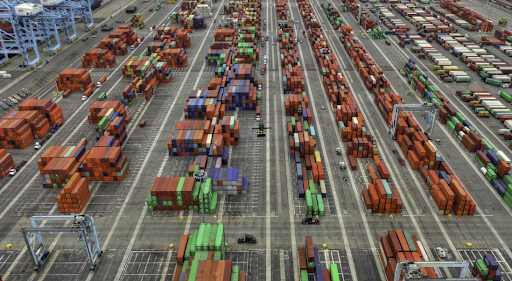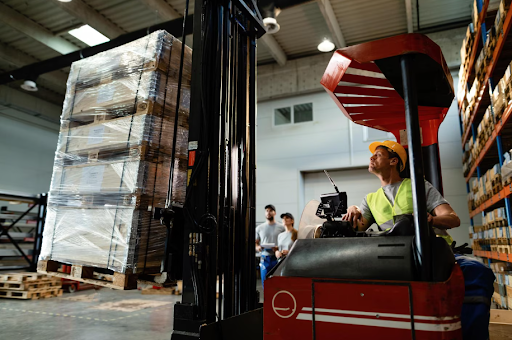

Warehouse performance depends on how efficiently space is organized and used. As complexity grows, warehouses must handle higher volumes and faster fulfillment without expanding, making organization a key performance driver.
According to McKinsey & Company, advanced analytics unlocks 7-15% additional capacity and reduces inventory levels by 20-30%. However, poor organization increases travel time, creates congestion, and slows operations.
This blog explores top 15 warehouse organization ideas to improve efficiency and unlock capacity within existing space.
1. Design a Logical Warehouse Layout Based on Workflow
To begin with, layout design should follow the natural flow of goods, not static space availability.
For instance,
- Aligning high-frequency pick paths with the shortest travel routes
- Positioning fast-moving SKUs closer to dispatch zones
- Reducing intersections between inbound and outbound flows
With this, warehouses move toward simulation-led planning instead of relying on periodic redesigns or static assumptions. Solutions like Synkrato enable this shift by creating a digital representation of the facility where layout decisions can be evaluated before execution.
For instance, creating a digital twin of the facility lets operations teams test scenarios such as rack repositioning, aisle restructuring, or flow changes. They also immediately understand the impact on travel time, throughput, and congestion.
To validate layout decisions before execution, simulate:
- Changes in rack configurations and storage density
- Aisle width adjustments and their effect on traffic flow
- Process flow variations across peak and non-peak periods
This removes guesswork and allows layout decisions to be made with precision before any physical change is implemented.
Suggested Read: What is Warehouse Optimization
2. Segment Warehouse into Functional Zones
Once the layout is aligned with the workflow, the next step is to introduce clear functional zoning. High-efficiency warehouses divide space into dedicated zones for receiving, bulk storage, forward picking, packing, returns, and value-added services. This segmentation reduces operational overlap and ensures that each activity is optimized for its specific role.
More importantly, zoning enables parallel processing. Without it, activities compete for the same space and resources, slowing down throughput.
To make zoning effective in practice, leading warehouses focus on:
- Defining clear boundaries between picking, replenishment, and packing activities
- Isolating reverse logistics to prevent disruption in the outbound flow
- Structuring zones based on order profiles rather than using any static warehouse storage organization ideas
That said, static zoning is becoming a limitation. Demand variability, seasonal peaks, and SKU shifts require zones to adapt dynamically. Advanced warehouses use simulation-driven approaches to continuously rebalance zones based on real-time data.
With an AI-driven environment, check how reallocating space between zones impacts flow, labor utilization, and congestion before making physical changes. This allows zoning to evolve with operations rather than becoming a fixed constraint.
Suggested Read: How to Optimize Warehouse Operations
3. Use ABC Analysis for Inventory Placement
After establishing zones, inventory placement within those zones becomes critical. ABC analysis remains one of the most effective frameworks, but its real value today comes from how intelligently it is applied.
In principle, high-velocity SKUs should be placed in the most accessible locations, while slower-moving items are stored deeper within the warehouse. However, traditional ABC models fail because they rely on periodic updates and do not account for real-time shifts in demand.
Thus, embedding AI and digital twin capabilities into ABC analysis from the start makes it responsive to real demand patterns and operational flow. It:
- Continuously recalculates SKU classifications based on live order and inventory data
- Identifies hidden demand patterns that are not visible in historical averages
- Evaluates how SKU placement impacts pick paths, congestion, and replenishment cycles before execution
When applied effectively, this approach leads to:
- Faster picking for high-frequency SKUs
- Reduced travel time across order cycles
- Improved labor productivity without additional resources
By combining ABC logic with AI and digital twin validation, warehouses move from static categorization to a continuously optimized placement strategy that adapts to operational realities.
4. Implement Proper Slotting Strategies
Slotting has evolved from a static exercise based on historical velocity into a continuously refined process that shapes how inventory flows through the warehouse. Warehouses use AI-driven slotting engines to move beyond rule-based placement and toward data-backed recommendations that adapt to real-time demand patterns.
Instead of relying on periodic re-slotting exercises, modern operations evaluate slotting decisions in a simulated environment before execution. Leveraging a digital twin allows for checking SKU placement impact on pick density, congestion, and replenishment frequency across the warehouse.
In practice, slotting decisions are triggered by operational signals such as:
- Sudden shifts in order mix or SKU demand patterns
- An imbalance between picking load and replenishment activity
- Emerging congestion in high-frequency pick zones
This approach ensures that slotting is optimized for storage and overall workflow efficiency. Moreover, by validating slotting changes in advance, warehouses avoid costly disruptions and ensure that every adjustment improves throughput rather than creating unintended bottlenecks.
Suggested Read: Warehouse Organization Ideas
5. Optimize Vertical Space with Smart Racking Systems
As horizontal expansion becomes constrained, vertical space emerges as an underutilized asset in warehouse operations. However, simply adding more racks is not enough. The challenge lies in aligning storage density with accessibility, equipment capability, and workflow efficiency.
This is where simulation-driven planning plays a critical role. Before investing in new racking systems or reconfiguring existing ones, warehouses model different storage configurations in a digital environment. This helps in understanding how changes in rack height, aisle width, or storage density will impact picking speed, equipment movement, and safety.
To maximize vertical space without compromising efficiency, warehouses prioritize:
- Matching rack configurations with material handling equipment capabilities
- Designing storage density based on SKU characteristics and turnover rates
- Evaluating the trade-off between storage capacity and retrieval speed
By testing these configurations virtually, operations identify the optimal balance between capacity and performance. This ensures that vertical expansion translates into real gains in throughput and space utilization, rather than creating access challenges or slowing down operations.
6. Standardize Bin and Shelf Labeling System
Even the most optimized warehouse layout, organization idea, and slotting strategy fail if execution on the floor lacks clarity. Labeling is often underestimated, yet it plays a critical role in ensuring accuracy, reducing search time, and enabling consistent operations across teams and shifts.
Warehouses are moving beyond basic labeling toward centralized and standardized labeling systems that integrate with operational workflows. With enterprise labeling platforms, organizations manage label templates centrally. They ensure consistency across facilities and eliminate manual errors caused by outdated or mismatched labels.
That’s because a standardized labeling system should enable:
- Clear and consistent location identification across all zones
- Real-time updates to reflect slotting or layout changes
- Seamless integration with scanning and mobility tools for execution
Moreover, labeling must evolve with the warehouse. As layouts, slotting, and processes change, labeling systems need to adapt instantly without creating operational friction. By integrating labeling with broader warehouse intelligence systems, organizations ensure that every change made at the planning level is accurately reflected on the floor, while maintaining alignment between strategy and execution.
Suggested Read: Warehouse Management Challenges
7. Use Bin Location Mapping for Easy Navigation
As warehouse complexity increases, navigation needs to be system-directed and continuously updated.
Bin location mapping becomes far more powerful when it is tied to a live data layer that reflects actual inventory position, active orders, and current movement across the floor.
It shifts bin mapping from a static address system to a decision layer. Each movement, including putaway, picking, and replenishment, is influenced by real-time conditions. Navigation paths adjust based on congestion, task priority, and order clustering, which reduces dependency on operator familiarity.
To make bin mapping work at scale, focus on:
- Building multi-level location hierarchies that reflect both storage logic and movement patterns
- Linking bin locations to task sequencing so that routing decisions are optimized automatically
- Maintaining continuous sync between physical movement and system updates to avoid location drift
- Using mobility tools to guide operators with step-by-step navigation tied to live conditions
With a digital twin, location mapping is stress-tested under peak volumes. It becomes possible to identify where navigation slows down, where paths overlap excessively, and where reconfiguration improves flow before making physical changes.
8. Keep Fast-Moving Inventory Easily Accessible
Fast-moving inventory drives a disproportionate share of warehouse activity. The challenge is not just placing these SKUs closer to dispatch zones, but maintaining accessibility as demand patterns shift across time periods, channels, and order types.
Warehouses treat accessibility as a continuously managed variable. As part of broader large or small warehouse organization ideas, placement decisions are recalibrated based on order frequency, order combinations, and picking waves. This ensures that high-demand SKUs remain aligned with current operational load without creating localized pressure points.
Accessibility is strengthened by:
- Aligning storage height and position with pick frequency to reduce handling effort
- Distributing fast movers across multiple pick faces to balance workload across operators
- Adjusting placement based on order batching logic to reduce repeated travel
- Monitoring pick path density to prevent congestion around high-demand SKUs
Simulation capabilities allow these adjustments to be evaluated across different demand scenarios. It becomes possible to see how a surge in specific SKUs or channels will affect access patterns and whether the current placement sustains throughput without delays.
Suggested Read: Warehouse Management Best Practices
9. Implement FIFO or FEFO Inventory Rotation
First In, First Out (FIFO) and First Expiry, First Out (FEFO) strategies are critical for maintaining inventory integrity, particularly in industries with shelf-life constraints. The real challenge lies in defining these rules and ensuring they are consistently followed during day-to-day operations, especially under high volume and time pressure.
Modern warehouses embed rotation logic directly into system-driven workflows. Batch data, expiry dates, and arrival timestamps are integrated into task generation, so picking and replenishment naturally follow the required sequence without relying on manual checks.
Execution becomes more reliable when operations focus on:
- Structuring storage locations to support sequence-based picking paths
- Embedding expiry and batch validation into scanning and mobility workflows
- Aligning replenishment timing with rotation logic to prevent misplacement
- Monitoring compliance at the task level to identify and correct deviations early
In more advanced setups, rotation strategies are evaluated alongside actual workflow conditions before implementation. This makes it possible to understand how strict adherence to FIFO or FEFO affects picking speed, replenishment cycles, and space utilization. As a result, warehouses can maintain compliance without introducing delays or operational friction.
10. Reduce Clutter with Regular Inventory Audits
Clutter in a warehouse is rarely just a space issue; it is a signal of poor inventory control, inaccurate records, and delayed decision-making. Excess, obsolete, or misplaced inventory consumes valuable space and disrupts flow, making picking slower and increasing the risk of errors.
Regular inventory audits maintain discipline across storage and movement. However, warehouses now move beyond periodic cycle counts and adopt continuous audit mechanisms that align with daily operations.
To keep clutter under control:
- Run targeted cycle counts based on SKU criticality and movement frequency
- Identify slow-moving and obsolete inventory early to free up space
- Reconcile system records with physical stock in near real time
- Link audit results with replenishment and storage decisions
When audits are integrated into operational workflows, they become a proactive tool rather than a corrective one. This ensures that space is consistently available for high-value inventory and that storage areas remain optimized for flow.
Suggested Read: Warehouse Space Optimization
11. Create a Dedicated Returns and Reprocessing Area
Returns introduce variability that is difficult to manage through static processes. The challenge is not just isolating returns, but handling them efficiently without disrupting forward flow or tying up valuable space.
With simulation-led planning, you design and refine return areas based on actual return volumes, product types, and processing requirements. By modeling different scenarios in a digital environment, it becomes possible to determine how much space is needed, where it should be located, and how it should connect with the rest of the workflow.
To make returns handling efficient:
- Design dedicated zones for inspection, grading, and disposition
- Structure flows that prevent reverse logistics from intersecting with outbound operations
- Prioritize quick decision-making to move items back into sellable inventory or alternate channels
- Track return patterns to continuously adjust space allocation and workflows
Thus, simulation allows you to evaluate return processes under different load conditions. This ensures that the area remains efficient during peak periods and does not become a bottleneck for the rest of the operation.
12. Optimize Aisle Width and Traffic Flow
Aisle width and traffic flow directly influence how smoothly people and equipment move across the warehouse. The goal is to strike the right balance between storage density and movement efficiency, which becomes more complex as order volumes and SKU diversity increase.
Rather than relying on fixed design rules, advanced warehouses analyze movement patterns and validate layout decisions before implementation. By modeling traffic flow in a digital environment, it becomes possible to understand how aisle width, intersection design, and equipment movement interact under real operating conditions.
To optimize aisle design and flow, operations focus on:
- Aligning aisle width with equipment type and load handling requirements
- Separating high-frequency picking paths from bulk movement routes
- Reducing cross-traffic at key intersections to avoid delays
- Continuously monitoring movement patterns to identify emerging congestion points
By evaluating these factors in advance, warehouses prevent bottlenecks and ensure smoother flow across peak and non-peak periods. This approach allows aisle design to evolve with operational demands while maintaining both efficiency and safety.
Suggested Read: Warehouse Slotting Optimization
13. Use Visual Management (Signs, Color Coding)
At scale, visual management is about encoding operational logic into the physical environment. The goal is to reduce interpretation time to near zero so that execution remains consistent even under peak load, shift changes, or workforce variability.
Advanced warehouses treat visual management as an extension of system rules. Every sign, color, and marker reflects a decision already made at the system level, whether it is priority, flow direction, or exception handling. This ensures that what operators see on the floor aligns with how the operation is actually running.
To make visual systems effective at a higher level of maturity, operations focus on:
- Encoding priority and exception states through color logic, not just location identifiers
- Designing directional cues that guide movement paths and reduce hesitation at decision points
- Using visual triggers for replenishment, congestion, or task escalation
- Standardizing visual language across zones to avoid interpretation gaps between teams
When visual management is tightly coupled with workflow logic, it reduces dependency on supervision, shortens training time, and ensures consistent execution even as complexity increases.
14. Leverage Warehouse Management System (WMS)
A WMS is the execution backbone, but its real value lies in how well it supports decision-making under dynamic conditions. Most WMS platforms are built on predefined rules and configurations, which work well in stable environments but struggle to adapt to demand variability, SKU proliferation, and shifting order profiles.
To address this, WMS data is elevated into a continuous decision layer. That is to say, operational data is analyzed in real time to generate recommendations for slotting, labor allocation, workflow adjustments, and space utilization. These recommendations are validated before execution, reducing the risk of disruption.
Thus, advanced operations move beyond basic WMS usage by:
- converting transactional data into decision inputs for layout, slotting, and flow optimization
- continuously recalibrating system rules based on actual performance and demand shifts
- integrating data across WMS, ERP, mobility, and floor-level inputs for unified visibility
- closing the loop between planning and execution so that system recommendations are reflected in real-time operations
This shifts WMS from a rule-driven execution system to a continuously learning environment. Decisions are no longer based on historical assumptions alone, but on validated insights that adapt to current operating conditions to scale without adding complexity.
Suggested Read: Warehouse Picking Optimization
15. Adopt Automation and Smart Organization Tools
Even the most optimized warehouse design breaks down without strong execution on the floor. Decisions around layout, slotting, and flow need to translate into consistent, error-free actions across picking, putaway, and cycle counting.
This is where Synkrato brings planning and execution together. It combines AI-driven decision intelligence, digital twins, and no-code mobility to ensure that every operational change is both validated and executed correctly. Layout and slotting strategies are first simulated in a digital twin to understand their impact, while AI agents continuously analyze data across systems to recommend improvements in real time.
At the execution level, Synkrato’s Enterprise Mobility layer ensures that these decisions are embedded directly into frontline workflows. Tasks are guided step by step, data is captured in real time, and process changes can be deployed instantly without relying on IT cycles.
Execution improves when warehouses focus on:
- Digitizing frontline workflows with guided, step-by-step mobile instructions
- Enabling real-time data capture through barcode scanning and validation
- Allowing supervisors to modify workflows quickly based on operational needs
- Embedding system-driven decisions directly into execution-level tasks
This creates a closed-loop system where decisions are simulated, validated, and executed seamlessly. As a result, warehouses reduce delays between insight and action, maintain consistency on the floor, and continuously improve performance without increasing operational complexity.
Ready to turn your warehouse organization ideas into measurable results? Request an appointment now with Synkrato and optimize layout, slotting, and workflows with real-time, data-driven precision.
FAQs
How can I organize a warehouse for better space utilization?
Focus on aligning layout, slotting, and zoning with actual demand patterns rather than static plans. Using Synkrato, these decisions can be validated through simulation, ensuring space is used efficiently before making physical changes.
How does Synkrato improve warehouse organization?
Synkrato connects data across systems and uses AI with digital twins to continuously optimize layout, slotting, and workflows. This enables faster decisions and measurable improvements in capacity, travel time, and overall efficiency.
Can Synkrato help optimize warehouse layout and slotting?
Yes, Synkrato allows layout and slotting strategies to be tested in a simulated environment before execution. This ensures that changes improve flow and productivity without disrupting live operations.
What are common mistakes in warehouse organization?
Relying on static layouts, infrequent slotting updates, and manual decision-making are common pitfalls. Synkrato addresses these by enabling continuous optimization and validating decisions using real operational data.
Does Synkrato integrate with existing warehouse systems?
Yes, Synkrato integrates with existing WMS, ERP, and other systems to unify data and enhance decision-making. It acts as an intelligence layer without requiring the replacement of the current infrastructure.
What tools are used for warehouse organization?
Key tools include WMS, mobility solutions, labeling systems, and analytics platforms. Synkrato brings these together with AI, simulation, and automation to create a unified and continuously optimized warehouse environment.